
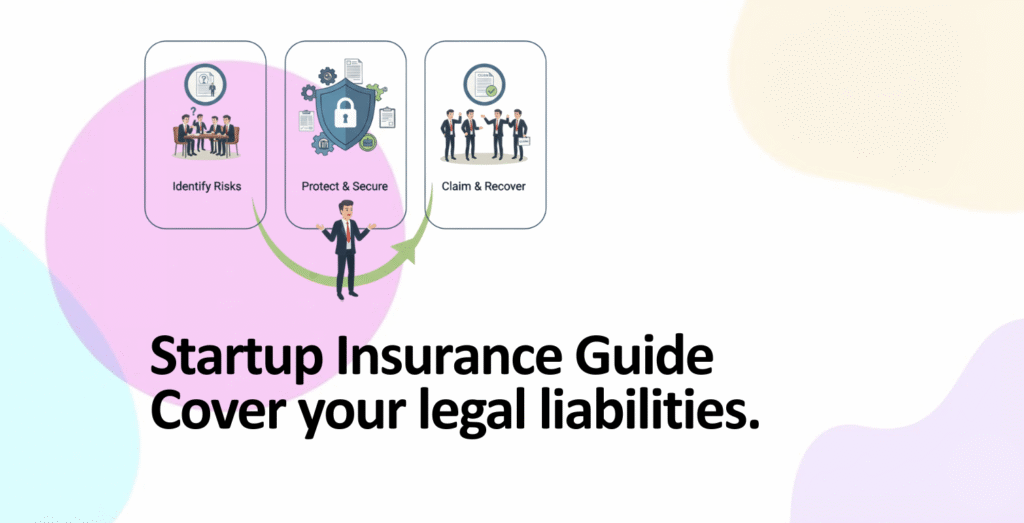
Complete startup insurance guide 2025 India: D&O insurance ₹12,000-₹1,50,000/year (directors officers liability), Cyber liability ₹50,000-₹3,00,000/year (data breaches, ransomware, business interruption), General liability ₹20,000-50,000/year, Key person insurance cost breakdown, when to buy which coverage, cost-benefit analysis for startups, investor requirements.
Table of Contents
Why Startups Need Insurance (It’s Not Optional)
Most founders skip insurance. They think “we’re small, we won’t get sued.” This is a dangerous assumption. One lawsuit can kill your startup.
Real Startup Insurance Horror Stories
- Scenario 1: Data Breach Hits (Actual): Customer data leaks. ₹50 lakh in breach notification costs. ₹1 crore in fines. ₹2 crore in lawsuit settlements. Total = ₹3.5 crore loss. Startup dies. With cyber insurance? ₹1.5 lakh premium saves the company
- Scenario 2: Director Sued (Actual): Founder makes business decision that fails. Investor sues founder personally for misrepresentation. ₹30 lakh legal costs. Founder pays from personal savings. With D&O insurance? ₹30,000 premium covers everything
- Scenario 3: Key Person Dies (Actual): CTO (only technical person) dies unexpectedly. Company loses all technical knowledge. Can’t deliver to customers. ₹1 crore revenue lost. With key person insurance? ₹10 lakh payout helps hire replacement + bridge gap
Insurance is Investor Requirement
- VCs mandate it: Venture capitalists require D&O insurance before Series A funding. No insurance = no funding conversation
- Cyber insurance gaining traction: Data-centric startups must have cyber insurance. Non-negotiable for fintech, healthtech, edtech
- Bankers require it: If you take business loans, bank often requires general liability or specific coverage
D&O Insurance: Protecting Directors & Officers
D&O insurance protects founders and directors from personal liability. This is THE most important insurance for startups.
What D&O Insurance Covers
- Legal defense costs: If sued, all lawyer fees covered (₹0 cost to you)
- Judgments and settlements: Court orders to pay damages = covered
- Regulatory investigations: If regulatory body investigates your decisions, costs covered
- Shareholder lawsuits: Investor sues founder for mismanagement = covered
- Employment claims: Employee sues for wrongful termination = covered under some policies
- Errors in judgment: You made a business decision that turned out wrong = covered (even if not criminal)
D&O Insurance Pricing (2025)
| Company Stage | Coverage Limit | Annual Premium | Deductible | Best For |
|---|---|---|---|---|
| Pre-seed / Bootstrapped | ₹50-100 lakh | ₹12,000-25,000 | ₹50,000-1,00,000 | Early stage, low risk, small team |
| Seed Funded | ₹1-2 crore | ₹40,000-70,000 | ₹1,00,000-2,00,000 | After seed round funding |
| Series A Funded | ₹2-5 crore | ₹80,000-1,50,000 | ₹2,00,000-5,00,000 | Series A + investor requirement |
| Series B+ | ₹10+ crore | ₹2,00,000+ | ₹5,00,000+ | Larger companies, higher risk |
Real Example: ₹1 Crore D&O Coverage
A typical D&O policy with ₹1 crore coverage, ₹2 lakh deductible, worldwide territory: ₹1,50,000/year (mid-range for growing startup)
Key D&O Terms Explained
- Side A coverage: Protects INDIVIDUAL directors if company can’t pay their legal bills. Most critical part
- Side B coverage: Reimburses company if it pays director’s legal bills. Less critical but still important
- Side C coverage: Securities-related claims. Only relevant for public companies (skip if private)
- Deductible: Your out-of-pocket before insurance kicks in. Higher deductible = lower premium. ₹2L deductible common for startups
- Run-off coverage: Covers claims made AFTER you leave company (important for founders exiting)
Cyber Insurance: Data Breaches & Ransomware
If your startup handles customer data (which most do), cyber insurance is critical. One data breach costs millions.
What Cyber Insurance Covers
- Data breach response costs: Notification to customers, credit monitoring services, forensic investigation = can cost ₹50L+
- Regulatory fines: GDPR-like fines if you have EU customers. India’s upcoming data law fines. Can reach ₹1 crore+
- Business interruption losses: Your system is down due to attack. Revenue loss covered. Example: SaaS down for 1 week = ₹50L revenue loss covered
- Ransomware payment: Hacker demands ₹5 crore. Some policies cover ransom (but this is controversial)
- Liability claims: Customer sues because their data was leaked through your system = costs covered
- Legal defense + PR costs: Lawyer fees + crisis management PR firm = all covered
Cyber Insurance Pricing (2025)
| Business Type | Coverage Limit | Annual Premium | Deductible | Best For |
|---|---|---|---|---|
| Low-risk (e-commerce, non-sensitive data) | ₹50 lakh | ₹50,000 | ₹2,00,000 | Startups with minimal personal data |
| Medium-risk (SaaS, healthcare, fintech light) | ₹1 crore | ₹95,000-1,50,000 | ₹3-5,00,000 | Most SaaS + B2B startups |
| High-risk (Banking data, healthcare records, payments) | ₹2-5 crore | ₹2,00,000-3,00,000 | ₹5,00,000+ | Fintech, payments, healthtech |
Cyber Insurance Trends (2025)
- Insurers demanding security audits: Before issuing policy, must prove you have basic security (firewalls, encryption, access controls)
- Premium discounts for good hygiene: Regular security patches = lower premium. No patching = higher premium or rejection
- Bundled coverage: Cyber + General Liability + E&O bundled = 20-30% discount vs buying separately
General Liability: Third-Party Claims
If a customer gets injured or sues because your product harmed them, general liability covers it.
What General Liability Covers
- Bodily injury: Customer gets hurt using your product = covered
- Property damage: Your product damages someone’s equipment = covered
- Advertising injury: You’re sued for defamation, copyright infringement in ads = covered
- Legal defense costs: All lawsuit costs paid = ₹0 cost to you
Who Needs It?
- Physical product companies: Hardware startups, manufacturing = MUST HAVE
- B2B services with client sites: If employees visit client offices, need coverage
- E-commerce/consumer brands: Product liability if product harms customer = need it
- SaaS/Software only: Usually skip (unless product can cause financial harm = get E&O instead)
General Liability Pricing (2025)
- Small startups (₹50 lakh coverage): ₹20,000-30,000/year
- Medium startups (₹1 crore coverage): ₹40,000-60,000/year
- High-risk (manufacturing, chemicals): ₹1,00,000+/year
Key Person Insurance: Protecting Critical People
If your CTO, CFO, or sales lead dies or becomes disabled, can the company survive? Key person insurance funds the gap.
How Key Person Insurance Works
- Company buys life insurance policy on key person (founder, CTO, lead engineer)
- Key person passes away or becomes disabled
- Company receives payout (₹50L-1Cr+ depending on policy)
- Company uses funds to: hire replacement, pay debts, bridge revenue gap, retain other team members
Key Person Insurance Pricing (2025)
| Key Person’s Annual Salary | Insurance Amount (Typical) | Annual Premium | Term |
|---|---|---|---|
| ₹10-20 lakh/year | ₹50-75 lakh | ₹30,000-50,000 | 10-15 years |
| ₹20-40 lakh/year | ₹1 crore | ₹60,000-80,000 | 10-15 years |
| ₹40-60 lakh/year | ₹1.5 crore | ₹1,00,000+ | 10-15 years |
Who Should Get It?
- Single founder company: If you die, business dies. Critical
- CTO is irreplaceable: Only technical person who understands architecture. Critical
- Sales lead brings 50%+ revenue: If they leave, revenue collapses. Important
- CFO with investor relationships: If they leave, might lose investor support. Important
Key Person Insurance vs Personal Life Insurance
- Key person (company-owned): Company buys policy on employee. Company is beneficiary. Company pays premiums (tax deductible). Payout goes to company bank account
- Personal life insurance: Individual buys policy on themselves. Beneficiary gets payout. Not tax deductible. Personal benefit
- Which is better for startup? Key person insurance. Company can use funds immediately without waiting for personal beneficiary to distribute
When to Buy Which Coverage
Not all insurance types are equally urgent. Here’s the priority order.
Insurance Priority Matrix
| Stage | Must-Have | Should-Have | Nice-to-Have | Skip |
|---|---|---|---|---|
| Idea/Pre-MVP | Nothing mandatory yet | D&O (bare minimum) | N/A | Cyber, General Liability, Key Person |
| MVP/Beta Launch | D&O insurance (if any customer data) | Cyber insurance (if handling data) | Key person (if single founder) | General liability (unless physical product) |
| Seed Fundraising | D&O (CRITICAL – investor mandatory) | Cyber (if B2C or data-heavy) | General liability (if product/service risk) | Key person (unless CTO is flight risk) |
| Seed Funded | D&O (₹1+ crore limit minimum) | Cyber (if SaaS or financial data) | Key person (if CTO critical) | General liability (unless applicable) |
| Series A Fundraising | D&O (₹2-5 crore limit, investor requirement) | Cyber (mandatory for fintech/healthtech) | General liability (if applicable) | Probably nothing left to skip |
| Series A+ (Scaling) | D&O (₹5-10 crore), Cyber (₹1-2 crore) | General liability, Key person (if applicable) | E&O (errors & omissions, for SaaS) | Few exceptions |
Decision Framework by Business Type
SaaS / B2B Software Startup
Must buy: D&O (₹1 crore) immediately. Annual cost ₹40-70K.
Should buy: Cyber insurance (₹1 crore) if customer data (payments, health, emails). Cost ₹95K-1.5L/year.
Total Year 1 cost: ₹1.35-2.2L
Fintech / Payments Startup
Must buy: D&O (₹2-5 crore) + Cyber (₹2-5 crore). Cost ₹2-3L annually.
Why: Regulatory compliance + investor requirement + data sensitivity extreme.
Total Year 1 cost: ₹2-3L minimum
E-commerce / Consumer Product Startup
Must buy: D&O (₹50L-1 crore). Cost ₹25-50K/year.
Should buy: General liability (if physical product). Cost ₹30-50K/year.
Cyber: Low priority (unless marketplace with user data).
Total Year 1 cost: ₹55-1L
Total Insurance Costs & ROI
Here’s what a typical startup realistically spends on insurance.
Minimal Insurance Setup (Bootstrapped Startup)
| Coverage Type | Limit | Annual Cost | Why Minimal |
|---|---|---|---|
| D&O Insurance | ₹50-100 lakh | ₹15,000 | Bare minimum protection for founder |
| Total Year 1 | N/A | ₹15,000 | Skip cyber/general liability if low risk |
Standard Insurance Setup (Seed-Funded Startup)
| Coverage Type | Limit | Annual Cost | Why Needed |
|---|---|---|---|
| D&O Insurance | ₹1-2 crore | ₹50,000 | Investor requirement |
| Cyber Insurance | ₹1 crore | ₹1,00,000 | Customer data protection |
| Key Person Insurance | ₹1 crore | ₹70,000 | Protect critical founder/CTO |
| Total Year 1 | N/A | ₹2,20,000 | Comprehensive coverage for growth stage |
Comprehensive Setup (Series A Funded Startup)
| Coverage Type | Limit | Annual Cost | Why Needed |
|---|---|---|---|
| D&O Insurance | ₹3-5 crore | ₹1,20,000 | Investor + operational requirement |
| Cyber Insurance | ₹2 crore | ₹1,80,000 | Scaling data = scaling risk |
| General Liability | ₹1 crore | ₹50,000 | If product liability applies |
| Key Person Insurance | ₹1.5 crore | ₹90,000 | Multiple critical people now |
| Total Year 1 | N/A | ₹4,40,000 | Full protection for funded startup |
Insurance ROI (Hidden Value)
- D&O insurance ₹50K/year: Saves ₹50L+ in personal founder liability. 1000x ROI
- Cyber insurance ₹1L/year: Prevents ₹1Cr+ in breach costs. 100x ROI
- Key person insurance ₹70K/year: Replaces ₹1Cr revenue loss if founder dies. 1400x ROI
- Investor confidence: Having insurance signals maturity = raises valuation. Not directly quantifiable but huge
How to Lower Insurance Costs
- Higher deductibles: Choose ₹5L deductible instead of ₹2L = 20-30% lower premium. Trade-off: you pay more if claim happens
- Bundled policies: Buy D&O + Cyber + GL together = 15-25% bundle discount vs buying separately
- Improve security practices: Strong cybersecurity hygiene (regular patches, encryption, access logs) = 20-40% lower cyber insurance premium
- Clean claims history: No prior claims = lower rates. One claim = premium spikes 50%+
- Shop around: Get quotes from 3-4 insurers. Same coverage = 30-50% price variation
Key Takeaways: Startup Insurance Essentials
1. D&O insurance is non-negotiable. Even pre-seed founders should have ₹50-100 lakh coverage (₹15K/year). One lawsuit can bankrupt you personally without it
2. D&O pricing: ₹12,000-25,000 for ₹50-100L coverage (bootstrapped). ₹40-70K for ₹1-2 crore (seed funded). ₹80-150K for ₹2-5 crore (Series A).
3. Cyber insurance is critical for data-centric startups (SaaS, fintech, healthtech). ₹50,000-3,00,000/year depending on coverage + business type. One data breach costs ₹1+ crore in breach response, fines, lawsuits
4. General liability needed only for physical product companies or client-site services. ₹20,000-50,000/year for small startups.
5. Key person insurance protects if founder/CTO dies. ₹30,000-1,00,000/year depending on salary. Use payout to hire replacement or bridge revenue gap.
6. Investor requirement: VCs mandate D&O insurance before Series A. No insurance = deal killer.
7. Insurance priority by stage: Pre-MVP = skip all. MVP = D&O minimum. Seed = D&O + Cyber. Series A = D&O + Cyber + anything applicable
8. Cyber insurance is becoming investor expectation (like D&O). By Series A, you’ll need it regardless of data handling.
9. Bundled policies save 15-25% vs buying separately. Shop with multiple insurers = get 30-50% price variation for same coverage.
10. Total insurance budget for seed-funded startup: ₹2-3 lakh/year (D&O + Cyber + Key Person). Series A: ₹4-5 lakh/year as limits increase.
11. Deductible trade-off: Higher deductible (₹5L vs ₹2L) = lower premium (20-30% savings) but you pay more if claim happens. Balance based on cash position.
12. D&O covers: Legal defense costs, judgments, regulatory fines, shareholder lawsuits, errors in judgment by founders/directors.
13. Cyber insurance covers: Data breach notification, regulatory fines, business interruption losses, ransomware recovery, liability claims, PR/legal costs.
14. One data breach without cyber insurance = ₹1+ crore loss. One director lawsuit without D&O = founder’s personal assets at risk.
15. Action plan: (1) Get D&O quote within 1 week (₹15K minimum). (2) Get cyber quote if handling data (₹50K+). (3) Reassess annually as company grows + stage changes.