
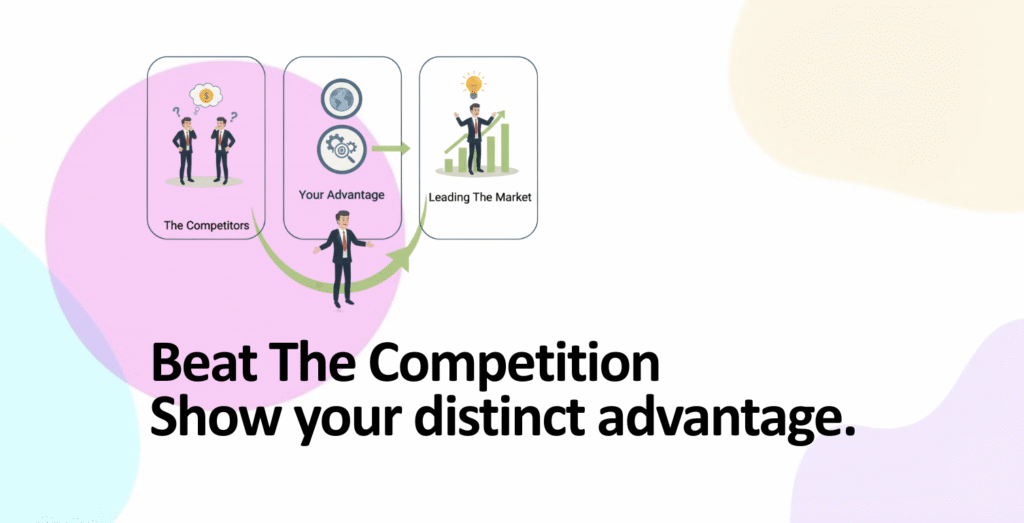
Master slides 4-5 of your pitch deck (2025): TAM/SAM/SOM calculation methods (top-down vs bottom-up), competitive positioning matrix, why “we have no competitors” is a red flag, real examples from Uber Slack Notion, AI market $1.8 trillion opportunity, investor evaluation framework, realistic market share assumptions.
Table of Contents
- Why Market Size & Competition Matter Most to Investors
- TAM Explained: Total Addressable Market
- SAM Explained: Serviceable Available Market
- SOM Explained: Serviceable Obtainable Market
- Calculation Methods: Top-Down vs Bottom-Up
- The Competitive Landscape Slide: What Investors Expect
- Positioning Matrix: Showing Your Unfair Advantage
- Real Examples from Funded Startups
- Common Mistakes That Sink Slides 4-5
- Best Practices & Design Framework
Why Market Size & Competition Matter Most to Investors
Investors evaluate startups on two core questions: (1) Is the market big enough to justify the investment? (2) Can this team win against competition? Slides 4-5 answer both questions with data and logic.
The Investor’s Mental Model
- Market size determines ceiling revenue: A $100M market caps your upside. A $10B market enables billion-dollar exits. Investors fund based on potential return, not current revenue. If TAM is small, even 100% market share won’t generate venture-scale returns
- Competition determines feasibility: Investors want to understand: Who else is in this space? Why will you win? If you claim “no competitors,” investors think you haven’t done market research. If you understand competitors and articulate clear differentiation, investors think you understand the battlefield
- Realistic market share assumptions determine credibility: Claiming 50% market share in 5 years signals delusion. Claiming 2-5% signals realism. Investors mentally discount aggressive projections by 50-75%. Better to be conservative and surprise them later
- Market sizing is the foundation of valuation: Pre-revenue startups are valued based on market opportunity × realistic market share × future revenue multiple. Get market sizing wrong and your valuation (and funding amount) crumbles
How Investors Read Slides 4-5
| What They See | What They Think | What They Value |
|---|---|---|
| TAM: $500B global market | “Is this number credible or inflated?” | Math is transparent, sources are cited |
| SAM: $50B serviceable segment | “Can they realistically reach this?” | Geography, customer segment, and channel are realistic |
| SOM: $500M in 5 years | “Can they execute to this?” | Bottom-up math (customers × price) is grounded in traction |
| Competitors listed (5-7 players) | “Do they understand the landscape?” | They identify both direct competitors and indirect alternatives |
| Clear differentiation on matrix | “Why will this team win?” | Unfair advantage (technology, network, unit economics) |
TAM Explained: Total Addressable Market
TAM is the total revenue opportunity if 100% of the world that could use your product did use it. It’s the ceiling. It’s aspirational. It’s rarely something you’ll capture.
TAM Definition & Examples
What TAM Actually Means
TAM = All potential customers globally × average annual price they’d pay for your solution. It’s not the size of an existing industry. It’s the size of the opportunity your solution creates or captures.
Example 1: SaaS Invoicing Platform
- Potential customers: 8.3 million freelancers worldwide (from ILO data)
- Average annual spend on invoicing tools: $600/year (based on Xero, FreshBooks pricing)
- TAM = 8.3M × $600 = $4.98B (round to $5B)
Example 2: AI-Powered CRM
- Potential customers: 300+ million small businesses globally (World Bank SME data)
- Average annual CRM spend: $500-2,000 depending on company size. Average ~$1,000
- TAM = 300M × $1,000 = $300B
Example 3: Enterprise Supply Chain Visibility (Highly Specific)
- Potential customers: 50,000 global manufacturers with $50M+ annual revenue
- Average annual spend on supply chain visibility tools: $2-5M per company. Average ~$3M
- TAM = 50,000 × $3M = $150B
The Problem With TAM (And How Investors Judge It)
- TAM is often inflated: Founders calculate TAM by taking the size of a massive industry (e.g., “healthcare is $4 trillion”) and claiming a slice. Investors see this as delusional. They want bottom-up math grounded in real customer numbers and real prices
- Investors don’t care about TAM as much as you think: They care more about SAM and SOM. TAM just needs to be big enough to justify venture funding. If TAM is under $1B, you’re unlikely to raise Series A from most VCs
- Investors verify your TAM math: They’ll check: “Are those real customer counts? Is that realistic pricing?” If your assumptions don’t hold up, your entire market size crumbles. Show your work. Cite sources
SAM Explained: Serviceable Available Market
SAM is the slice of TAM that you can realistically reach. It accounts for geography, customer segment, distribution channel, and competitive reality. It’s where investors start to see your business model clearly.
SAM Definition & Narrowing Strategy
SAM = TAM × (% you can realistically reach based on geography, segment, and channel)
Example: SaaS Invoicing Platform (Narrowing from TAM)
- TAM: 8.3M freelancers globally × $600 = $4.98B
- Geographic focus: Focus on North America (USA + Canada) where freelancer adoption is highest. 2.5M of the 8.3M live in North America. That’s 30% of TAM
- Language & cultural factors: English-speaking freelancers prioritize. That’s another 80% of the 2.5M. So 2M freelancers
- Online-first segment: Freelancers who actively use Upwork, Fiverr, or similar platforms (digitally active). That’s 70% of the 2M. So 1.4M
- SAM = 1.4M × $600 = $840M
Notice: We narrowed from $5B (TAM) to $840M (SAM) by being realistic about geography, language, and channel reach. This is credible. SAM should be 10-20% of TAM for most startups
Key SAM Levers (What You Control)
| SAM Lever | Definition | Example | Why It Matters |
|---|---|---|---|
| Geography | Which regions can you realistically reach? | “Starting in US West Coast, expand to US-wide in Year 2” | Investors know sales expansion costs money and time. Multi-country is harder than single-country focus |
| Customer Segment | Which type of customer do you target? | “SMBs with 5-50 employees, not enterprises” | Narrow segment = clear go-to-market. Broad segment = confusion |
| Distribution Channel | How do customers find you? | “Direct sales, not marketplace or indirect” | Channel determines customer acquisition cost and complexity |
| Willingness to Pay | Can these customers afford your price? | “Mid-market enterprise, can pay $5K-50K annually” | Customers who can’t afford you shouldn’t be in SAM |
SOM Explained: Serviceable Obtainable Market
SOM is the realistic slice of SAM you can capture in 3-5 years given your resources, team, and execution. This is where investors assess your credibility as a founder. Realistic SOM = thoughtful founder. Inflated SOM = delusion.
SOM Calculation: The Reality Check
SOM = SAM × (realistic market share % you can capture in 5 years)
Example: SaaS Invoicing Platform (SAM to SOM)
- SAM: $840M (1.4M freelancers × $600)
- Realistic market share in Year 5: 2-5% of SAM is realistic for a well-funded SaaS startup with good execution
- Let’s assume 3% capture rate: SOM = $840M × 3% = $25.2M
- Translate to customers: $25.2M ÷ $600 per customer = 42,000 customers
This is credible. It’s ambitious but achievable. It aligns with successful SaaS comparable companies (FreshBooks, Wave, Zoho raised on similar metrics)
How to Calculate Realistic SOM (Bottom-Up Preferred)
Method 1: Bottom-Up (Preferred by Investors)
Start with customers, not percentages.
Formula: Customers you can realistically acquire × Average annual revenue per customer × (1 – assumed churn)
Example:
- Year 1 customers: 1,000 (based on beta/pilot traction)
- Growth rate: 100% YoY (aggressive but achievable for early SaaS)
- Year 5 customers: 1,000 × 2^4 = 16,000 customers
- Average annual revenue per customer: $600
- Assumed churn: 5% annually
- SOM Year 5 = 16,000 × $600 × 0.95 = $9.12M
Notice: Bottom-up starts with what you’ve proven (first 1,000 customers) and extrapolates. It’s grounded in reality
Method 2: Top-Down (Less Preferred, But OK)
Start with market percentage.
Formula: SAM × (assumed market share %)
Example:
- SAM: $840M
- Assumed market share (Year 5): 2%
- SOM = $840M × 2% = $16.8M
Investor reality check: Is 2% realistic for a 5-year-old startup? Against how many competitors? With what resources? Better to show bottom-up math to justify this percentage
SOM Reality Checks (Investor Perspective)
- 1% of SAM is conservative: 0.5-1% is realistic for a well-funded startup in a crowded market. Consider as floor
- 5% of SAM is aggressive: Achievable if you have significant competitive advantage (network effect, proprietary technology, first-mover advantage). Usually requires $50M+ funding to achieve
- 10%+ of SAM is unrealistic: Only in niche markets with minimal competition. Avoid claiming this unless you have extraordinary traction already
- SOM should grow 100-150% annually for first 3 years: Then slow to 50% growth as you scale. If your SOM is flat or declining, execution risk is high
Calculation Methods: Top-Down vs Bottom-Up
There are two ways to calculate TAM, SAM, and SOM. Investors strongly prefer one over the other.
Top-Down: Industry Data → Your Slice
Process: Start with industry report. Identify total market size. Calculate what % you can capture. Multiply down
Example: “Global SaaS market is $250B (Gartner). Project management segment is 8% ($20B). We target SMBs specifically, which is 30% of that segment ($6B SAM). We expect 2% capture = $120M SOM”
Pros: Quick, uses credible sources, shows big-picture thinking
Cons: Feels top-down and assumptions-heavy. Easy to inflate numbers. Investors distrust it because it’s easy to manipulate
Bottom-Up: Your Customers → Market Size
Process: Start with customers you can realistically reach. Build up. Show math grounded in traction
Example: “We can directly reach 5,000 SMBs in our vertical (verified list). Each spends $2,000/year on PM tools. That’s $10M SAM. We’ve acquired 50 customers in beta (pilot validation). With 3x team growth, we can do 10,000 customers in Year 5 = $20M SOM”
Pros: Credible because grounded in reality. Shows founder understands customer acquisition. Investors trust it more
Cons: Takes more work. Requires actual customer research and traction data
Best Practice: Hybrid Approach
Use both methods. Show how they converge on similar numbers. This signals rigor and confidence.
Example: “Top-down: Global SaaS market $250B, project management $20B, SMB segment $6B. Bottom-up: 5,000 addressable SMBs × $2,000 average annual spend = $10M SAM. Converging estimate: $8-10M SAM is realistic”
The Competitive Landscape Slide: What Investors Expect
Investors hate when founders say “We have no competitors.” This signals either delusion or ignorance. Every market has competitors—direct or indirect. Your job is to show you understand the landscape and why you’ll win.
What “Competition” Really Means
- Direct competitors: Companies offering nearly identical products. Example: Slack vs. Microsoft Teams
- Indirect competitors: Companies solving the same problem in a different way. Example: Email (indirect competitor to Slack—communication problem, different solution)
- Potential competitors: Companies that aren’t yet in your space but could enter. Example: AWS could build more supply chain tools (potential competitor to specialized supply chain startups)
- Incumbent solutions: Status quo that customers use today (even if imperfect). Example: Spreadsheets compete with QuickBooks for small business accounting
The Competitive Matrix: How to Visualize
Create a 2×2 matrix or multi-axis grid showing competitors plotted against your key differentiators.
| Company | Ease of Use (Low-High) | Feature Richness (Low-High) | Your Position |
|---|---|---|---|
| QuickBooks | Medium (steep learning curve) | Very High (enterprise-grade) | Complex + Rich |
| Freshbooks | High (intuitive UI) | Medium (good for SMBs) | Easy + Moderate |
| Xero | Medium | High | Balanced |
| Wave (Free tool) | Medium | Low (basic features) | Simple + Minimal |
| Your Product | Very High (easiest to use) | High (freelancer-specific) | Easiest + Relevant Features |
This visualization shows: You’re positioned in the top-right (easy + feature-rich for your segment). Competitors are scattered. Your unfair advantage is clarity: simplicity + features freelancers actually need
Competitive Positioning: Your Unfair Advantage
Don’t just say “we’re better.” Explain why and for whom.
Good competitive positioning statement: “QuickBooks is too complex for freelancers. FreshBooks is good but built for agencies, not solo creators. Wave is too basic. We’re purpose-built for freelancers: 30-second setup, invoice templates, automated payment reminders, freelancer-specific workflows. We win on simplicity + relevance”
Bad competitive positioning: “We have better UX than competitors.” (Everyone claims this—it’s meaningless without specifics)
Positioning Matrix: Showing Your Unfair Advantage
The 2×2 Matrix Template (Most Effective)
Create a 2×2 grid with axes representing your two key value drivers. Plot competitors. Show why you win.
Example Matrix: Project Management Tools (Ease of Use vs. Feature Richness)
- X-axis: Ease of Use (Low → High)
- Y-axis: Feature Richness (Low → High)
- Top-left (Hard + Rich): Asana, Monday.com (Powerful but steep learning curve)
- Top-right (Easy + Rich): Your product (Simple setup + powerful features for mid-market). This is the “sweet spot”
- Bottom-left (Hard + Basic): Spreadsheets, legacy tools
- Bottom-right (Easy + Basic): Trello (Simple but limited for complex projects)
Visual insight: You’re in the desirable quadrant. Competitors are scattered. Your positioning is clear
Multi-Axis Matrix (Advanced)
If you have 3+ key differentiators, use a bubble chart or multi-axis graph.
Example: AI-Powered CRM
- X-axis: Price ($0-$500/month)
- Y-axis: AI Automation Level (Manual → Fully Automated)
- Bubble size: Number of features
- Color: Type of company (incumbent vs. startup vs. open-source)
This shows: Traditional CRMs (Salesforce, HubSpot) are expensive, manual, feature-rich. Startups (Pipedrive) are cheaper, less AI, fewer features. Your position: Affordable + AI-native + essential features. Clear value proposition
Real Examples from Funded Startups
Uber’s Market Size Pitch (Series A, ~2010)
Market Size: “Global taxi market is $100B. Ride-sharing will capture 20% of this by 2020 ($20B opportunity). Uber targets 10% of ride-sharing in Year 5 = $2B potential revenue”
Competition: “Taxis are incumbent competition. Yellow Cab, black car services. We’re offering: cheaper, easier, on-demand. Digital disruption”
Why it worked: TAM was huge. Competition was clear (legacy taxis). Positioning was revolutionary. Investors saw the future
Slack’s Market Size Pitch (Series A, ~2013)
Market Size: “Enterprise communication market: Email + IM tools + Project management = $50B+. Slack targets knowledge workers globally. Conservative estimate: $5B serviceable market”
Competition: “Email (incumbent), Hipchat, Yammer. But none have achieved product-market fit. Email is painful, bulky, asynchronous. We’re real-time, focused, faster”
Why it worked: Huge market. Clear pain (email overload). First-mover in real-time team communication. Investors believed in the vision
Notion’s Market Size Pitch (Series A, ~2018)
Market Size: “Productivity software market: $150B+ (Microsoft Office, Salesforce, Asana, Monday, etc.). Notion targets creators + knowledge workers. TAM: $30B”
Competition: “Asana, Monday, Confluence. But each is single-purpose. Asana = project management. Confluence = documentation. Notion = all-in-one. We’re positioning as ‘one tool to replace five'”
Why it worked: Clear TAM. Unique positioning (all-in-one workspace). Better unit economics (one tool = higher LTV than single-purpose tools)
Common Mistakes That Sink Slides 4-5
Mistake 1: Inflated TAM (No Validation)
What you do: “Healthcare is a $4 trillion industry. We’re targeting 1%, so $40B TAM”
What investors think: “That’s absurd. You’re not capturing 1% of global healthcare. You’re solving a micro-problem. Show realistic numbers”
Fix: Bottom-up TAM. “We target oncology nurses in US hospitals (50,000 people). Each spends $10K/year on our type of software. TAM = $500M. SAM = $50M (targeting 10% of oncology nurses, those who use modern EHR systems)”
Mistake 2: Claiming “No Competitors”
What you do: “We have no direct competitors. The market is wide open”
What investors think: “Either you haven’t done market research, or the problem isn’t important enough for anyone else to solve. Red flag”
Fix: “Competitors: Salesforce (enterprise-focused), Pipedrive (SMB-focused), Copper (integration-heavy). We differentiate on: simplicity + AI. We’re category-defining for AI-native CRM”
Mistake 3: Unrealistic Market Share (5-10% in Year 5)
What you do: “We’ll capture 7% market share by Year 5”
What investors think: “Delusional. Only incumbents with 20+ year history have that share. You’re a 5-year-old startup”
Fix: “We project 2% market share by Year 5. Here’s why: 3x team growth, $50M raised, direct sales model in US+EU, brand awareness from early adopters”
Mistake 4: Vague Competitive Positioning
What you do: “We’re better than competitors because we have better UX and stronger team”
What investors think: “Everyone claims this. What’s your actual differentiation?”
Fix: “Salesforce is general-purpose (slow implementation). Pipedrive is for pipeline-focused teams only. We’re hybrid: sales pipeline + relationship-focused. Implementation is 2 weeks vs. 3 months. Our secret: no customization required—built-in playbooks for SaaS sales”
Mistake 5: Competitor Matrix That’s Confusing
What you do: 2×2 matrix with vague axes (“Quality vs. Price”). Competitors scattered randomly. No clear pattern
What investors think: “I don’t understand this. What’s your actual positioning?”
Fix: Clear axes: “X-axis: Speed to deploy (weeks). Y-axis: Features (basic to advanced).” Your position: top-right (fast + full-featured). Competitors: scattered. Visual insight is immediate
Best Practices & Design Framework
Slide 4 (Market Size) Design Framework
| Element | Content | Visual Treatment | Space % |
|---|---|---|---|
| Headline | “$XXB Total Addressable Market” | Large, bold, color accent | 15% |
| TAM Calculation | Show your math: “X customers × $Y price = $Z TAM” | Formula + visual representation | 25% |
| TAM to SAM to SOM Funnel | Waterfall diagram showing narrowing | Funnel chart with percentages | 40% |
| Key Assumptions | List 2-3 biggest assumptions you’re making | Small text, clear bullets | 15% |
| Whitespace | – | Clean breathing room | 5% |
Slide 5 (Competition) Design Framework
| Element | Content | Visual Treatment | Space % |
|---|---|---|---|
| Headline | “Competitive Positioning: [Your Category]” | Large, bold | 10% |
| 2×2 Matrix | Competitors plotted, your position highlighted | Clear quadrants, competitor bubbles/dots | 50% |
| Your Differentiation | “Why we win: [key insight]” | Text or visual callout | 20% |
| Legend/Key | Axis labels, competitor names | Small text, organized | 15% |
| Whitespace | – | Clean, organized | 5% |
Key Metrics to Include
- TAM in billions (or millions): Should be $1B+
- SAM in millions (or billions): Should be 10-20% of TAM
- SOM in millions: Should be 2-5% of SAM, achievable in 5 years
- Assumed market share Year 5: Should be realistic (1-5%, not 10%+)
- Competitors identified: 5-7 major competitors, both direct and indirect
- Your unique positioning: 1-3 clear differentiators vs. competition
Presentation Tips (Live Pitch)
- Spend 60-90 seconds on market size: Walk through TAM → SAM → SOM. Show your math. Cite sources
- Spend 60-90 seconds on competition: Show matrix. Explain why you’re positioned to win. Highlight your unique advantage
- Be ready for “Why are you confident you’ll hit 2% market share?”: Have customer acquisition plan ready. Explain go-to-market
- Admit uncertainty: “We’re being conservative. If we execute, we could do 5% share instead of 2%”
Key Takeaways: Market Size & Competition Mastery
1. Investors care about TAM to filter feasibility; they care about SAM and SOM to evaluate execution. Big TAM ($5B+) is table stakes. SAM shows addressable market. SOM shows whether your team can execute
2. TAM should be calculated bottom-up (customers × price), not top-down (percentage of huge industry). Bottom-up is 3x more credible. Show your math. Cite sources
3. SAM = TAM × realistic percentage you can reach. Account for geography, customer segment, distribution channel. SAM should be 10-20% of TAM
4. SOM = SAM × realistic market share you can capture in 5 years. 1-5% is realistic. 10%+ is delusional. Show bottom-up math: starting customers × growth rate × price
5. Hybrid approach beats pure top-down or pure bottom-up. Show both methods converging on similar SAM/SOM. This signals rigor
6. Never claim “no competitors.” Every market has competitors. Claiming none signals either delusion or poor market research. List 5-7 competitors, identify both direct and indirect
7. Competitive matrix (2×2) is most effective way to show positioning. Axes = your key value drivers (e.g., ease of use vs. features, price vs. functionality, speed vs. depth)
8. Your positioning statement must be specific, not generic. “Better UX” is meaningless. “30-second setup vs. 3 months for competitors” is credible
9. Investors mentally discount aggressive SOM by 50-75%. Better to be conservative and surprise them than claim 10% share and lose credibility
10. Real examples: Uber (100B taxi market, 20% ride-share, 10% Uber = $2B), Slack (50B communication market, 10% SAM, 2-5% SOM), Notion (150B productivity, 30B TAM, all-in-one positioning). Each had clear TAM, unique positioning, realistic SOM
11. AI market represents $1.8 trillion opportunity (2030 forecast per Grand View Research, 37.3% CAGR 2023-2030). But be specific about your slice (e.g., AI for customer service = $14-50B SAM, not entire 1.8T)
12. SAM levers you control: geography (US vs. global), customer segment (SMB vs. enterprise), channel (direct sales vs. marketplace), pricing (enterprise vs. freemium). Master these to show realistic SAM
13. Mistakes that kill slides: inflated TAM with no validation, claiming no competitors, unrealistic 5-10% market share, vague “better UX” positioning, confusing competitor matrix. Avoid all five
14. Slide 4 structure: TAM headline + calculation math + TAM-to-SAM-to-SOM funnel diagram + key assumptions. Show all your work. Investors verify
15. Slide 5 structure: competitive positioning headline + 2×2 matrix with competitors plotted + your differentiation callout + legend. Visual should communicate your positioning in 5 seconds
16. Realistic market share assumptions by stage: Pre-seed: focus on problem validation, not SOM. Seed: 0.5-2% SOM in 5 years. Series A: 2-5% SOM. Series B: 5-10% SOM
17. Competitive advantage sources (pick 1-2): Network effect (hard to copy), proprietary technology, brand (early adopter preference), unit economics (cheaper to deliver), customer moat (high switching costs)
18. Be ready to explain why incumbents (Salesforce, HubSpot, Microsoft) won’t crush you. Good answer: “They’re enterprise-focused. We target SMB. Different GTM. They’ll eventually acquire us or we become standalone category leader”
19. Market size is foundation of valuation. Pre-revenue startup valuation = (TAM × realistic market share % × future revenue multiple) / risk discount factor. Get TAM wrong, valuation collapses
20. Action plan: (1) Calculate TAM bottom-up (actual customer count × realistic price). (2) Narrow to SAM (geography, segment, channel). (3) Estimate SOM bottom-up from traction (current customers × growth rate × price). (4) List 5-7 competitors (direct + indirect). (5) Create 2×2 matrix with clear axes. (6) Plot competitors and your position. (7) Write differentiation statement. (8) Have investor push back answers ready (“Why 2% not 10%?”, “Why will you win vs. Salesforce?”)