
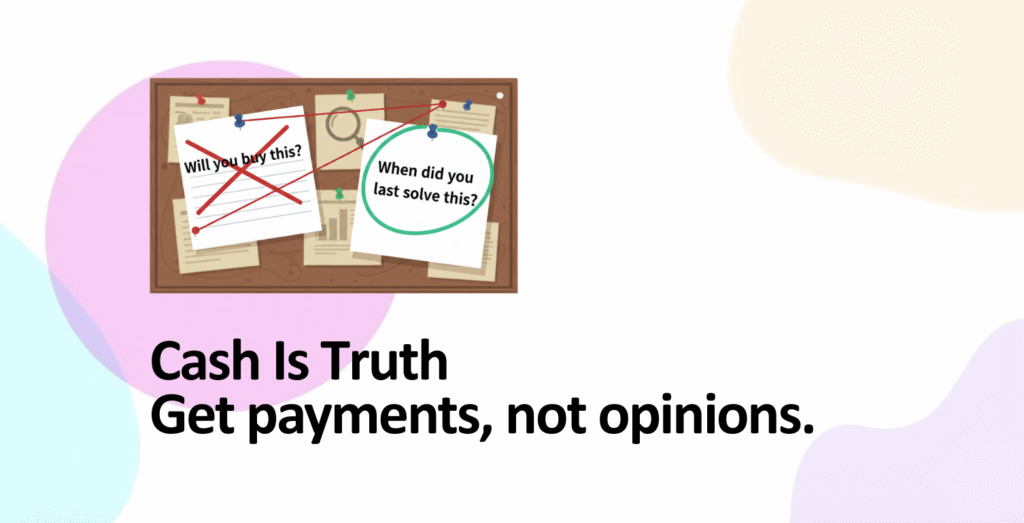
The validation failure epidemic (2025): 90% of failed startups never validate before building, 19% fail from building unwanted features, “false confidence” kills more startups than bad ideas, “validation ≠ PMF” (saying yes ≠ paying), 5-25 real conversations reveal what matters, fake door tests show actual behavior not hypothetical intent. Building features buyers don’t pay for is the fastest way to stall growth and waste runway.
Table of Contents
- The Validation Illusion: Why Early Feedback Lies
- False Confidence: The Killer Nobody Talks About
- Bad User Interviews: What Actually Happens
- Building Wrong Features: The $500K Mistake
- Warning Signals: How to Spot Bad Validation
- Real Validation vs Fake Validation: The Difference
- The Right Interview Framework: 5-25 Conversations
- Fake Door Tests: Measuring Behavior Not Words
- Product-Market Validation Checklist
The Validation Illusion: Why Early Feedback Lies
Here’s the trap: You ask friends and potential customers, “Do you like this idea?” They say yes. You think you have validation. You don’t. You have false positives
People are polite. When someone asks “Do you think this product would be useful?” most people say yes. It costs them nothing. They haven’t committed. They’re being nice
The real test: Can you get them to pay? Or use? Or change their behavior? Most won’t. This is the gap between “validation” and product-market fit
The Three Levels of Validation (Spoiler: You Need Level 3)
| Level | Definition | Signal You Get | What It Actually Means |
|---|---|---|---|
| Level 1: Idea Validation | People like the idea (when asked) | “That’s a great idea! I’d definitely use that” | They’re being polite. Costs them nothing to say yes |
| Level 2: Problem Validation | Customers confirm they have the problem | “Yeah, I really struggle with this” | Real problem exists. But they might not buy your solution |
| Level 3: Solution Validation (PMF) | Customers will pay/use your solution over alternatives | Payment, usage, retention, word-of-mouth, switching behavior | Real product-market fit. They’ve committed their own resources |
Most founders stop at Level 1 or 2. They collect positive feedback and think they have validation. They’re wrong. Level 3 is the only one that matters
False Confidence: The Killer Nobody Talks About
Quote from founder in 2025: “You’re just making good time in the wrong direction. Startups rarely die from bad code. They die from false confidence. The product might be brilliant. The idea might even be right. But if you don’t know how people actually use it, or why they stop, or what they thought it would do, you’re building for a world that only exists in your head.”
This is the hidden kill switch. You have high confidence. You’re building fast. You’re shipping features. Everyone who sees it (before launch) loves it. But nobody’s actually using it. Or paying for it. And when you launch, growth stalls
The False Confidence Cycle
Week 1: You have a brilliant idea. You know it’s brilliant
Week 2: You talk to 3 people. They say “great idea!” You’re validated
Week 4: You build the product. It looks great. You show 5 friends. They love it
Week 8: You launch. Early users sign up. You think “we’re on to something”
Week 12: Growth flatlines. Nobody’s coming back. Why?
Week 16: You ask users “why did you stop using this?” They say “I wasn’t sure what the value was” or “it didn’t solve my problem the way I expected”
Reality: You spent weeks building something based on false confidence and false positives. The feedback you got was nice, not honest
Bad User Interviews: What Actually Happens
Bad user interviews are everywhere. Most founders do them wrong because they’re asking the wrong questions
Bad Interview Questions (What You Shouldn’t Ask)
- “Do you like this idea?” → Biased question. Of course they’ll say yes (polite)
- “Would you use this?” → Hypothetical. Hypothetical yes ≠ actual yes
- “How much would you pay for this?” → Asked too early. No context. Numbers are useless
- “Don’t you think X is a problem?” → Leading question. You’re suggesting the answer
- “Would your company buy this?” → They don’t know. They’re not the buyer
Real quote from startup founder: “We interviewed people and they all said ‘yes, this is a great app!’ But our first week after launch, nobody came back. I asked one early user ‘why aren’t you using it?’ She said ‘I didn’t think the features matched what I needed.’ But when I interviewed her, she said it was great. She was being nice”
What Bad Interviews Miss
- Current workarounds: How are they actually solving this today? (Most interviews skip this)
- Willingness to switch: Would they actually change behavior to use your product? Most won’t
- Decision criteria: Who actually decides to buy? (Often not the person you interviewed)
- Emotional drivers: What triggers the pain? When does it hurt most?
- Real urgency: How urgent is this problem? If not urgent, they won’t prioritize your solution
Building Wrong Features: The $500K Mistake
CB Insights research: 19% of startup failures result from building products with too many features that nobody wanted
This is what happens when you skip real validation. You build what you think customers want. You include 15 features. Your early users actually use 3. The other 12 wasted developer time and runway
Real Scenario: The Healthcare App
Founder built a patient management app. She interviewed 10 doctors. They all said “yeah, we need better patient management.” She built 15 features based on feedback. Launched
What actually happened: Doctors started using the app. After 2 weeks, usage dropped. She investigated. Found out: 60% of doctors were using only the appointment scheduling feature. The other 14 features (which she spent months building) were ignored
The deeper problem: She asked “what features do you need?” Instead of observing “how are you solving this today?” She optimized based on what doctors said they wanted (14 features), not what they actually needed (1 feature)
Developer cost: $500K+ in engineer time. Wasted because she didn’t validate the right features before building
The Feature Validation Gap
| What Founder Assumes | What Users Actually Do | Cost of Mismatch |
|---|---|---|
| “Feature X is critical” (from interviews) | 5% of users actually use Feature X | Wasted developer time on unused complexity |
| “Users want advanced analytics” | Users want simple reporting (one click) | Built wrong version. Doesn’t sell |
| “Integrations are must-have” | Users want core product to work first (not integrations) | Built features before solving core problem |
| “Enterprise features needed” | SMBs want simplicity, not enterprise power | Product too complex for actual market |
Warning Signals: How to Spot Bad Validation
These signals tell you that your validation is false
Red Flags (Your Validation is Bad)
- Everyone you interview says yes: If 100% of people say “great idea,” you’re asking the wrong questions or talking to the wrong people
- People say yes, but don’t remember the conversation: If they don’t care enough to remember, they don’t have real pain
- Early adopters aren’t showing up: If you build it and they don’t come, your validation was wrong. “If you build it, they will come” doesn’t work without real pain
- Retention is below 30% M1: If 70% of users stop using after month 1, they weren’t really validated on the problem
- Users request different features than you built: Early users asking for different features = you didn’t build what they need
- You can’t get anyone to pay: The ultimate validation signal. If you can’t convert to paying customers, your problem doesn’t matter
- Beta program requests go silent: You ask users to test. They say yes. Then they ghost. They’re not invested
Real Validation vs Fake Validation: The Difference
| Fake Validation | Real Validation |
|---|---|
| “That’s a great idea!” (verbal) | User pays money (behavior) |
| People say problem matters | People change their behavior to use your solution |
| Hypothetical interest (“I would use this”) | Actual usage (logged in, returned, engaged) |
| Interview feedback loops (what they say) | Retention & engagement metrics (what they do) |
| Everyone agrees it’s a good problem | Specific customer segment shows buying behavior |
| You ask; they answer (biased) | You observe; you don’t ask (unbiased) |
| Funding or praise from investors | Customers voting with their money/time |
The key difference: Real validation is about behavior change and resource commitment. Fake validation is about people being nice to you
The Right Interview Framework: 5-25 Conversations
You don’t need 100 interviews. You need the right interviews. 5-25 conversations with real decision-makers reveal almost everything
The Right Interview Structure
Part 1: Understand Their World (Not Your Product)
Ask about their job, their day, their current situation. Don’t mention your product yet
Questions: “Walk me through a typical day.” “What’s the most time-consuming part?” “What frustrates you most?”
Part 2: Understand Their Problem
Dig into the specific problem. Get them talking. Listen more than you talk
Questions: “How are you solving this today?” “What have you tried?” “Why didn’t that work?” “What’s the cost of this problem?”
Part 3: Understand Their Criteria
What matters to them? Not features. Outcomes
Questions: “If this problem was solved, what would change?” “How would you measure success?” “What would you give up to solve this?”
Part 4: Understand Behavior (Optionally Show Your Solution)
Show your solution, but only after understanding their problem. Get their reaction
Questions: “Does this address your problem?” “Would this change how you work?” “What would you need to actually use this?”
Sample Size: 5-25 is Enough
- 5 interviews: Reveals major directional issues (wrong problem focus, wrong persona)
- 10-15 interviews: Reveals feature priorities and customer problems
- 20-25 interviews: Enough to spot patterns and validate across segments
- 50+: You’re probably overthinking it. You should already know what you need
Reddit founder quote (r/startups): “I typically talk with 5-25 people and form some hypothesis (several mentioned they like X) to then put that into a larger survey to get a more measured viewpoint (24% of people like X). Often, in the early iteration days of a startup, you need directional information (most people we talked with want X), so massive question responses aren’t needed.”
Fake Door Tests: Measuring Behavior Not Words
Fake door tests show you what people actually want (behavior), not what they say they want (words)
How Fake Door Tests Work
Example: You add a button to your app: “Schedule Weekly Review.” Button doesn’t actually work (yet). When users click it, they see “Coming Soon” and a feedback form asking “How interested are you?”
What you learn: If 40% of users click the button, you know this feature matters. If 2% click, it doesn’t. This is behavioral data, not hypothetical
Why Fake Door Tests Beat Interviews
- Real behavior: Users clicking a button = real signal. Interview yes = polite response
- Lightweight: No backend needed. Just UI + logging
- Scales easily: Doesn’t require 1-on-1 conversations. Can test with 1000+ users
- Removes bias: Users don’t know it’s a test. They’re just doing what they naturally do
- Fast iteration: You can test 10 features in a week
Real Fake Door Test Results (SaaS Company)
| Feature Tested | Users Who Clicked “Fake Door” | What Company Built | Outcome |
|---|---|---|---|
| Slack Integration | 8% of users | Built expensive 3-month integration | Almost nobody used it post-launch. Wrong feature |
| Custom Alerts | 34% of users | Built feature based on high interest | Became most-used feature. 60% activation |
| Team Dashboards | 18% of users | Deprioritized (lower interest than expected) | Launched 6 months later. Still lower adoption than Custom Alerts |
The company saved 3 months of development by testing first. Fake door tests revealed actual behavior. Interviews would have lied
Product-Market Validation Checklist
Pre-Interview Phase (Week 1)
☐ Define your Ideal Customer Profile (ICP) specifically (not “startups”, but “Series A funded B2B SaaS in Europe”)
☐ Write your problem hypothesis in one sentence
☐ Identify 20-30 people who match your ICP
☐ Create interview guide (4 sections: their world, their problem, their criteria, solution)
☐ Recruit beta testers separately (don’t interview and test same person)
Interview Phase (Weeks 2-3)
☐ Run 5 interviews first (get directional insights)
☐ Listen 70%, talk 30% (let them talk, don’t lead)
☐ Ask “how are you solving this today?” (most important question)
☐ Take notes, don’t record audio (less biased)
☐ After 5 interviews, spot check: do you see patterns? (if yes, continue; if no, change ICP)
☐ Run 10-20 more interviews until patterns repeat
Fake Door Test Phase (Week 2 parallel)
☐ Identify 3-5 top features you think customers want
☐ Add fake buttons/CTAs to your landing page or app (no backend)
☐ Run test for 1-2 weeks (minimum 50 users seeing each feature)
☐ Track: % who click, patterns in which segments click most
☐ Compare fake door results vs interview feedback (they often disagree)
Validation Decision Phase (Week 4)
☐ Do interview patterns match fake door results? (if divergent, your ICP might be wrong)
☐ Can you get any of these customers to pay or commit? (try even before product)
☐ What’s the #1 problem they mentioned? (build this first, not everything)
☐ Would they actually switch to your solution? (key validation question)
☐ Decision: Do you have real validation to build, or do you need to pivot?
Post-Validation: Pre-Launch (Weeks 5-8)
☐ Build ONLY the core feature (the one that solves the #1 problem)
☐ Run beta with 20-50 real customers (not friends)
☐ Track: retention (M1, M3), feature adoption, usage frequency
☐ Ask why they stop (if churn is high, your validation was wrong)
☐ Get to 30%+ M1 retention before launch
Launch Phase
☐ Launch with core feature only (resist feature creep)
☐ Measure: CAC, LTV, retention by cohort
☐ Features beyond core only after you have paying customers
Key Takeaways: Product-Market Validation
1. 90% of failed startups never validate before building: They’re overconfident that they know what customers want. This is avoidable
2. 19% of startup failures result from building features nobody wants: Too many features, no core problem solved. Validation prevents this
3. “Validation ≠ PMF” – saying yes to “is this a good idea?” doesn’t mean they’ll pay: Level 1 validation is fake. Only Level 3 (behavior + payment) matters. Track behavior, not words
4. False confidence kills more startups than bad ideas: You think you’re right, so you build fast, ship features, nobody uses them. Confidence without validation is lethal
5. People are polite: When you ask “do you like this idea?”, they say yes. When you ask “would you pay?”, they disappear. Behavior never lies
6. Early user feedback lies: Beta program users say “great product!” then never return. They were being polite, not honest. Measure retention, not satisfaction
7. Building wrong features = wasting $500K: You build 15 features based on interviews. Users only use 3. Validate before building
8. The healthcare app example: Founder asked “what features do you need?” Built 15. Only appointment scheduling got used. Ask “how are you solving this today?” instead
9. Bad interview questions are biased: “Do you like this?” “Would you use this?” “Don’t you think X is a problem?” All lead the witness. Ask neutral questions
10. Real interviews reveal: current workarounds, willingness to switch, decision criteria, emotional drivers, real urgency. Most startups skip these
11. Fake validation signals: Everyone says yes (wrong questions), people don’t remember conversation (not urgent), early adopters don’t show up (validation was wrong). Watch for red flags
12. Retention below 30% M1 = validation failure: If users aren’t coming back, you didn’t solve their real problem. Fix validation before scaling
13. You don’t need 100 interviews: 5-25 real conversations reveal almost everything. 5 = directional, 10-15 = patterns, 20-25 = validated across segments. Quality > quantity
14. Interview formula: (1) Understand their world (2) Understand their problem (3) Understand their criteria (4) Show solution last (if at all). This order prevents bias
15. Fake door tests reveal actual behavior: Button clicks = real signal. Interviews = polite responses. Test features before building them. Users clicking > users saying yes
16. Real fake door test result: Feature with 34% clicks became most-used. Feature with 8% clicks that company built anyway flopped. Trust the test, not intuition
17. Fake door tests beat interviews because: real behavior not hypothetical, scales easily, removes bias, fast iteration. Add one to your MVP
18. Funding/praise ≠ validation: Investors saying “great idea!” doesn’t mean customers will pay. Only customers voting with money matters. Track customer behavior not investor excitement
19. ICP definition matters: Not “startups” but “Series A B2B SaaS in Europe, 10-50 people, <$5M ARR”. Specific = better interviews. Vague ICP = bad validation
20. Action plan: (1) Define ICP specifically (2) Run 5 interviews (3) Build fake doors for top 3 features (4) Run interviews 10-20 more times (5) Compare interview vs fake door data (6) Get commitment to pay/use (7) Build only core feature (8) Launch and measure retention (9) Iterate based on real behavior. Validation before building = success