
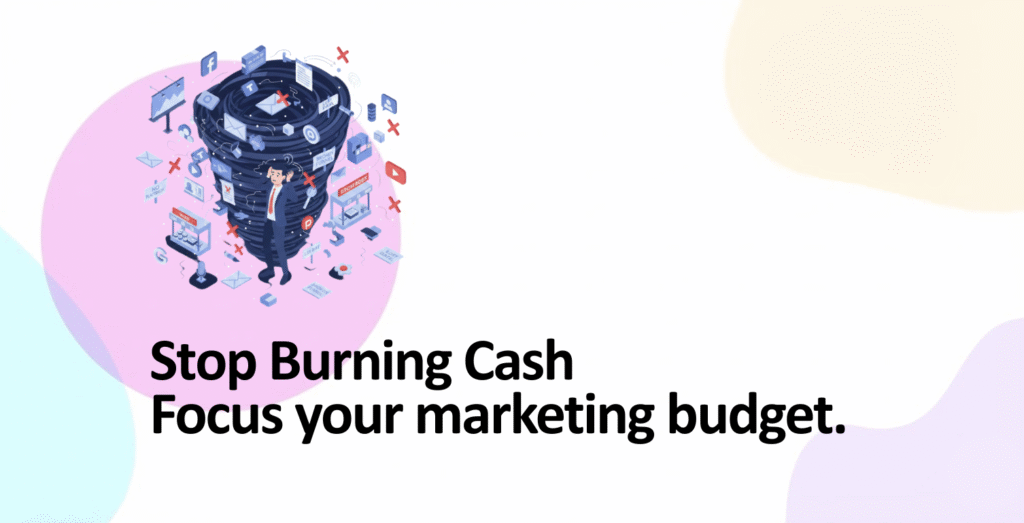
Acquisition chaos reality (2025): “Most common startup failure mode: investing in too many channels at once.” Companies focusing on one lane see 3x faster growth, 60% of time wasted on channel switching instead of optimizing, only 3 core growth lanes work (performance marketing, virality, content), first 100 customers acquired through focused channel (not 10 experiments simultaneously), referrals convert 3-5x higher than cold leads, founder-led sales necessary until $500K ARR. No playbook = no repeatable growth.
Table of Contents
- The Acquisition Chaos Problem: Too Many Channels
- Why Spreading Thin Destroys Growth
- The Three Growth Lanes (Only Three Work at Scale)
- Getting First 100 Customers: The Focused Approach
- Why Playbooks Matter: Repeatability Over Experimentation
- Founder-Led Sales: Non-Negotiable Until $500K ARR
- The Validation Phase: Testing Your Lane
- The Scaling Phase: Once You Have a Working Channel
- Multi-Channel Growth Checklist
The Acquisition Chaos Problem: Too Many Channels
First Round Review on startup failure modes: “Unfortunately, this often leads to founders running head-first into one of the most common startup failure modes: investing in too many channels at once, and as a result not investing in any one channel enough.”
This is the chaos trap. You’re trying to win at performance marketing, virality, partnerships, content, communities, and paid ads all at once. You have no resources. You have no expertise. You’re dividing your already-thin team across 10 channels
Result: None of the channels work. You spend 60% of your time context-switching between channels instead of optimizing any single one. You have no repeatable growth. No playbook. You’re stuck
The Pattern: Early-Stage Chaos
Week 1: “Let’s focus on cold outreach.” You get 2 customers from 200 cold emails (1% conversion). This feels wrong, so you abandon it
Week 2: “Let’s try Product Hunt.” You launch. Get 5 signups. One-time spike. Abandon it
Week 3: “Let’s try community (Reddit, Indie Hackers).” You post. One customer. Too slow. Abandon it
Week 4: “Let’s try paid ads (Google/Facebook).” You burn $2,000 getting no customers. Abandon it
Week 5: “Let’s try partnerships.” You pitch 10 companies. None interested. Abandon it
Month 3 result: 15 total customers from dozens of experiments. No pattern. No repeatable growth. No playbook. Just chaos
Why Spreading Thin Destroys Growth
The Math of Resource Dilution
| Scenario | Team Effort | Growth Per Channel | Total 3-Month Growth | Playbook Created? |
|---|---|---|---|---|
| Focused (1 channel) | 100% effort on cold outreach | 2 customers/week × 12 weeks = 24 customers | 24 customers + compound referrals | YES – refined cold outreach playbook |
| Scattered (6 channels) | ~17% effort per channel (400+ hours wasted switching) | 2-3 customers/week across all channels | 8-10 customers (no compounding) | NO – each channel too immature to optimize |
| Difference | -82% on context switching | 3x fewer customers per channel | 2-3x less total growth | Zero repeatability vs documented playbook |
This is not linear. Spreading effort 6 ways doesn’t give you 6× growth. It gives you less than 1× growth because each channel is under-resourced
Why Channel Switching is So Expensive
- Context switching loss: Takes 20 minutes to context-switch between channels. If you switch 10 times per day, that’s 3.3 hours wasted daily
- Momentum loss: Just when you’re finding traction in one channel (week 3-4), you switch. You never reach inflection point
- No learning: Each channel needs weeks to yield data. 2 weeks per channel across 10 channels = 20 weeks. You never learn what works
- Tool bloat: Each channel requires different tools. Cold outreach = Lemlist. Paid ads = Google Ads. LinkedIn = Sales Navigator. Cost: $500+/month on tools you don’t fully use
- Psychology of failure: Every time you switch, it feels like the previous channel “failed.” Confidence drops. You get more conservative
The Three Growth Lanes (Only Three Work at Scale)
First Round Review analysis of consumer companies: “In our experience, founders are often surprised to learn that there are very few routes to scalable new customer acquisition. For consumer companies, there are only three growth ‘lanes’ that comprise the majority of new customer acquisition.”
This insight applies to B2B too. There are three lanes. Everything else is noise
The Three Lanes Explained
| Lane | Definition | How It Works | Timeline to Traction | Team Needed |
|---|---|---|---|---|
| Performance Marketing | Paid channels (Google Ads, Facebook Ads, LinkedIn Ads) | You pay for visibility. Target specific audience. Measure ROI directly. Scale by increasing ad spend | 2-4 weeks to find profitable CAC | Small: 1-2 people initially |
| Virality/Network Effects | Word-of-mouth, referrals, invites (K-factor >1) | Each user brings multiple new users. Exponential growth. Network effect compounds | 4-12 weeks to see compounding | Cross-functional: product + marketing + growth |
| Content/SEO | Organic traffic from search, blogs, YouTube, communities | You create valuable content. People find you via search. Build authority. Long tail drives volume | 3-6 months to meaningful traffic (SEO is slow) | Content creator + SEO specialist (1-2 people) |
Note: These aren’t the only channels (partnerships, sales, PR exist), but they’re the only ones that scale to meaningful volume. Everything else is supplementary
When Each Lane Works Best
- Performance marketing: Works when you have a clear ICP, proven conversion path, and cash to spend. Best for B2B with clear ROI
- Virality: Works when product is naturally shareable (Slack, Dropbox, TikTok) or when referral incentives create loops (Uber, PayPal). Hardest to engineer
- Content: Works when you can create authority (guides, videos, thought leadership). Long-term play but compound massively
Getting First 100 Customers: The Focused Approach
The goal for first 100 customers is clarity, not scale. You need to identify which ONE channel will work for you and build a repeatable playbook for that channel
The Stage-By-Stage Framework
Stage 1: First 10 Customers (Weeks 1-4)
Objective: Get ANY customer and understand why they bought
Method: Founder-led sales. Direct outreach. Manual conversations. No marketing, no fancy tactics. Just talk to people
Activity: 50 personal emails/DMs to people matching your ICP. Schedule 10 calls. Close 5-10 customers through conversations
Success metric: You can articulate why each customer bought. Extract the exact language they use to describe their pain
Stage 2: 10 to 50 Customers (Weeks 5-12)
Objective: Identify which acquisition channel is working and start to refine
Method: Continue founder-led sales but start to separate channels. Track which activities generated each customer
Activity: Keep outreach going. Ask each customer “who else do you know with this problem?” (referrals). Track source of each customer
Success metric: Clear pattern emerges. “60% of our customers came from direct outreach” or “referrals” or “community”
Stage 3: 50 to 100 Customers (Weeks 13-24)
Objective: Codify the working channel into a repeatable playbook. Start to scale it
Method: Double down on the channel that’s working. Systematize it. Create templates, scripts, processes
Activity: If referrals worked best, activate customer referral program. If outreach worked, systematize cold email. If community worked, post daily
Success metric: You can consistently acquire 5-10 customers/week from a single channel without founder doing all the work
Real Approach: First 100 Customers
Referral Loop Magic: Early on, referrals convert 3-5x higher than cold leads. Why? They come with social proof. Early companies like Superhuman and Basecamp grew largely through referral loops. Each satisfied customer was asked “Who else do you know who struggles with this?” This single question became their primary growth engine
The Process:
- Close 10 customers (via whatever means)
- Ask each: “Who else do you know who struggles with X?”
- Get introduced. Close 70% of referred leads (vs 5-10% cold leads)
- Each new customer generates 3+ referrals on average
- Repeat
By customer 50: 50% of new customers are coming from referrals, not your outreach. This is compounding growth
Why Playbooks Matter: Repeatability Over Experimentation
A playbook is: the exact process, messaging, script, and success criteria for acquiring customers through one specific channel
Why this matters: Once you document the playbook, you can:
- Delegate it: Train someone else to run the process. Not just “do customer acquisition,” but “run the cold outreach playbook”
- Scale it: Take 1 person closing 5 customers/week and add 2 more people running the same playbook = 15 customers/week
- Optimize it: Without a playbook, you’re constantly experimenting. With a playbook, you’re continuously improving a known system
- Measure it: “Outreach playbook targets 5% conversion on cold emails, 20% call-to-close.” You have metrics. You can track progress
What a Playbook Looks Like
Cold Outreach Playbook (Example)
ICP: VP of Sales at B2B SaaS, 50-300 people, $10M-50M ARR
Message: “Subject: [Specific pain point] at [Company]” → Personalized opener → Social proof (case study) → Clear ask (15-min call)
Process: Find 50 prospects → Send custom emails day 1, 3, 5 → Track opens/clicks → Call anyone who opens → Close target 5%
Metrics: 50% open rate, 10% reply rate, 20% call-to-close = 5% from initial emails
Team: 1 founder running this initially. Can delegate to 1 SDR once playbook is proven
Time to scale: Months 1-2 (founder testing), Month 3 (playbook documented), Month 4+ (delegate to SDR)
Founder-Led Sales: Non-Negotiable Until $500K ARR
This is not negotiable. You must lead sales yourself until you hit $500K ARR. Here’s why
Why Founder-Led Sales is Critical
- Product learning: You discover why customers actually buy (vs why you think they buy). This informs roadmap
- Messaging learning: You hear what language resonates. This becomes your marketing message
- ICP clarity: You discover which customer segments buy easiest and generate highest LTV
- Playbook creation: You can’t delegate until you’ve built the playbook. The founder must build it
- Early relationships: Your early customers are your best advocates. Founder relationships are sticky
The mistake: Hiring a salesperson too early. You hire a talented SDR thinking “they’ll scale sales while I focus on product.” Result: They’re chasing the wrong message to the wrong ICP using the wrong process. They’re not building a playbook, they’re just making calls
The right sequence:
- Founder leads sales (months 0-6)
- Founder documents playbook (months 3-6)
- Founder hires SDR or AE (month 6-7)
- SDR/AE follows documented playbook (month 7+)
The Validation Phase: Testing Your Lane
Before you commit to a lane, you need to validate it works for YOU. Not that it works in theory, but that it works with your team, your product, your ICP
The Validation Framework (3-4 Weeks)
| Week | Activity | Success Criteria | Decision Point |
|---|---|---|---|
| Week 1 | Test 1-2 channels with light effort (5-10 hours each) | Generate 5-10 leads from each channel | Which channel generated highest quality leads? |
| Week 2 | Commit 100% effort to winning channel | Close 2-3 customers. Understand why | Is the channel sustainable? Can you do this 20x? |
| Week 3 | Repeat winning channel with refined messaging | Close 3-5 more customers. Refine language | Is the conversion rate consistent? Playbook-able? |
| Week 4 | Document playbook and test delegation | Can a second person run this process? Get 2-3 customers | Ready to scale? Hire for this lane? |
Key insight: You’re not looking for perfection or massive scale. You’re looking for a repeatable process that works consistently. Once you have that, you can scale
The Scaling Phase: Once You Have a Working Channel
Once you’ve validated a lane, you scale it. But you don’t do this by spreading wider. You do this by going deeper
Scaling the Winning Channel
If your lane is Performance Marketing: You’re currently spending $500/month and getting 3 customers. Scale by 2x: spend $1,000, get 6 customers. Then 3x: spend $1,500, get 9 customers. Optimize CAC as you go
If your lane is Virality/Referrals: You have 10 customers generating 3 referrals each = 30 new customers. Scale by formalizing the referral program. Add incentives. Systemize ask. Compound grows automatically
If your lane is Content: You published one guide that generated 20 customers. Scale by publishing one guide/month. Build content library. SEO compounds over time
Now (after lane validation) you can layer in secondary channels. Once your primary lane is generating 20-30 customers/week consistently, you can invest 20% of effort into a secondary lane
The key: Your primary lane is still generating 80-90% of growth. You’re just experimenting with secondary lanes
Multi-Channel Growth Checklist
Pre-Launch: Channel Selection (Week 1)
☐ Define ICP specifically (not “B2B SaaS”, but “Series A SaaS companies in Europe, 10-50 people”)
☐ Map where your ICP discovers new products (LinkedIn? Reddit? Community? Direct mail?)
☐ Identify 3 potential lanes (performance, content, virality for your specific ICP)
☐ Make hypothesis: “Our ICP discovers us primarily through [channel]”
☐ Document why you chose these 3 (not random guessing)
Validation Phase (Weeks 2-4)
☐ Test Lane 1 for 1 week (light effort, 5-10 hours). Track leads generated
☐ Test Lane 2 for 1 week (light effort). Track leads
☐ Pick winning lane based on lead quality, not volume
☐ Commit 100% effort to winning lane for Week 2
☐ Close minimum 2 customers. Document why they bought (exact language)
☐ Refine messaging based on customer language
☐ Close 3-5 more customers with refined message
☐ Calculate conversion rate: (customers ÷ leads) × 100. Target: >5% for outbound, >20% for inbound
Playbook Documentation (Week 4)
☐ Document exact process: ICP → outreach → messaging → call → close
☐ Create templates (email, call script, objection handling, pricing close)
☐ Define success metrics (open rate, reply rate, call-to-close, average deal size)
☐ Document timeline (how long does a prospect take from first touch to close?)
☐ Create playbook one-pager that someone else could follow
Delegation & Scale (Weeks 5+)
☐ Train 1 person (or hire) to run the winning playbook
☐ Monitor their conversion rate vs yours (should be >80% of your rate initially)
☐ Scale spend/effort on winning lane as it proves consistent
☐ Add second lane only after first lane is consistently generating 20+ customers/week
☐ Continuously optimize winning lane (test new messaging, new ICPs, new formats)
☐ Never return to experimentation mode once you have playbook (except for secondary lane)
Ongoing: Quarterly Reviews
☐ Monthly: Review CAC, LTV, conversion rate. Any decline? Investigate
☐ Quarterly: Is primary lane hitting diminishing returns? Time to add secondary lane?
☐ Yearly: Does our ICP still prefer this channel? Markets shift. Adapt
Key Takeaways: Acquisition Chaos
1. “Most common startup failure mode: investing in too many channels at once”: This is the #1 acquisition mistake. Spreading thin across 6 channels gives you 2-3x less growth than focusing on 1
2. Companies starting with one growth lane see 3x faster growth: Focus beats diversification. Master one lane before adding another
3. 60% of time wasted on context switching instead of optimizing: Switching channels 10x/day = 3+ hours wasted. This compounds. In 6 months that’s 720 hours (18 work weeks) lost to switching
4. Only 3 core lanes work at scale (performance marketing, virality/referrals, content): Everything else is supplementary. Stop experimenting with 10 channels. Master one of these 3
5. First 100 customers need focused channel, not 10 simultaneous experiments: You need a playbook by customer 50. Can’t build playbook if you’re scattered
6. Referrals convert 3-5x higher than cold leads: Early customers are your best acquisition engine. Ask “Who else struggles with this?” and watch referrals compound
7. Founder-led sales is non-negotiable until $500K ARR: You must close customers yourself to build the playbook. Hiring salesperson too early breaks everything
8. Channel validation takes 3-4 weeks: Test light, pick winner, double down for weeks 2-4, document playbook week 4. Don’t commit to channel without validation
9. A playbook is: ICP + message + process + metrics: Document it on one page. Someone else should be able to follow it. Without this, you can’t scale or delegate
10. Scaling doesn’t mean adding channels, it means going deeper: Spend 2x on winning channel, then 3x. Optimize CAC as you go. Primary lane should fund secondary experiments
11. Secondary lanes only after primary hits 20-30 customers/week: Once you have winning channel, invest 20% effort into secondary lane. But primary should still drive 80%+ of growth
12. Context switching is extremely expensive: 20 minutes per switch × 10 switches/day = 3.3 hours lost daily = 17 hours lost weekly = 884 hours annually. That’s 22 work weeks of productivity lost
13. No playbook = no repeatable growth: You have 50 random customers from 50 random tactics. This doesn’t scale. Playbook = system you can repeat, delegate, optimize
14. ICP clarity is foundational: If ICP is vague, all channels fail. If ICP is specific, channels work. Spend week 1 defining ICP precisely
15. Each lane has different timeline: Performance marketing (2-4 weeks to traction), virality (4-12 weeks), content (3-6 months). Pick lane that matches your timeline needs
16. Resource dilution math: Effort on 6 channels × 1/6 ÷ overhead of switching = <1x total growth. Focused effort on 1 lane = 3x growth. Math forces focus
17. Real example: Superhuman + Basecamp: Both built early customers through referral loops, not ads or marketing. They identified a working lane (referrals) and scaled it
18. Messaging matters more than channel: Same message across 3 channels works. Same channel with 3 messages fails. Get message right first
19. Validation criteria: Can you close 5 customers in week 2? Can a second person close 2 in week 4? If yes, playbook is ready to scale. If no, keep testing
20. Action plan: (1) Define ICP (2) Choose 3 potential lanes (3) Validate 1 lane in weeks 2-4 (4) Document playbook (5) Train second person (6) Scale winning lane 2-3x (7) Only add secondary lane after primary is proven). (8) Rinse and repeat quarterly. Focused sequencing beats chaos