
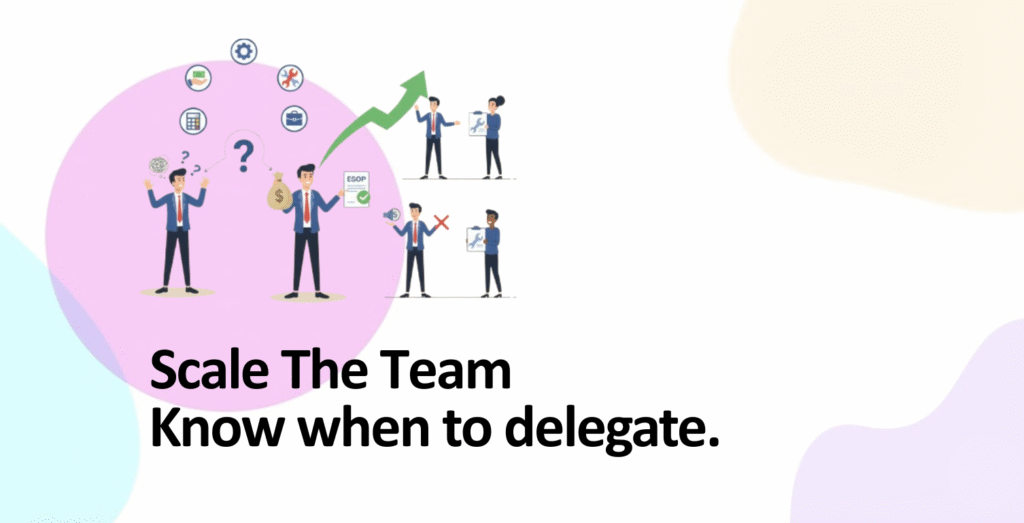
Master first hire timing: transition after 10-25 customers, first roles (engineer ₹13-36L or sales ₹15-40L or ops ₹12-35L), equity 0.5-1.5%, onboarding essentials, management tips, and how to avoid 6 costly hiring mistakes.
Table of Contents
The Founder Era: When to Stay Solo
Most founders ask the wrong question: “When should I hire?” Better question: “When should I stop doing everything myself?”
The Solo Founder Reality (2025 Data)
- Average founder works 70-80 hours/week in first 2 years (Startup Genome Report 2025)
- Founder-led sales is fastest path to PMF (nearly universal truth in startup advice)
- 33% of early hires quit within 90 days (if not managed well)
- Bad first hire costs 30% of annual salary in lost productivity and replacement costs (Carte/Kruze Consulting 2025)
- First 5 hires shape 80-90% of your company culture (Ruka Capital data on culture formation)
- Median time to hire: 3-4 months (from posting to productive contributor)
What You Should Do as a Solo Founder
- Sales & customer conversations: Talk to 50-100 customers before hiring a salesperson. This teaches you market
- Product development: For tech, keep building until PMF clear. For non-tech, focus on customer feedback loops
- Operations/Admin: Outsource to virtual assistants (₹10K-20K/mo) before hiring first full-time ops hire
- Marketing/Content: Founder voice is often best. Post on LinkedIn, write blogs, build audience
- Finance: Use tools (Zoho, QuickBooks) + part-time CA before hiring finance hire
The Cost of Hiring Too Early
- Salary cost: ₹15-60L/year for first hire = cash runway drain
- Opportunity cost: Manager time spent onboarding, 1-on-1s, feedback = less time on core business
- Culture cost: Wrong first hire sets tone for all future hires. Very hard to fix
- Scaling paradox: Hiring someone too early forces you to pivot to match their skills, not your best path
Timing Signals: When to Hire #1
Ignore vanity metrics like “we should hire to scale.” Look for these actual signals.
Green Lights for First Hire (Most Important)
| Signal | What It Means | Why It Matters |
|---|---|---|
| 10-25 paying customers | For B2B: consistent 10+ customers. For B2C: 25+ | Proves market wants product. New hire won’t be chasing dead market |
| Repeatable sales process | You can consistently convert leads (similar close rate 3+ times) | New salesperson has a playbook. Not inventing from scratch |
| ₹10-15L MRR or quarterly recurring revenue | Predictable revenue of ₹40-60L+ annually | Can afford salary + buffer. Not dependent on single hire closing deals |
| Founder is bottleneck (not market) | You have more opportunities than time. Can’t physically do more | Hire will multiply output, not create artificial work |
| PMF signals clear | Users love product, retention >80%, NPS >50 | Stability to invest in team, not chasing product changes |
| Runway for 18-24 months | Cash in bank covers payroll through growth phase | Reduces pressure on hire to close sales immediately. They can ramp |
Red Lights: DO NOT HIRE YET
- No repeatable sales process: Each deal is different, won by relationship, not system. New hire will fail
- Runway <12 months: Too tight. Pressure is on hire to be revenue-generating in month 1
- You’re hiring because you’re tired: Exhaustion is not a hiring signal. Take a break first
- Founder still figuring out positioning/market: New hire gets confused messaging, context changes constantly
- Post-funding urgency to “deploy capital”: Worst hiring motivation. Money doesn’t need deploying into bad hires
First Roles & Cost Comparison
Not all first hires are created equal. Some roles multiply your impact more than others.
First Hire Role Comparison (2025 India Salaries)
| Role | Annual Cost | Best Timing | Impact Type | Typical Background |
|---|---|---|---|---|
| Software Engineer | ₹13-24L (junior), ₹24-36L (mid) | When product build is bottleneck | Multiplies feature velocity | 1-3 YOE, can work independently |
| Sales/Revenue Role | ₹15-40L (base + commission, uncapped) | After 10-15 customers, founder proven close-able | Multiplies revenue and customers | Scrappy, hungrier than experienced. Eats what they kill |
| Operations/COO | ₹12-35L | When admin/processes are suffocating founder | Frees up founder for strategy | Program manager type. Can run systems |
| Marketing/CMO | ₹12-28L | Once product-market fit clear | Scales customer acquisition | Content savvy, channel expert |
| Product Manager | ₹15-32L | After 4-5 engineers hired (rare for first hire) | Organizes product development | Usually not a first hire. Too early |
Most Common First Hire: Engineer or Sales?
- Engineer first if: Product is technical complexity blocker, you’re non-technical founder, B2B SaaS with technical moat needed
- Sales first if: Product is built, you’ve closed customers but can’t close enough, go-to-market is bottleneck
- Ops first if: Rare (maybe 5% of startups), but critical if supply chain/logistics complexity is massive
- Reality: 47% of first hires are tech roles (engineering, product). But biggest ROI often comes from sales hire
Total Cost of First Employee (Year 1 Full Cost)
- Salary: ₹15-40L depending on role
- Benefits: ₹1.5-3L (PF, health insurance, gratuity provision)
- Equipment/workspace: ₹30K-100K (laptop, desk, monitor)
- Recruitment cost: ₹50K-200K (if using recruiter, lost productivity in hiring)
- Training/onboarding: ₹50K-150K (founder time, tools, courses)
- Total Year 1: ₹17-44L (₹15L base salary + all add-ons)
Equity & Compensation Strategy
Equity for First Employee (2025 Data)
| Role Type | Typical Equity % | Vesting Schedule | Rationale |
|---|---|---|---|
| Co-founder (equity partner) | 15-30% (split with other co-founders) | 4-year vesting, 1-year cliff | Long-term partner in company growth |
| First key employee (engineer/sales leader) | 0.5-1.5% | 4-year vesting, 1-year cliff (sometimes 0.5-year) | Retention + skin in game, not ownership |
| First 5 employees combined | 3-5% pool total | Varies per role | Carta/Kruze data: first 5 get ~3.6% avg |
| Later hires (Series A+) | 0.1-0.5% | 4-year vesting, standard cliff | Equity becomes less valuable per person |
Salary + Equity Mix (Early Stage)
- Market rate salary: Always pay 80-100% of market rate (not equity-heavy discount)
- Why: Equity-heavy pay signals you can’t afford them. Top talent avoids this
- Equity on top: 0.5-1.5% is “on top” of full market salary, not instead of it
- Example: Market rate for engineer = ₹24L/yr. Pay ₹22-24L salary + 0.75% equity
- NOT: Pay ₹12L salary + 5% equity. This is false economy
Vesting Structure (Standard)
- 4-year vesting, 1-year cliff: 25% after 1 year, then 1/36th per month for 36 months. Very standard
- Why cliff: Protects company if employee leaves in month 11. No one gets anything
- Why 4-year: Long-term retention incentive. Leaving in year 2 means losing 75% of equity
- Early-stage exception: Some first hires negotiate no cliff or 0.5-year cliff (≤0.5%, not 1.5%)
Managing Your First Employee
First 90 Days Framework
| Period | Founder Focus | Employee Expectations | Success Metrics |
|---|---|---|---|
| Days 1-14: Onboarding | Spend 5-10 hrs/week explaining context, codebase, customers, culture | Learn systems, meet customers/team, set up tools | Can execute first task independently |
| Weeks 3-6: Foundation | Weekly 1-on-1s (30 mins). Unblock regularly. Give clear wins | Close first customer OR ship first feature OR close first deal | First contribution completed. Confidence building |
| Weeks 7-12: Ramping | Bi-weekly 1-on-1s. More autonomy. Feedback on performance | Running own projects. Making decisions. Producing output at 50% efficiency | Hit 50-60% productivity. Clear path to 100% by month 6 |
Critical Management Practices (First Year)
- Weekly 1-on-1s (30 mins): Non-negotiable first 3 months, then bi-weekly. Clear agenda, feedback loop
- Clear role definition: Written role document. What success looks like in 90 days, 6 months, 1 year
- Feedback culture from day 1: 33% of early hires quit within 90 days. Often due to lack of feedback/feeling lost
- First wins matter: Set them up for early success. Not baptism by fire. Builds confidence
- Culture documentation: How decisions get made? How do we communicate? What are non-negotiables? Write it down
Red Flags in First 90 Days
- Quiet quitting: Shows up, does minimum. Not engaged in company. Problem: founder didn’t communicate excitement/importance
- Constant context-switching: Employee bounces between priorities. Problem: founder didn’t prioritize clearly. Not employee’s fault
- Founder frustrated: “They’re not moving fast enough” – most common reason for first hire regrets. They need 2-3 months to ramp
- No clear deliverables: Employee is confused what they should be doing. Problem: founder expected them to figure it out
6 Common Hiring Mistakes
Mistake #1: Hiring Too Quickly (Without PMF)
- What it looks like: Founder has 3 customers, raises seed funding, immediately hires 2-3 people
- Why it fails: New hire has nothing to do or bounces between tasks as product/market shifts
- How to avoid: Wait for 10-25 customers + repeatable motion before first hire
- Cost if wrong: ₹20L+ wasted salary + damaged culture + time spent managing instead of building
Mistake #2: Experience Over Cultural Fit
- What it looks like: Hire someone from Google/Microsoft just because resume looks good, even if they’re cynical about startup life
- Why it fails: Big company people often struggle in scrappy environment. They expect processes, hierarchy, lots of free time
- How to avoid: Prioritize attitude/hustle/belief in mission over fancy background
- Reality: First hire with wrong culture is 5x worse than hire with less experience but right attitude
Mistake #3: Hiring Friends/Network Without Vetting
- What it looks like: “I have a friend who knows someone who coded at a startup, let’s hire them”
- Why it fails: Skip real evaluation. Later, can’t fire them because friendship. Bad dynamics
- How to avoid: Even friends/network go through full process. Work project test. Check references properly
- Hard truth: Worst hires are friends. Different standards of accountability
Mistake #4: Promoting Your First Hire Into Management Too Fast
- What it looks like: Hire strong engineer, then within 1 year make them “Tech Lead” with 3 people reporting
- Why it fails: IC (Individual Contributor) skills ≠ management skills. They’re often frustrated, team is poorly managed
- How to avoid: Keep first hire as IC for 2-3 years. Get real managers when needed
- Cost: Losing great IC while creating bad manager
Mistake #5: Ineffective Onboarding (Drop Ball After Hiring)
- What it looks like: Spend 3 months recruiting, then day 1 arrive and “figure it out”
- Why it fails: No structure, context, clarity. Leads to quiet quitting or early departure
- How to avoid: Structured 90-day onboarding plan. Weekly 1-on-1s. Clear milestones
- Stat: 69% more likely to retain with positive onboarding
Mistake #6: Hiring Out of Desperation (Reactive vs Strategic)
- What it looks like: “Sales aren’t moving, let’s throw a sales hire at it” or “We’re drowning, hire help immediately”
- Why it fails: Desperation hiring = lower bar. You accept mediocre. Regret within 6 months
- How to avoid: Plan hiring 2-3 months in advance. Interview 3-5 candidates. Take time
- Rule: Bad hire is worse than no hire. Empty seat is not emergency
Your Hiring Roadmap
Phase 1: Pre-Hiring Assessment (Month 1-3)
- Do you have 10-25 customers? If no, keep building solo. Hire too early kills startups
- Is founder the bottleneck (not market)? Evaluate honestly. Don’t hire if lack of customers is problem
- Do you have 12-18 months runway? Essential. Hiring creates fixed cost
- Is product stable? PMF signals clear? Not shifting every month?
Phase 2: Define the Role (Month 2-4)
- Write clear role description: responsibilities, success metrics, reporting structure
- Determine first hire role priority: Engineer? Sales? Operations? Based on biggest bottleneck
- Set salary range (80-100% market rate). Research on Levels.fyi, Payscale, Internshala
- Plan equity: 0.5-1.5% vesting over 4 years with 1-year cliff
Phase 3: Sourcing & Interviewing (Month 3-5)
- Source from network + angel investors + LinkedIn + referrals. Agencies are expensive
- Interview 3-5 serious candidates. Not just 1 person
- Do work test: small project, 2-3 hours. See them in action
- Check references + do culture fit assessment
Phase 4: Onboarding Plan (Month 4-6)
- Write 90-day onboarding plan before hire starts
- Prepare: equipment, workspace, accounts, intro meetings
- Schedule weekly 1-on-1s for first 3 months (30 mins each)
- Set clear milestones for weeks 2, 6, 12
Phase 5: First 90 Days (Month 6-9)
- Spend 5-10 hrs/week on new hire training + context
- Weekly feedback loops. Don’t wait for performance reviews
- Help them win first project to build confidence
- Document culture, values, decision-making process as you go
Key Takeaways: First Hire Strategy
1. Founder-led phase (solo) is your advantage, not a liability. Lean into it. Most mistakes come from hiring too early. Speed to market wins PMF validation, not having team.
2. Wait for 10-25 customers + repeatable sales motion before hiring #1. This is the real signal, not funding. Funded + no customers = bad hire will fail.
3. First hire costs ₹17-44L total year 1 (salary + benefits + recruiting + training). This is fixed cost. Must be justified. Make sure you can afford buffer.
4. Role choice: Engineer if product is bottleneck, Sales if go-to-market is bottleneck. 47% of first hires are tech roles but highest ROI often sales. Choose based on your constraint, not default.
5. Pay 80-100% market rate salary. Equity (0.5-1.5%) on top of salary, not instead of. Under-paying drives away talent. ₹24L salary + 0.75% equity, not ₹12L + 5% equity.
6. 33% of early hires quit within 90 days. Usually due to poor onboarding or unclear expectations, not bad hiring decision. Onboarding is as critical as hiring.
7. Vesting: 4-year vesting with 1-year cliff is standard. No cliff = loss of protection. 2-year vesting = signals high turnover expectations. Structure matters.
8. First hire shapes 80-90% of company culture. Cultural fit > experience. Wrong first hire is 5x worse than less experienced right fit. Culture compounds.
9. Hire for roles that multiply your output, not just task completion. Operations hire frees founder for strategy. Sales hire scales revenue. Choose multipliers. Not just filling seats.
10. Weekly 1-on-1s (30 mins) first 3 months are non-negotiable. 69% more likely to retain with positive onboarding. Framework > winging it. Structure saves time long-term.
11. Work test (2-3 hour project) in hiring process reveals real capability. Resumes lie. Work doesn’t. Always do work test for first 5 hires.
12. Common mistake: Hiring friend without vetting. Different standards of accountability. Friend hires fail 2x more often than strangers. Process applies to everyone.
13. Founder bottleneck ≠ market bottleneck. If lack of customers is problem, hiring someone doesn’t solve it. Diagnose before hiring.
14. Bad hire is worse than no hire. Empty seat > bad cultural fit. Take your time. Desperation hires are most regretted. Quality > speed in hiring.
15. Action: Audit your signals NOW. Do you have 10-25 customers? Repeatable sales process? 12-18 month runway? If all yes, start 2-month hiring plan. If any no, stay solo 3-6 more months.