
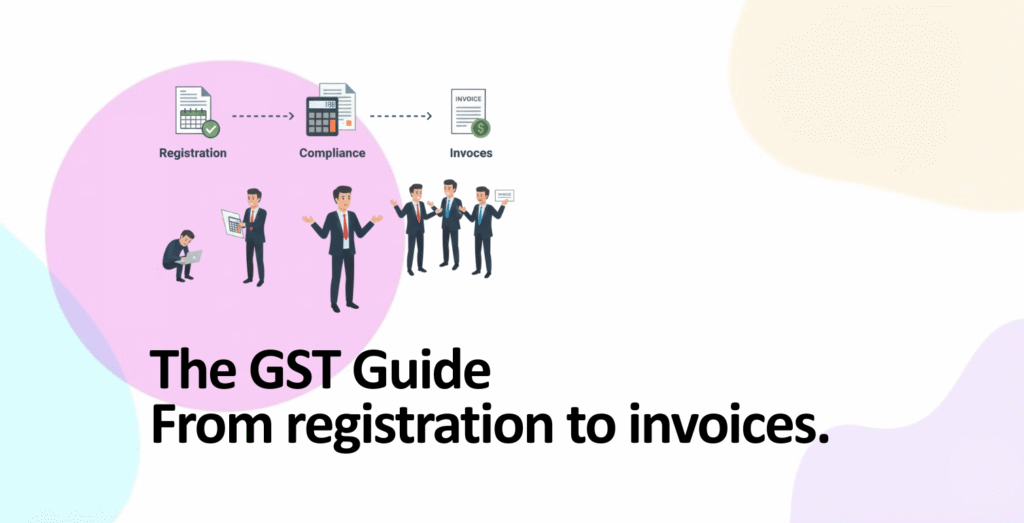
Complete GST compliance guide 2025 India: registration thresholds goods ₹40L (₹20L special states), services ₹20L (₹10L special states), GSTR-1 monthly by 11th, GSTR-3B monthly by 20th, late fees ₹50/day (₹20/day nil returns) capped ₹5000, 18% annual interest on unpaid tax, invoicing requirements, common mistakes, penalties, and compliance framework.
Table of Contents
- When to Register for GST: Thresholds & Mandatory Requirements
- GST Registration Process: Step by Step
- Filing Timelines: GSTR-1 & GSTR-3B Deadlines
- Invoicing Requirements: What Must Be on Invoice
- Compliance Framework: Input Tax Credit & Records
- Common GST Compliance Mistakes & Penalties
- Late Fees & Penalty Rates 2025
When to Register for GST: Thresholds & Mandatory Requirements
GST registration isn’t mandatory for all businesses. There are clear turnover thresholds. Once you cross them, you must register within 30 days or face penalties.
GST Registration Thresholds 2025 (India)
| Business Type | Normal States | Special Category States | Mandatory Registration Trigger |
|---|---|---|---|
| Supplier of Goods | ₹40 lakh/year | ₹20 lakh/year | When annual turnover exceeds ₹40L (₹20L in special states) |
| Service Provider | ₹20 lakh/year | ₹10 lakh/year | When annual turnover exceeds ₹20L (₹10L in special states) |
| Both Goods + Services | ₹40 lakh/year (goods limit applies) | ₹20 lakh/year | Aggregate turnover (goods + services) triggers threshold |
| Inter-state Supplier | ANY turnover | ANY turnover | If you supply interstate (any amount = mandatory registration) |
| Online Marketplace Seller | ANY turnover | ANY turnover | From Day 1 of first sale (online = mandatory) |
Special Category States (Lower Thresholds)
- States with ₹20L goods threshold: Arunachal Pradesh, Manipur, Meghalaya, Mizoram, Nagaland, Sikkim, Tripura, Uttarakhand
- States with ₹10L services threshold: Same as above
- Exception: Assam and Jammu & Kashmir opted for ₹40L (same as normal states)
When Registration is MANDATORY (Regardless of Turnover)
- Interstate supply: If you supply goods/services across state lines, register immediately (any turnover)
- Online marketplace selling: Selling on Amazon, Flipkart, Meesho = mandatory from day 1
- Supply of specific goods: Supply of alcohol, tobacco, motor vehicles = mandatory
- Casual taxable person: Non-resident making occasional supplies into India = must register
- Input Tax Credit requirement: If you need to claim ITC from day 1 = voluntary registration (before threshold)
Voluntary Registration (Below Threshold)
- Can register voluntarily even below threshold. Benefits: claim ITC immediately, B2B credibility increases, appear larger
- Cost of voluntary registration: Must file monthly GSTR-1 + GSTR-3B (more compliance burden)
- When to do it: If your business has high raw material costs (high ITC recovery), register early
- Example: Manufacturing business with ₹30L turnover but ₹8L raw material costs. Register early, claim ₹8L ITC month 1
GST Registration Process: Step by Step
GST registration is online-only through GST portal (gst.gov.in). It’s free. Takes 1-3 days if documents are clean.
Documents Required for GST Registration
- PAN: Permanent Account Number (mandatory)
- Business address proof: Electricity bill, lease deed, property tax certificate (utility bill preferred)
- Bank account details: Account number, IFSC code (same as PAN holder if individual)
- Business details: Nature of business, products/services, turnover estimate
- Authorized signatory: Details of person signing (if business is partnership/company)
- For goods supply: Usually just above docs
- For services supply: Usually just above docs
GST Registration Timeline (Step by Step)
| Step | Action | Timeline | What Happens Next |
|---|---|---|---|
| 1 | Go to gst.gov.in → New Registration | 10 minutes | Enter PAN, email, phone. OTP verification |
| 2 | Fill registration form (ARN form) | 30-45 minutes | Get ARN (Application Reference Number) |
| 3 | Upload documents (address, bank, etc) | 15 minutes | Form submitted |
| 4 | GST officer verification (optional call) | 0-2 days | Officer may call for clarification |
| 5 | Registration approval | 1-3 days | GSTIN issued (13-digit number) |
| 6 | Download GST certificate | Immediate | Ready to operate (file first GSTR-1 within 21 days) |
Cost of GST Registration
- GST registration fee: FREE (no cost)
- Time investment: 1-2 hours (form filling + document upload)
- Timeline: 1-3 days if clean documents, up to 7-10 days if GST officer asks questions
- Expedited option: No expedited track (first-come-first-serve)
After Registration: First 21 Days
- You have GSTIN (13-digit number). Valid for life (unless cancelled)
- First GSTR-1 due within 21 days of registration. Report all supplies made on/after registration date
- Must obtain GST certificate from portal. Use this to conduct business (for invoicing)
- Communicate GST number to customers/suppliers. Customers can claim ITC only with valid GSTIN on invoices
Filing Timelines: GSTR-1 & GSTR-3B Deadlines
GST returns have strict deadlines. One day late = penalty. The two main returns are GSTR-1 and GSTR-3B. Both have different filing frequencies based on turnover.
GSTR-1 Filing Deadlines (Outward Supplies) 2025
| Annual Turnover (Previous FY) | Filing Frequency | Due Date | Example (For Period Ending) |
|---|---|---|---|
| Up to ₹1.5 Crore | Quarterly (3 months) | 13th of next quarter month | Jan-Mar period → Due 13th April |
| ₹1.5 Crore to ₹5 Crore | Monthly (Opted quarterly in some states) | 11th of next month (monthly) OR 13th (quarterly if opted) | For March 2025 → Due 11th April (monthly) |
| Above ₹5 Crore | Monthly (Mandatory) | 11th of next month | For March 2025 → Due 11th April |
| Online marketplace sellers | Quarterly (IFF format) | 13th of next quarter month | Jan-Mar → Due 13th April |
GSTR-3B Filing Deadlines (GST Liability) 2025
| Annual Turnover (Previous FY) | Filing Frequency | Due Date | What It Is |
|---|---|---|---|
| Up to ₹5 Crore | Monthly (Most common) | 20th of next month | Simple summary: ITC claimed + tax liability |
| Up to ₹5 Crore (Opted Quarterly) | Quarterly | 22nd or 24th of next quarter (state dependent) | Quarterly summary instead of monthly |
| Above ₹5 Crore | Monthly (Mandatory) | 20th of next month | Monthly summary of all liabilities |
Key Dates to Remember (2025-26 Financial Year)
- GSTR-1 for April 2025: Due 11th May 2025
- GSTR-3B for April 2025: Due 20th May 2025
- GSTR-1 for Jan-Mar 2025 quarter: Due 13th April 2025
- GSTR-3B for Jan-Mar 2025 quarter: Due 22nd April 2025 (state dependent, could be 24th)
What Happens if You Miss the Deadline (Late Filing)
- Late fee: ₹50/day for regular returns, ₹20/day for nil returns (auto-calculated)
- Late fee cap: ₹5,000 per return (regular), ₹500 (nil returns)
- Interest: 18% per annum on unpaid tax (separate from late fee)
- ITC blocked: Input Tax Credit blocked until returns filed and late fees paid
- Example: GSTR-3B filed 15 days late = ₹50 × 15 = ₹750 late fee (capped at ₹5000)
Filing Extensions & Relief
- Standard extension: No automatic extension. GST portal closes sharply at deadline
- COVID/Force majeure relief: Government occasionally announces extensions (rare, case-by-case)
- Best practice: File 1-2 days before deadline. Don’t wait until last minute
Invoicing Requirements: What Must Be on Invoice
Under GST, invoicing is critical. If invoice is wrong, your customer can’t claim ITC. This breaks trust and loses you business.
Mandatory GST Invoice Elements (Section 31 GST Law)
| Field | Required | Example | Why Important |
|---|---|---|---|
| Supplier GSTIN | Yes | 27AABCU5055K1Z0 | Customer verifies legitimacy. Used in GSTR-2B |
| Invoice number & date | Yes | INV-2025-001, 29-Dec-2025 | Sequential + chronological. System validation |
| Supplier name & address | Yes | Camphor Solutions, 123 M.G. Road, Bangalore | Customer cross-check against GSTIN |
| Customer name, address, GSTIN (if registered) | Yes (GSTIN if B2B registered) | Tech Corp, 456 Park Lane, Delhi, 27ABCDE1234F1Z5 | B2B invoices must have customer GSTIN |
| Item description | Yes | “Software consulting services (GST code SAC: 9983)” | Must match HSN/SAC code for verification |
| HSN/SAC code | Yes (if turnover >₹5Cr or as applicable) | 9983 (Professional services), 6203 (Apparel) | System validation. ITC mapping |
| Quantity & unit price | Yes | 100 units @ ₹500/unit = ₹50,000 | Base for GST calculation |
| Taxable value | Yes | ₹50,000 | Base on which tax calculated |
| IGST/SGST/UTGST rates & amounts | Yes | SGST ₹4,500 (9%), CGST ₹4,500 (9%) = ₹9,000 total | ITC split. Customer claim validation |
| Total invoice value | Yes | ₹59,000 | Final amount due |
| Payment terms & due date | Optional but recommended | “Due within 30 days from invoice date” | Manages cash flow expectations |
GST Slab Rates 2025 (Standard)
- 5% GST: Most essentials (medicines, food grains, edible oil)
- 12% GST: Most services (consulting, design, IT services)
- 18% GST: Most products (electronics, apparel, software)
- 28% GST: Luxury goods (air-conditioners, high-end cars)
- 0% GST (Nil/Exempt): Services like education, health, agriculture
Invoice Format: B2B vs B2C
B2B Invoices (Business to Business)
- Must have customer GSTIN. If customer is registered GST taxpayer, GSTIN is mandatory
- If customer GSTIN not mentioned: System rejects GSTR-1 (error)
- Customer then claims ITC in GSTR-2B. Buyer cross-verifies invoice in seller’s GSTR-1
- Example: Software company invoicing law firm (both registered) = full GST, customer claims ITC
B2C Invoices (Business to Consumer)
- No customer GSTIN required. Consumer can’t claim ITC anyway
- Customer details optional. Can be “Walk-in customer” or “Retail customer”
- Invoice still shows GST. Consumer pays GST but gets no ITC benefit
- Example: Retail shop selling products to individual customers (no GSTIN) = GST collected
Common Invoicing Mistakes (That Block ITC)
- GSTIN mismatch: Invoice shows one GSTIN, seller’s actual GSTIN different = ITC blocked
- Missing customer GSTIN (B2B): Customer registered but invoice doesn’t show GSTIN = ITC lost
- Wrong HSN/SAC code: Product code doesn’t match description = system flags, ITC blocked
- Invoice date after supply: Invoice dated after delivery = system mismatch
- Duplicate invoice numbers: Two invoices with same number = system rejects both
- GST rate error: Item marked 12% but should be 5% = customer’s ITC wrong, flags in audit
Compliance Framework: Input Tax Credit & Records
GST has complex compliance. Most businesses fail not on filing, but on ITC claims and record maintenance.
Input Tax Credit (ITC): What Can You Claim
| Expense Type | ITC Claimable | Conditions | Example |
|---|---|---|---|
| Raw materials/goods purchased | Yes | GST invoice from registered supplier, used for business | Fabric purchased for manufacturing clothes = full ITC |
| Services (software, consulting, etc) | Yes | GST invoice from registered supplier, used for business | Software subscription ₹10K with 18% GST = ₹1800 ITC |
| Equipment & machinery | Yes | GST invoice, used for taxable supply | Sewing machine purchased = full ITC (if used in business) |
| Rent (premises for business) | Yes (if GST applicable) | Landlord must be registered & charge GST. Very rare for house rent | Commercial office rent with GST = ITC claimable |
| Travel & meals (business) | Partial/No | Complex. Hotels/flights yes, but personal meals no | Conference registration with GST = ITC. Personal meals = no ITC |
| Motor vehicle purchase | No | Never claimable (banned category) | Car purchase (even for business use) = NO ITC |
| Personal goods (fuel, office snacks, etc) | No | Personal nature, not business | Boss’s lunch = NO ITC. Office pantry items = NO ITC |
| Alcohol & tobacco | No | Blocked category | Beer purchased for office party = NO ITC (blocked) |
ITC Claim Timeline
- When can you claim ITC? In GSTR-3B after filing GSTR-1 (but can adjust in same month)
- Claim window: Can claim ITC within 24 months of GSTR-1 filing (or goods receipt, whichever later)
- After 24 months: ITC lost, can’t be claimed later
- Monthly adjustment: Usually claimed same month as GSTR-1 filing or next month
GST Records You Must Maintain (Audit-Ready)
- All invoices (outward): Copies of all GST invoices issued. Sequential. Retained for 6 years
- All purchase invoices (inward): GST invoices from suppliers. Proof of ITC claims
- Bank statements: Supporting GST payments, vendor payments
- E-way bills: For movement of goods ₹50K+. Mandatory document
- Debit/credit note ledger: If you issue credit notes (returns, discounts)
- GSTR-1 & GSTR-3B copies: Filed returns (auto-saved in GST portal but keep backups)
- Physical goods if applicable: Stock registers, warehouse records (for audit trail)
Record Maintenance Best Practices
- Digital storage (preferred): Cloud backup or accounting software (Tally, Zoho Books). 6-year retention mandatory
- Invoice sequence: Must be chronological + sequential (no gaps like INV-001, INV-003). Gaps raise audit flags
- Backup suppliers list: Keep updated list of all suppliers with GSTIN + TAN. For cross-check
- Monthly reconciliation: GSTR-1 (sales) should match your sales ledger. Catches errors early
Common GST Compliance Mistakes & Penalties
Most penalties come from preventable mistakes. Here are the top 10 compliance errors and how to avoid them.
Mistake #1: Missing Filing Deadlines
- Error: Filing GSTR-1 on 12th instead of 11th (monthly)
- Penalty: ₹50/day late fee = ₹50 for 1 day late (capped ₹5,000)
- Real impact: 15 days late = ₹750 penalty + 18% interest on unpaid tax
- How to avoid: Set calendar reminder 2 days before deadline. File early. Use accounting software for auto-filing
Mistake #2: Filing NIL Returns Without Due Diligence
- Error: No business this month = skip filing GST returns
- Reality: Must file NIL return (₹0 sales, ₹0 tax). Skipping = penalty
- Penalty: ₹20/day for nil returns (capped ₹500). Seems small but 6-month non-filing = ₹3K penalty
- How to avoid: File even if ₹0. Takes 5 minutes. Portal makes it easy
Mistake #3: Wrong HSN/SAC Code on Invoice
- Error: Invoicing software services as “Goods” (HSN 9983 wrong code used)
- Reality: Customer can’t match your GSTR-1 with their GSTR-2B. ITC blocked
- Penalty: Customer loses ITC ₹10K+. They ask why. Relation damaged. Potential GST audit
- How to avoid: Know HSN/SAC before invoicing. Use GST database search. Test codes in ERP first
Mistake #4: Missing Customer GSTIN on B2B Invoice
- Error: Invoice to registered business but forgot to mention their GSTIN
- Reality: Customer’s GSTR-2B doesn’t auto-populate. They lose ITC. Payment delayed
- Impact: Vendor loses credibility. Repeat orders at risk
- How to avoid: Always ask for customer GSTIN upfront (B2B). Verify it matches their PAN
Mistake #5: Not Filing GSTR-2B (Inward Supplies) Timely
- Error: Received invoices from suppliers but forgot to file GSTR-2B on time
- Reality: GSTR-2B auto-generated from suppliers’ GSTR-1. Must be matched in GSTR-3B to claim ITC
- Penalty: ITC blocked if GSTR-2B not accepted before GSTR-3B deadline
- How to avoid: GSTR-2B auto-generated. Accept/reject within 30 days to claim ITC
Mistake #6: Claiming ITC on Non-Compliant Invoices
- Error: Supplier invoice missing key details (GSTIN, HSN code) but you claim ITC anyway
- Penalty: GST audit catches discrepancy. ITC reversed + 50% penalty + 18% interest
- Example: Claimed ₹50K ITC from supplier X, but later audit reveals invoice fake = ₹75K total fine
- How to avoid: Verify invoice completeness before claiming. Check GSTIN validity online (gst.gov.in)
Mistake #7: Not Updating GSTIN Details (Address, PAN Change)
- Error: Moved office, updated PAN, but didn’t update GSTIN
- Penalty: GST officer notices mismatch. Registration can be suspended
- Impact: Can’t generate invoices or e-way bills. Business operations halted
- How to avoid: Update GSTIN details within 30 days of any change (Form GST REG-14)
Mistake #8: Delayed Tax Payment (Without Filing Return)
- Error: File GSTR-3B showing tax liability ₹50K due, but don’t pay for 60 days
- Penalty: 18% per annum interest on ₹50K = ₹7.5K interest (60 days) + late fee if not paid before filing
- Impact: Next GSTR-1 can’t be filed until past dues cleared
- How to avoid: Pay tax BEFORE filing GSTR-3B. Avoids interest
Mistake #9: Poor Record Keeping (Missing Invoices for Audit)
- Error: Filed GSTR-1 claiming ₹100L sales, but during audit can’t find invoices
- Penalty: Deemed fraudulent. Entire return disallowed. Heavy penalties + jail risk
- How to avoid: Maintain digital backup of all invoices. Cloud storage (Google Drive, Dropbox). 6-year retention
Mistake #10: Not Registering When Threshold Crossed
- Error: Annual turnover crossed ₹40L but didn’t register for GST (bought unregistered status)
- Penalty: ₹10K penalty (Section 122) + demands for back tax with interest + potential jail
- How to avoid: Monitor monthly turnover. Register within 30 days of threshold breach
Late Fees & Penalty Rates 2025
GST penalties are automated and strict. Even 1-day delay triggers fees. Here’s the complete penalty framework.
Late Filing Penalties (Section 47)
| Return Type | Late Fee Amount | Calculation | Maximum Cap | Example |
|---|---|---|---|---|
| GSTR-1/GSTR-3B (Regular) | ₹50/day | ₹25 CGST + ₹25 SGST | ₹5,000 per return | 15 days late = ₹750 (₹50 × 15) |
| GSTR-1/GSTR-3B (Nil Return) | ₹20/day | ₹10 CGST + ₹10 SGST | ₹500 per return | 30 days late = ₹500 (capped, not ₹600) |
| GSTR-9 (Annual) | ₹200/day | ₹100 CGST + ₹100 SGST | 0.25% of turnover (or ₹1L, whichever lower) | 10 days late = ₹2,000 (₹200 × 10) |
| GSTR-4 (Composition) | ₹200/day | ₹100 CGST + ₹100 SGST | ₹1,000 per return | 5 days late = ₹1,000 (capped) |
Interest on Delayed Tax Payment (Section 50)
- Interest rate: 18% per annum on unpaid tax
- Applies when: You file return but don’t pay tax on time
- Calculation: (Unpaid tax × 18% × Days delayed) / 365
- Example: Tax due ₹10,000. Paid 30 days late = (₹10,000 × 18% × 30) / 365 = ₹148 interest
- Note: Interest accrues daily until payment received. Non-negotiable
Real Examples: Late Fee + Interest Combined
Example 1: Small Business – 15 Days Late
- GSTR-3B due date: 20th April 2025
- Actually filed: 5th May 2025 (15 days late)
- Tax liability: ₹20,000 (paid same day)
- Late fee: ₹50 × 15 days = ₹750
- Interest: (₹20,000 × 18% × 15) / 365 = ₹148
- Total penalty: ₹750 + ₹148 = ₹898 (4.5% of tax owed)
Example 2: Larger Business – 45 Days Late
- GSTR-3B due date: 20th April 2025
- Actually filed: 5th June 2025 (45 days late)
- Tax liability: ₹1,00,000 (paid on filing date)
- Late fee: ₹50 × 45 = ₹2,250
- Interest: (₹1,00,000 × 18% × 45) / 365 = ₹2,219
- Total penalty: ₹2,250 + ₹2,219 = ₹4,469 (4.5% again, scales)
- Key lesson: Interest compounds. Long delays expensive
Other Penalties (Section 122, 125, 129)
| Penalty Type | Amount | When Applicable | Severity |
|---|---|---|---|
| False/Incorrect Return | ₹10,000 + amount of disputed tax | Intentional false claim (ITC, turnover underreported) | Very High |
| Non-Registration | ₹10,000 or 10% of tax, whichever higher | Operating without GST when mandatory | Very High |
| Unaccounted Goods | Amount of tax evaded + 50% penalty | Goods found during audit not reported in returns | Critical |
| Blocked E-way Bill | ₹200/day (or ₹2,000 cap) | Not generating e-way bill for ₹50K+ goods movement | Medium |
| Cancelled GSTIN | Business cannot operate | Repeated non-filing or non-compliance | Critical |
How Penalties Affect Your Business
- Direct impact: Money out of pocket (late fee + interest)
- Compliance impact: Low compliance score affects credit rating (lenders notice)
- Operational impact: Repeated non-filing can trigger registration cancellation
- Reputation impact: Vendors/customers see low compliance score. Trust erodes
- Audit risk: Multiple penalties trigger deeper GST audit. More scrutiny on future returns
Key Takeaways: GST Compliance Mastery
1. GST registration thresholds: ₹40L goods/₹20L services in normal states, ₹20L goods/₹10L services in special category states. Turnover exceeding = mandatory registration within 30 days.
2. Online marketplace sellers & interstate suppliers must register from Day 1 (any turnover). No threshold applies. Immediate registration mandatory.
3. GST registration is FREE, online-only, takes 1-3 days if documents clean. Required docs: PAN, address proof, bank details, business details.
4. GSTR-1 filing: businesses <₹1.5Cr file quarterly (due 13th next quarter), ₹1.5-5Cr file monthly or quarterly (due 11th or 13th), >₹5Cr file monthly (due 11th).
5. GSTR-3B filing: businesses <₹5Cr file monthly (due 20th) or quarterly (due 22nd/24th state-dependent), >₹5Cr file monthly (due 20th).
6. Late filing penalties: ₹50/day for regular returns (capped ₹5,000), ₹20/day for nil returns (capped ₹500). One day late = automatic fee.
7. 18% annual interest on unpaid tax (separate from late fee). Interest accrues daily until payment. Pay tax BEFORE filing to avoid interest charges.
8. GST invoices must include: supplier GSTIN, invoice #/date, customer GSTIN (B2B), item description, HSN/SAC code, taxable value, GST rates & amounts.
9. Input Tax Credit (ITC) claimable on business purchases (goods, services, equipment) with valid GST invoices. Non-compliant invoices block ITC (customer loses credit).
10. ITC claim window: 24 months from GSTR-1 filing date. After 24 months, credit lost permanently. Monthly reconciliation catches errors early.
11. Records retention: all invoices, purchase docs, bank statements, e-way bills retained 6 years (audit trail). Digital storage + backups mandatory.
12. Most common mistakes: missing deadlines, wrong HSN codes, missing customer GSTIN, filing nil returns late, poor record keeping. Prevention simple: use accounting software + calendar reminders.
13. Real penalty example: 15-day late GSTR-3B (₹20K tax due) = ₹750 late fee + ₹148 interest = ₹898 total (~4.5% penalty rate). Scales with larger tax amounts.
14. Non-registration penalty when threshold crossed: ₹10K minimum + back taxes with interest + potential jail. Register immediately if threshold breached.
15. Compliance scoring: repeated late filings lower score (affects lending, vendor relationships). Priority: file on time > claim full ITC > maintain clean records > plan tax payment upfront.
16. Action: Set calendar reminders 2 days before deadlines. Use accounting software with auto-filing. Maintain digital invoice backups. Verify supplier GSTIN before purchasing (ITC eligibility).