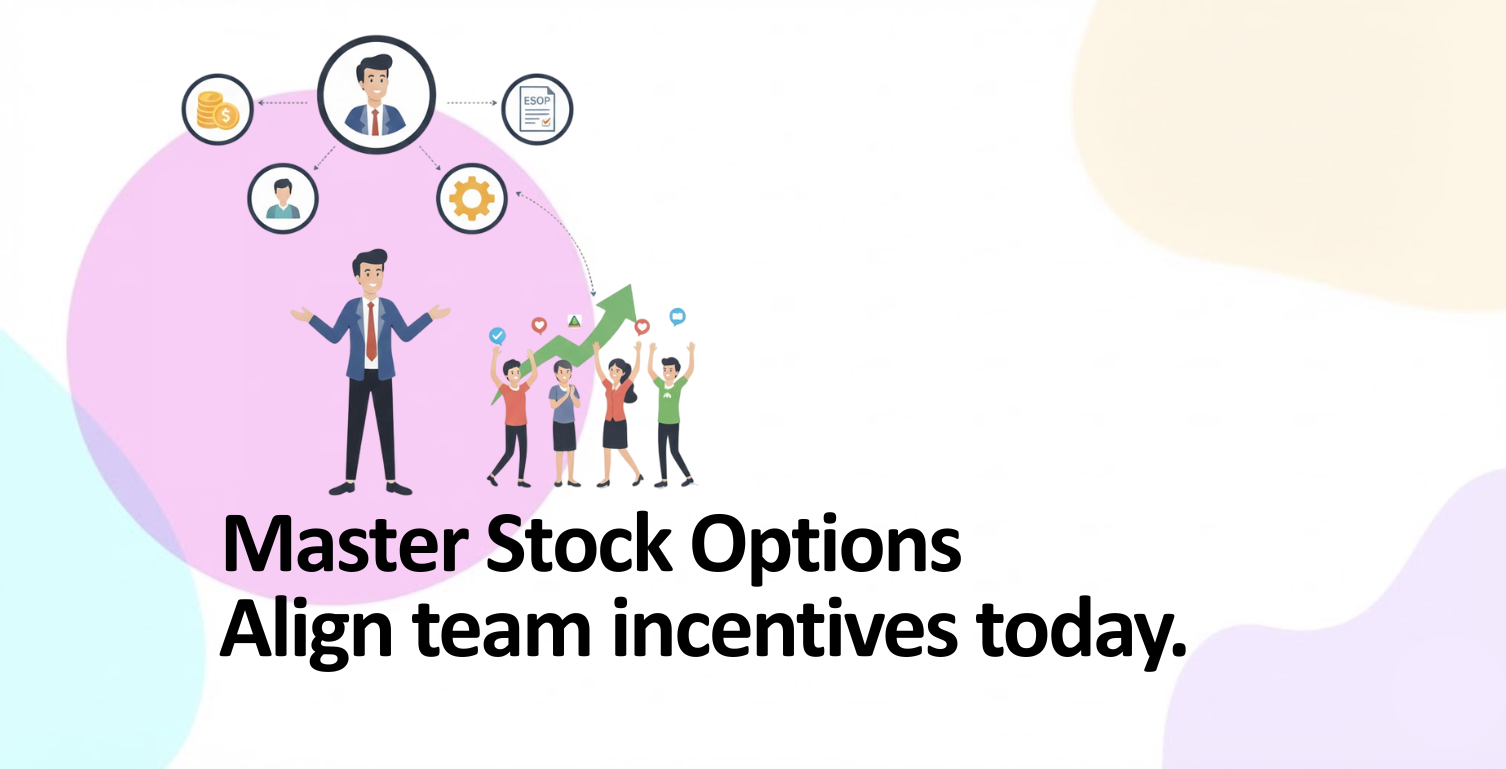
Master startup ESOPs 2025 India: what stock options are, how they work, 4-year vesting with 1-year cliff (standard), taxation (no tax at grant, perquisite income at exercise, 10-12.5% LTCG at sale), pool sizing (10-15%), tax deferral (48 months for eligible startups), motivation mechanisms, and negotiation strategy.
Table of Contents
What Are Stock Options? (ESOP Fundamentals)
Stock options give employees the right (not obligation) to buy company shares at a predetermined price, called the “strike price” or “exercise price.” They’re a promise of future ownership, not immediate ownership.
The Building Blocks (What You Need to Know)
- Strike/Exercise Price: The price at which you can buy shares. Usually set at Fair Market Value (FMV) on grant date. E.g., ₹100/share
- Number of Options: How many shares you have the right to buy. E.g., 10,000 options
- Vesting Schedule: When your options become exercisable. Standard: 4 years with 1-year cliff (0% after 1 year, then 25% cliff, then 1/36 per month)
- Grant Date: When you’re granted the options. No tax yet
- Exercise Date: When you actually buy shares (optional). Tax triggered here
- Exit/Liquidity Event: When company is acquired or IPO. Your options become valuable
Example: What 10,000 Options Actually Means
- You receive: 10,000 stock options at ₹50 strike price
- Vesting (4-year): Nothing for 12 months, then 2,500 options (25%) on 1-year anniversary, then ~275/month for 36 months
- At year 4: You fully own 10,000 options (all vested)
- If you exercise all: You pay ₹50 × 10,000 = ₹5L to buy 10,000 shares
- If company IPOs at ₹200/share: Your 10,000 shares worth ₹20L (profit of ₹15L after exercise cost)
Key Difference: Options vs Shares
- Stock Options: Right to buy shares at preset price (later). No voting rights yet. No dividends yet
- Restricted Stock / RSUs: Actual shares, but locked (restricted) for period. Voting + dividend rights even while locked
- Why options common in startups: Cheaper accounting, no immediate tax on employees, easier to grant large pools
How ESOPs Work: From Grant to Cash
ESOP journey has 5 stages. Let’s walk through each.
Stage 1: Grant (Day 0 – No Tax Yet)
- Company grants you: “You have the right to buy 10,000 shares at ₹50/share”
- What happens: You sign grant letter. Options added to your account. Nothing else
- Tax: None yet. No money changed hands. Just a promise
- Your wealth change: Zero. They’re not exercisable yet
Stage 2: Vesting (Year 1-4 – Still No Tax)
- Year 1: 0 vested (cliff period). Options locked
- Year 1 anniversary: 2,500 options (25%) suddenly vest. Now you CAN exercise these
- Years 2-4: Monthly vesting of remaining 7,500 options (~275/month)
- Tax: Still none. You haven’t exercised yet
- Your wealth change: Still zero until you exercise
Stage 3: Exercise (You Buy Shares – TAX TRIGGERED)
- You decide: “I want to buy my vested shares now”
- You pay: ₹50 strike price × number of vested options
- You receive: Actual shares in your name
- Tax triggered: YES. Perquisite value = (FMV on exercise date – strike price) × number of options
- Example: FMV on exercise day = ₹150. Strike = ₹50. Perquisite = ₹100 × 10,000 = ₹10L. Taxed as salary income
Stage 4: Hold (After Exercise – Potential Further Gains)
- You now own: 10,000 shares bought at ₹50 (cost = ₹5L)
- Company grows: Share price goes to ₹200
- Your shares now worth: ₹20L (paper gain of ₹15L)
- Tax: None yet. Unrealized gain
Stage 5: Exit/Sale (Company Acquired or IPO – CAPITAL GAINS TAX)
- Company gets acquired: Buyer offers ₹200/share
- You sell 10,000 shares: Get ₹20L total
- Tax calculation: Sale price (₹200) – FMV at exercise (₹150) = ₹50 gain per share × 10,000 = ₹5L capital gain
- Capital gains tax: If held >24 months = LTCG at 10% = ₹50K tax. If <24 months = STCG at 15% = ₹75K tax
- You net: ₹20L – ₹50K tax = ₹19.5L (before other costs)
Vesting Schedule: 4-Year / 1-Year Cliff (Standard)
Vesting is the most misunderstood ESOP concept. Let’s clarify.
What Vesting Actually Means
- Vesting = earning the right to exercise. Until vested, you can’t buy shares even if you wanted to
- NOT the same as exercising. Vested doesn’t mean you own shares. It means you CAN buy them
- Non-vested options are forfeited when you leave. Leave after 18 months? You forfeit 75% of your options
- Vested options are yours to keep. Leave after 18 months? You keep your 25% vested options (but usually have limited time to exercise)
Standard 4-Year Vesting with 1-Year Cliff (Detailed Example)
| Time Period | Total Vested | Monthly Vesting | If You Leave Now | Note |
|---|---|---|---|---|
| Month 0-11 | 0% | 0% per month | Lose all options | Cliff period. No vesting until 12 months |
| Month 12 (1-year mark) | 25% | 25% cliff vesting | Keep 25%, lose 75% | Cliff vesting all at once. Retention mechanism |
| Month 13-24 (Year 2) | 25-50% | 2.08% per month | Keep ~42%, lose ~58% | Monthly vesting after cliff |
| Month 25-36 (Year 3) | 50-75% | 2.08% per month | Keep ~67%, lose ~33% | Continued monthly vesting |
| Month 37-48 (Year 4) | 75-100% | 2.08% per month | Keep 100% | Final year of vesting |
| Month 48+ | 100% | 0% (fully vested) | Keep 100%, yours to keep forever | All options vested. No retention device |
Why This Schedule Works
- 1-year cliff: Deters people from taking job just for vesting. Commits you for minimum 1 year
- 4-year total: Retention through full journey. Early employees especially valuable, vesting incentivizes staying
- Monthly after cliff: No cliff on cliff = continuous vesting, not all-or-nothing drama after year 1
- Standard globally: 95% of startups use 4-year/1-year. Employees expect it. VCs require it
Acceleration Clauses (When Vesting Speeds Up)
- Double-trigger acceleration: If company acquired AND you’re laid off, 50% of unvested vests immediately. Protects you from acquisition layoffs
- Single-trigger acceleration: If company acquired (regardless of job status), 100% unvested vests. Rare. VCs usually don’t allow (they want retention post-acquisition)
- Equity refresh grants: When promoted or on anniversary, get new grant with fresh 4-year vesting. Keeps retention mechanism alive
ESOP Taxation in India (Complete Framework)
ESOP taxation is the most complex part. Three tax events. Let’s break each down.
Tax Event 1: Grant (No Tax)
- When: Day you receive grant letter
- Tax: None. Zero. Nothing owed
- Why: You haven’t received anything tangible. Just a promise to buy later
Tax Event 2: Exercise (Perquisite Income Tax)
| Component | Definition | Example |
|---|---|---|
| Fair Market Value (FMV) | Share price on the day you exercise. Determined by third-party valuation | Company valued at ₹100Cr, 10L shares, FMV = ₹1000/share |
| Strike Price | Price you agreed to pay. Usually same as FMV at grant | Strike = ₹500/share (FMV at grant date) |
| Perquisite Value | (FMV on exercise – Strike Price) × Number of options | ₹1000 – ₹500 = ₹500 per share × 1000 options = ₹5L |
| Tax Rate | Taxed as salary income. Your slab rate (10-30%+) | If in 30% slab: ₹5L × 30% = ₹1.5L tax owed |
Key Rule: FMV at Exercise Must Be Higher Than Strike for Tax
- If FMV on exercise day = ₹500 (same as strike): Perquisite value = 0. No tax
- If FMV on exercise day = ₹300 (lower than strike): Company underwater. Perquisite value = 0 (can’t be negative)
- If FMV on exercise day = ₹1000 (higher than strike): Perquisite value = ₹500. Tax owed
Tax Event 3: Sale (Capital Gains Tax)
Calculation: Sale Price – FMV at Exercise = Capital Gain (or Loss)
- Example: You exercise at ₹1000 FMV, buy 1000 shares (pay ₹5L). Later IPO at ₹2000, you sell. Sale price ₹20L – FMV at exercise (₹10L) = ₹10L capital gain
LTCG vs STCG (Holding Period Matters)
| Holding Period | Capital Gains Type | Tax Rate | Example (₹10L Gain) |
|---|---|---|---|
| Hold <24 months from exercise date | Short-Term Capital Gains (STCG) | 15% (unlisted), 20% (listed) | ₹10L × 15% = ₹1.5L tax |
| Hold >24 months from exercise date | Long-Term Capital Gains (LTCG) | 10% (unlisted), 12.5% (listed)* | ₹10L × 10% = ₹1L tax |
| Listed shares, >24 months, <₹1.25L gain | LTCG Exemption | 0% | ₹80K gain = ₹0 tax |
Tax Deferral for Eligible Startups (Game Changer)
Rule: For employees of eligible startups under Startup Act 2019, you can defer paying exercise tax for up to 48 months OR until you sell shares (whichever is earlier).
- Example: You exercise in 2025 with ₹5L perquisite value. Normally tax due immediately. But if eligible startup, you defer until 2029 or when you sell (whichever comes first)
- Huge benefit: You don’t need cash to pay tax right away. Wait for IPO/exit, then pay from proceeds
- Eligibility: Company must be recognized DPIIT startup with ₹25Cr valuation or under 10 years old (check criteria with CA)
Complete Tax Timeline Example
- Jan 2025 (Grant): Granted 1000 options at ₹500 strike. Tax = ₹0
- Jan 2026 (Exercise): FMV now ₹1000. Perquisite = (₹1000-₹500) × 1000 = ₹5L. Tax due = ₹5L × 30% slab = ₹1.5L (or deferred if eligible startup)
- Jan 2028 (IPO): Company IPOs at ₹3000. You sell 1000 shares. Sale price ₹30L. Capital gain = ₹30L – ₹10L (FMV at exercise) = ₹20L
- Capital gains tax: Held 2 years since exercise (Jan 2026 to Jan 2028). LTCG 10% (unlisted) or 12.5% (now listed) = ₹2-2.5L
- Total tax paid: ₹1.5L (exercise perquisite) + ₹2L (LTCG) = ₹3.5L
- Net proceeds: ₹30L sale price – ₹3.5L tax – ₹5L (cost to exercise) = ₹21.5L profit
Motivation & Retention: Why ESOPs Work
ESOPs aren’t just compensation. They’re a retention and motivation device. Here’s why they work.
The Psychological Impact (Research 2025)
- Ownership mentality: Employees with options think like owners. “This is my company” mindset increases productivity 20-30%
- Retention mechanism: Vesting schedule (especially 4-year cliff) keeps people attached. Early departure = lose most of equity
- Motivation for exit: Everyone motivated for company to succeed. Faster path to IPO/acquisition = everyone wins
- Alignment with founders: CEO and employees on same side. All want company to grow in value
- Financial literacy: Employees become financially invested. Learn cap table, valuation, market dynamics
The Economic Reality (When Options Become Real Money)
- Seed stage options: Usually worth ₹0 today (company pre-revenue or low valuation). Potential future value only
- Series A options: Starting to have value. If company valued ₹50-100Cr and you own 0.1%, that’s ₹50-100L potential
- Series C+ options: Likely worth significant money (if company succeeds). ₹5-50L+ depending on stage + size + role
- Exit scenarios: Acquisition or IPO = options convert to cash. This is when options become life-changing
ESOP Motivation Strategy: 78% of Indian Startups Now Offer Equity
- Not offering ESOP is now red flag: 78% of Indian startups offer ESOPs (up from 59% in 2021)
- Top talent expects ESOP: When choosing between ₹30L salary (no equity) vs ₹25L + 0.5% equity, many pick equity
- ESOP pool as VC signal: VCs look for startups with ESOP plans before investing. Proof of thoughtful equity management
- Productivity gains: Startups with ESOP see 20-30% higher productivity than salary-only companies (similar roles)
Refresh Grants (Keeping Motivation Alive Post-Vesting)
- Problem: After 4 years, all options vested. Retention device goes away. Risk of departure increases
- Solution: Equity refresh grants. Every promotion or year-4 anniversary, get new equity grant (another 4-year vesting)
- Example: Year 4 promotion = granted 0.3% additional equity. New 4-year vesting clock starts. Retention re-engaged
- Cost: Dilutes cap table, but worth it for retention of key people
Equity Negotiation: How Much to Ask For
Equity is negotiable. Most people don’t ask. Here’s how to play it.
Benchmarks by Role & Stage (2025 India)
| Role | Seed Stage | Series A | Series B | Series C+ |
|---|---|---|---|---|
| Software Engineer (Mid) | 0.3-0.8% | 0.15-0.4% | 0.05-0.2% | 0.01-0.1% |
| Product Manager | 0.5-1.5% | 0.25-0.6% | 0.1-0.3% | 0.02-0.15% |
| Sales Executive | 0.2-0.5% | 0.1-0.3% | 0.05-0.15% | 0.01-0.08% |
| Operations / Finance | 0.1-0.3% | 0.05-0.2% | 0.02-0.1% | 0.01-0.05% |
| Head of Department (Director level) | 1-3% | 0.5-1.5% | 0.2-0.6% | 0.05-0.25% |
How to Negotiate Equity (Conversation Framework)
Before Negotiating: Know Your Numbers
- Company valuation: Try to find from cap table or rumors. If ₹100Cr, 0.1% = ₹10L potential
- Salary market rate: Use Levels.fyi, 6figr.com, LinkedIn Salary. Know what you should be paid
- Total comp expectations: Decide equity/salary mix. If they won’t go higher on salary, push equity
The Negotiation (Email or Call)
- Option 1 (Equity focused): “Offer is ₹30L + 0.3% equity. I was hoping for 0.5-0.75%. My background is X (relevant experience/impact). Can we move to 0.6%?”
- Option 2 (Salary/equity trade): “If salary stays ₹30L, can we do 0.6% instead of 0.3%? I’m taking upside risk”
- Option 3 (Refresh plan): “Starting at 0.3%, but can we agree on refresh grant when I hit milestone X (e.g., 18 months shipping product/hitting revenue target)?”
Company Responses (What to Expect)
- “Our ESOP pool is limited”: Possible. Ask to increase pool if needed. Or take ₹50K more salary instead
- “All engineers at your level get 0.3%”: Possible, but companies adjust for exceptional talent. “I’m open to proving value and refresh grant after 18 months”
- “Equity will dilute when we fundraise”: True, but you knew this. Still get 0.5% pre-dilution = ~0.35% post-Series A. Still valuable
What NOT to Do (Rookie Mistakes)
- Accept equity instead of market-rate salary: “I’ll take 0.5% extra equity instead of ₹5L more salary.” Bad deal. Cash is king. Take market salary + equity
- Negotiate for more equity but no salary detail: Always know market rate for your role first. Use that as anchor
- Forget to clarify 4-year vesting: Always confirm vesting schedule in offer letter. Default to 4-year/1-year cliff
- Not get it in writing: All equity offers MUST be in writing (offer letter). Verbal promises are worthless
ESOP Implementation: Pool Sizing & Allocation
If you’re a founder building ESOP plan, here’s how to structure it.
Step 1: Define ESOP Pool Size (10-15% Standard)
- Seed stage: 10% of total shares allocated to ESOP pool. Conserve equity for founders + future funding rounds
- Series A: Increase to 12-15% (after dilution). VCs expect robust ESOP to attract talent
- Series B+: Maintain 10-12% refreshed pool. Top up during fundraising if diluted below target
- Why these %: Enough to attract talent, not so much that founders lose control. VC typically takes 20-30% per round
Step 2: Design Vesting Schedule
- Standard (non-negotiable): 4-year vesting with 1-year cliff
- Cliff rationale: Day 1-365 = 0%. Day 366 = 25% cliff. Then 1/36 per month for 36 months
- Why cliff: Retention gate. You must stay at least 1 year to get any equity
Step 3: Allocation Framework (Who Gets How Much)
| Role / Stage | Allocation % | Rationale |
|---|---|---|
| First 5 employees (Series A) | 3-5% combined (0.5-1.5% each) | Highest value. Core team building. Deserve more |
| Employees 6-15 | 2-3% combined (0.15-0.3% each) | Early team but post core. Less leverage in negotiation |
| Employees 16-30 | 1-2% combined (0.05-0.15% each) | Growth stage. Smaller individual grants |
| Employees 31+ | Remaining pool (0.01-0.05% each) | Later-stage hires. Equity less concentrated |
Step 4: Legal Setup (What to File)
- Board Resolution: Board approves ESOP scheme terms
- Shareholder Special Resolution: Shareholders approve (required under Companies Act)
- ESOP Scheme Document: Legal framework outlining eligibility, vesting, exercise, pricing
- Valuation Report: SEBI-registered merchant banker values shares (for unlisted companies)
- Grant Letters: Individual offer to each employee with their allocation
Step 5: Tax & Cap Table Management
- Track FMV: For taxation purposes, FMV must be documented at grant and exercise. Use valuation reports
- Cap table software: Use Carta, Ledgy, or similar to track shares, options, dilution, vesting
- Annual audit: Make sure cap table matches legal documents. Common source of disputes
Key Takeaways: ESOP Mastery
1. ESOPs = right to buy shares at preset price later, not immediate ownership. Strike price fixed at grant, options vest over 4 years. Standard practice globally.
2. 4-year vesting with 1-year cliff is industry standard (non-negotiable). 0% vesting for first 12 months, then 25% cliff, then 1/36 monthly for 36 months. VCs require this.
3. Taxation happens at 2 points: NO tax at grant. Perquisite income tax at exercise. Capital gains tax at sale. Three-stage tax event.
4. Exercise taxation: Perquisite value = (FMV on exercise – Strike Price) × # options. Taxed as salary income at your slab rate (10-30%+). Can be ₹100K+ for early employees.
5. Sale taxation: Capital gain = Sale Price – FMV at exercise. LTCG 10% if held >24 months, STCG 15% if <24 months (unlisted). Timing matters.
6. Tax deferral for eligible startups: Can defer exercise tax up to 48 months or until sale (whichever earlier). Game changer. Check DPIIT startup eligibility.
7. Equity benchmarks: First hire 0.5-1.5% (Series A), later employees 0.1-0.5%, director-level 0.5-1.5%. Varies by stage + company size.
8. Early stage options often worth ₹0 today (pre-revenue). Series C options often worth ₹5-50L+ if company succeeds. Value creation happens on exit (acquisition/IPO).
9. ESOPs increase retention 30-40% vs salary-only. Employees with equity 10x more likely to stay long-term. Motivation + retention mechanism.
10. Ownership mentality: 20-30% productivity increase when employees have equity. Psychological shift to “this is MY company”. Cultural impact matters.
11. 78% of Indian startups now offer ESOPs (up from 59% in 2021). Not offering ESOP is red flag to talent + VCs. Standard practice now.
12. Pool sizing: 10% seed, 12-15% Series A, 10-12% Series B+ (refreshed). Top up during fundraising to restore %. Dilution is real.
13. When negotiating equity: know company valuation + market salary first. Use as anchor. “If salary ₹30L not moving, can we do 0.6% instead of 0.3%?”
14. NEVER take equity instead of market-rate salary. Get market salary + equity. Trade-off should be small perks or start date, not base compensation.
15. Action: If employee, negotiate 0.3% → 0.5-0.75% at hire (role dependent). If founder, establish 10-15% pool + 4/1 vesting schedule BEFORE hiring. Plan ahead.