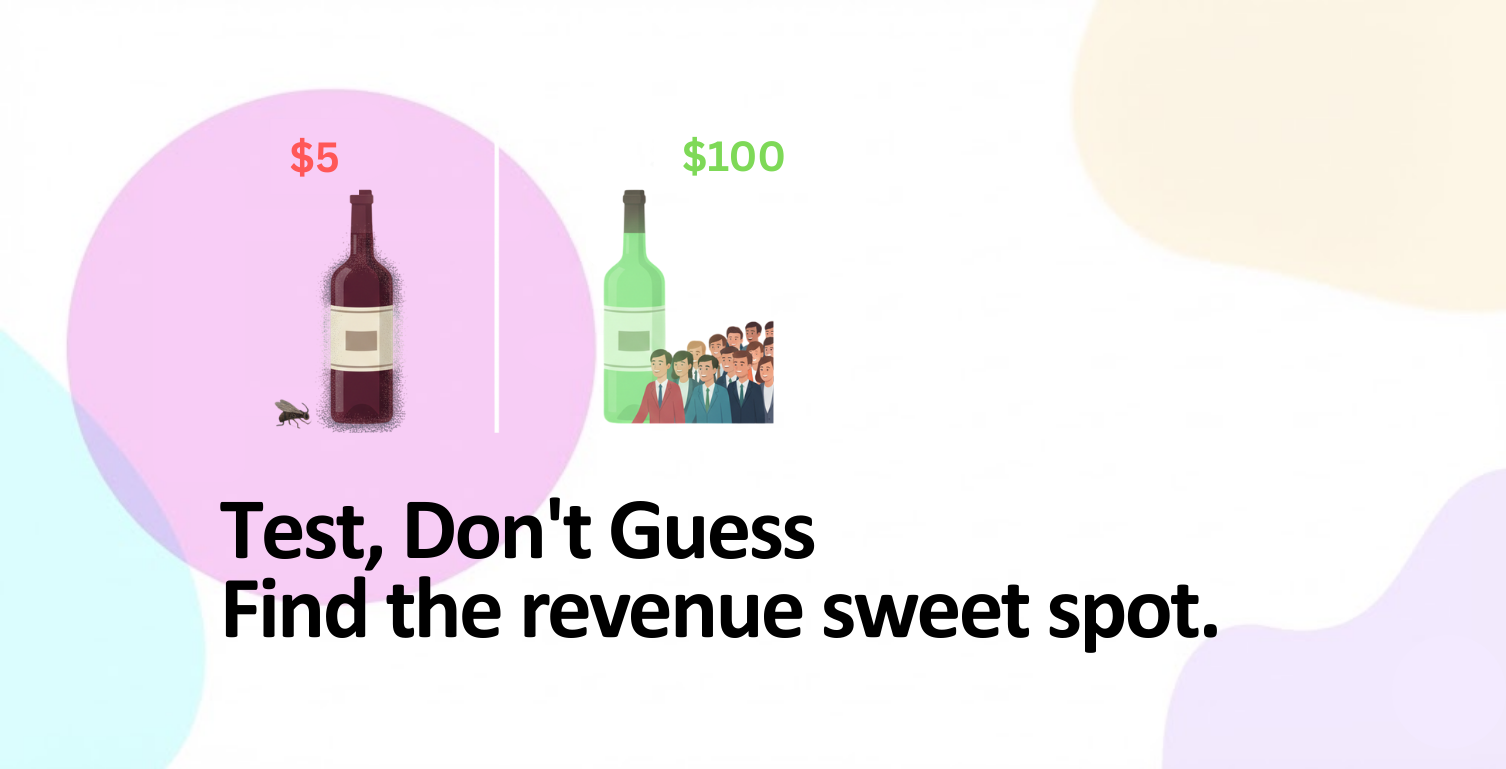
Pricing reality (2025): 78% of SaaS use value-based pricing, well-optimized pricing increases conversions 20-30%, companies testing pricing regularly see 30% higher growth, imposter pricing (underpricing) reduces LTV/CAC 50%+, wrong pricing experiments test only conversion (not customer quality), high prices kill volume while low prices kill margin. Elite companies: 90-day pricing sprints, continuous optimization, segment-specific pricing. Wrong pricing leaves $500K+ on the table annually for early-stage SaaS.
Table of Contents
- Pricing Paralysis: Why Founders Can’t Decide
- Imposter Pricing: The Hidden Revenue Killer
- Wrong Pricing Experiments: Testing the Wrong Things
- The Low-Price Trap: Attracting Wrong Customers
- The High-Price Trap: Killing Volume Without Benefit
- Value-Based Pricing: The 2025 Standard (78% Use It)
- Pricing Psychology: Real Experiment Results
- Right Pricing Experiments: How Elite Companies Do It
- Pricing Optimization Checklist
Pricing Paralysis: Why Founders Can’t Decide
Pricing paralysis is real: You have a product. It works. Early users love it. But you’re frozen on pricing. Should it be $29/month? $99/month? Freemium? Usage-based? The uncertainty paralyzes you
While you’re deciding, competitors launch at $49/month and capture market share. By the time you launch, the market has already decided your positioning
Why Founders Freeze on Pricing
- Fear of leaving money on the table: What if $99 is too low and you could get $199?
- Fear of losing customers: What if $99 is too high and everyone goes to competitors?
- No data: You have no evidence of what customers will actually pay
- No framework: You don’t know how to decide. Cost-plus? Value? Competition? All of the above?
- Too many options: Tiered pricing, freemium, usage-based, hybrid. Which one?
- Emotional attachment: You’re emotionally attached to the product. Charging money feels wrong
The result: You stay in limbo. Not launching. Not pricing. Waiting for clarity that never comes
Imposter Pricing: The Hidden Revenue Killer
Real scenario from 2025: Founder builds SaaS that saves customers 20 hours/week and thousands in operational costs. Early customers love it. When you check the pricing page: “Pro plan is $49/month.”
You’re leaving ~$500K+ on the table annually. This is called “imposter pricing” – underpricing out of fear, guilt, or low self-worth
How Imposter Pricing Destroys Your Business
| Problem | What Happens | Long-Term Cost |
|---|---|---|
| You attract high-churn customers | Cheap prices attract bargain hunters, not people with real pain. They churn at first friction | $100 customer LTV (should be $5,000+) |
| You attract demanding support users | Cheap customers demand 10x more support. You spend 80% of time on 20% of revenue | Support cost exceeds revenue. Unsustainable |
| You have zero margin for growth | Can’t hire engineers, marketers, or sales. Stuck grinding. No scale possible | Company stays small forever or shuts down |
| Your LTV/CAC ratio breaks | If customer LTV is $100 and CAC is $80, you can’t spend on marketing. Growth stops | Growth ceiling at $500K annual revenue (or lower) |
| Customers perceive low value | Price signals quality. $29/month = “this is cheap” = “this is low quality” | Brand damaged before you can fix it |
Real founder quote (r/SaaS, 2025): “I was terrified to raise prices by 25%. My worry: I’d lose customers. Result: I lost only 3% of users. Revenue jumped 22% (higher priced tier + same volume on lower tiers). My fear cost me 22% of revenue for 6 months while I dithered.”
Wrong Pricing Experiments: Testing the Wrong Things
Most founders run wrong pricing experiments because they track the wrong metric
The Problem with Bad Pricing Experiments
Bad experiment: Test price point $49 vs $99. Measure which converts more. $49 converts 25%, $99 converts 15%. Conclusion: “Keep $49 because higher conversion.”
Wrong conclusion: $99 generates $1,485 per 10 new signups. $49 generates $1,225 per 10 new signups. $99 wins on revenue, even with lower conversion
Even worse mistake: Not measuring customer quality. What if $49 customers churn in 2 months while $99 customers stay 12 months?
- $49 customer LTV = $49 × 2 months = $98
- $99 customer LTV = $99 × 12 months = $1,188
$99 wins 12x on actual LTV, despite lower conversion. But you measured only short-term conversion and missed the real signal
Metrics to Track in Pricing Experiments
Wrong metrics (surface level): Conversion rate, signups, initial booking rate
Right metrics (business level):
• Revenue per visitor (conversion % × price)
• Trial-to-paid conversion rate (not just signup rate)
• Customer LTV by price point (LTV = ARPU × lifetime in months)
• Churn rate by price tier (do $99 customers churn less?)
• Support cost per customer (do cheap customers require more support?)
• Expansion revenue potential (do higher-priced customers upgrade more?)
• Customer quality signals (usage, NPS, willingness to refer)
The Low-Price Trap: Attracting Wrong Customers
Pricing too low doesn’t just leave money on the table. It actively destroys your business
What Happens When You Underprice by 50%+
| Scenario | Right Price ($99/mo) | Underpriced ($49/mo) | Difference |
|---|---|---|---|
| Monthly Revenue (100 customers) | $9,900 | $4,900 | -50% revenue |
| Customer Type Attracted | Committed buyers with real pain | Bargain hunters, price-sensitive | Wrong customer segment |
| Support Tickets per Customer | 2 tickets/month | 8 tickets/month | 4x more support burden |
| M1 Retention | 75% | 40% | Half your customers churn |
| Customer LTV (12 months) | $891 (75% × 12 × $99) | $235 (40% × 6 × $49) | -74% LTV per customer |
| Total 12-Month Revenue (100 customers) | $89,100 | $23,500 | -74% total revenue |
The math is brutal: Underpricing by 50% on price costs you 74% in total revenue (because of churn + support costs). You’re harming both acquisition and retention
The High-Price Trap: Killing Volume Without Benefit
The opposite problem: pricing too high without justification also fails
Wrong approach: Price at $299/month because “enterprise customers will pay.” But your product doesn’t deliver $3,000+/month in value. Conversion rate collapses. Nobody buys
How to Know if You’re Too High
- Conversion rate below 5%: Most prospects say “no” before even trying
- Sales cycle >6 months: Expensive sales process for smaller deals
- Lots of price negotiation: Prospects ask “what’s your best price?” constantly
- LTV/CAC is barely positive: You’re barely breaking even on customers
- Tier distribution is skewed: Almost everyone chooses your lowest tier (they’re price-shopping)
The solution: Not “price is too high” necessarily, but “pricing doesn’t match value delivered.”
Value-Based Pricing: The 2025 Standard (78% Use It)
78% of SaaS companies now use value-based pricing (up from 62% in 2023). This is the direction the market moved
Value-based pricing means: charge based on the value you deliver, not your costs, not competitor prices
How to Implement Value-Based Pricing
Step 1: Quantify the Value
Ask customers: “How much time does this save you?” “How much money does this save you?” “What’s the outcome value?” Get specific numbers, not feelings
Example: “This saves me 15 hours/week” = 15 × $50/hr (their hourly rate) = $750/week value = $3,000/month value
Step 2: Capture 10-20% of That Value
If you deliver $3,000/month value, price at $300-600/month. This is customer-friendly (they still get 80% upside) and you get paid
Step 3: Align Tiers to Value Delivered
Starter tier delivers $500 value, price at $50. Pro tier delivers $3,000 value, price at $300. Enterprise delivers $20,000 value, price at $2,000
Step 4: Create Pricing Leverage
Larger customers (getting more value) should pay more. Build tiers that scale with customer size/usage
Value-Based Pricing Results (2025 Data)
| Company Type | Using Value-Based | Typical Results |
|---|---|---|
| Cost-Plus Pricing | No | Leave 60%+ of revenue on table. Customers undervalue product |
| Value-Based Pricing | Yes (78%) | 32% higher net revenue retention, 41% lower CAC, 28% higher expansion revenue |
| With WTP analysis | Yes (elite tier) | 23% higher ARPU without conversion impact. Same volume, higher price |
Pricing Psychology: Real Experiment Results
Psychological pricing is real and measurable
2025 Experiment Results
| Experiment | Control (A) | Variant (B) | Winner & Uplift |
|---|---|---|---|
| Price Ending Effect | $100/month | $99/month | $99 wins: +5-7% conversion |
| Anchor Effect | Show Pro ($99) first | Show Enterprise ($499) first | Enterprise anchor wins: +8-12% average tier conversion |
| Decoy Effect | Two tiers: Basic ($49), Pro ($99) | Three tiers: Basic ($49), Mid ($79), Pro ($99) | Three tiers win: +15-20% Pro conversions (people avoid extreme choices) |
| Annual Discount | $99/month only | $99/mo OR $950/year (20% discount) | With annual option: +18-24% LTV (40% choose annual) |
| Free Trial Length | 7-day trial | 14-day trial (all features) | 14-day wins: 3% → 18% trial-to-paid conversion |
| Hyperpersonalized Pricing | Standard pricing for all | AI-adjusted price based on behavior | AI pricing wins: +22% conversion vs static |
Right Pricing Experiments: How Elite Companies Do It
Elite SaaS companies (OpenView top performers, ProfitWell 2025 data) follow a specific framework for pricing experiments
The Right Experiment Framework
Phase 1: Hypothesis (Before Testing)
Write: “If we [change X], then [customer segment Y] will [behavior Z] because [belief].”
Example: “If we increase Pro tier from $99 to $149, then mid-market customers will still convert at >90% of baseline because the value is worth it, but churned customers will restart subscriptions at higher price tier.”
Phase 2: 10% Gradual Rollout
Don’t run 50/50 split. Run 10% on variant, 90% on control. Monitor for 2 days. If no issues, scale to 50/50
Phase 3: Measure Everything
• Conversion rate (short-term)
• Revenue per visitor (immediate)
• Trial-to-paid conversion (quality signal)
• Customer LTV by cohort (long-term)
• Churn rate (do expensive customers stay longer?)
• Support cost per customer (quality vs cost trade-off)
Phase 4: 90-Day Decision Window
Don’t decide after 2 weeks. Wait 90 days. See how cohorts behave over time. Price impact on churn often takes months to show
Real Case: Early-Adopter Pricing to Value-Based
Scenario (common in SaaS communities): Early adopters pay $19/month “forever” discount. But now you have 10,000 customers. Early adopter pricing is leaving money on the table
Wrong experiment: Increase early adopters to $99 (same as new customers). Result: 40% churn. Revenue drops because loyalty value of discount was high
Right experiment: Increase to $49 (meeting in middle). Offer to raise to $99 (full price) if they upgrade to new tier with more features. Result: 15% churn, 35% upgrade. Revenue per customer increases from $19 to $45 (137% increase)
The lesson: Run experiments to find the right price, not just “higher = better”
Pricing Optimization Checklist
Pricing Strategy Phase (Week 1)
☐ Quantify value: Ask 10 customers “how much time/money does this save you?” Get specific numbers
☐ Document current pricing rationale: Cost-plus? Value? Competition? Document your thinking
☐ Calculate LTV/CAC: Know your current unit economics (LTV ÷ CAC ratio)
☐ Segment customers: Who uses it? How much value does each segment get?
☐ Research competitors: What are they pricing? Not to copy, but to understand positioning
☐ Define success metrics: What are you optimizing for? Revenue? Conversion? LTV? Expansion?
Pricing Model Design (Weeks 2-3)
☐ Design tiers: How many? What’s in each? (typically 3-4 tiers work best)
☐ Set anchor prices: Use value-based pricing. Capture 10-20% of value delivered
☐ Price each tier: Starter, Pro, Enterprise with clear value jumps
☐ Add annual discount: Offer 20% off annual billing (increases LTV 15-25%)
☐ Create packaging: What features in each tier? (features align with value)
☐ Document positioning: Why this price? What value justifies it?
Experiment Design (Weeks 4-5)
☐ Write hypothesis: If [change X], then [segment Y] will [behavior Z] because [reason]
☐ Choose primary metric: Revenue per visitor OR LTV OR conversion rate?
☐ Set minimum effect size: Need 10-15% improvement to be statistically significant
☐ Plan rollout: 10% variant, 90% control first, then 50/50 if safe
☐ Set duration: Run for at least 4 weeks (or until 500+ trials in each cohort)
☐ Define customer quality metrics: Support cost? Feature adoption? Churn?
Experiment Execution (Weeks 6-10)
☐ Launch 10% variant cohort (monitor for 2 days)
☐ Scale to 50/50 if no technical issues
☐ Track daily: Conversion, revenue, quality signals
☐ Check weekly: Any unexpected patterns? Do we need to stop early?
☐ Run full 4 weeks minimum (even if variant underperforms)
Decision & Scale Phase (Week 11+)
☐ Calculate final metrics: Revenue per visitor, LTV, conversion, churn
☐ Compare to hypothesis: Did the experiment validate your belief?
☐ If variant wins: Gradually scale to 100% (monitor for issues)
☐ If control wins: Document why and iterate on different hypothesis
☐ Plan next experiment: Pricing is continuous optimization (90-day sprints)
Monitoring & Optimization (Ongoing)
☐ Track monthly: Conversion by tier, LTV by cohort, churn by price point
☐ Run 4-6 pricing experiments per year (90-day sprints)
☐ Test psychology: Annual vs monthly, price endings, anchoring, decoy effect
☐ Expand revenue: Upsells, expansion features, add-ons, modules
☐ Review quarterly: Is pricing aligned with market, value, and unit economics?
Key Takeaways: Pricing Paralysis & Wrong Experiments
1. 78% of SaaS now use value-based pricing (up from 62% in 2023): This is the market standard. You should too. Stop using cost-plus or competitor-based pricing
2. Well-optimized pricing increases conversions 20-30%: A single pricing experiment can generate 6-figure revenue impact. This is high-leverage work. Companies testing regularly see 30% higher growth
3. Imposter pricing (underpricing by 50%) destroys 74% of total revenue: You attract bargain hunters, they churn fast, support costs explode. Underpricing is worse than overpricing
4. “Validation ≠ Value”: Many founders set low prices to “get validation.” Result: wrong customer segment, high churn, broken unit economics. Price affects customer quality
5. Value-based pricing generates: 32% higher net revenue retention, 41% lower CAC, 28% higher expansion revenue. This is measurable, proven uplift
6. Wrong experiments test only conversion: You measure $49 vs $99 on conversion rate alone. But $99 wins on revenue because lower churn. Measure LTV, not just signups
7. Low-price trap: Attract wrong customers, 4x support burden, 75% churn vs 40%, net 74% revenue loss vs right pricing. Price signals value
8. Elite companies run 90-day pricing sprints: Continuous optimization, not one-time decision. Test 4-6 experiments per year. Price is ongoing, not static
9. Free trial length matters: 7-day = 3% conversion, 14-day with all features = 18% conversion (500% improvement). Trial length is a pricing variable
10. Price psychology works: $99 converts 5-7% better than $100. Annual discounts increase LTV 15-25%. Anchor effect shifts buying behavior. Implement psychological principles
11. Multi-dimensional pricing is now standard: 86% of $100M+ SaaS use 3+ dimensions (seats + usage + features). Single-dimension is dead. Design complex pricing
12. Hyperpersonalized AI pricing increases conversions 22%: Adjust price based on customer behavior and willingness-to-pay data. This is cutting-edge
13. Value-based pricing formula: Quantify value (how much do you save customer?), capture 10-20%, build tiers around that. Not guessing, math-based
14. Real founder result: Increase price by 25%, lose only 3% of customers, revenue jumps 22%. Fears are usually overblown. Test
15. Annual billing with 20% discount wins: 40% choose annual, increases LTV 15-25%, improves cash flow. Always offer annual option
16. Decoy effect works: Show 3 tiers instead of 2, middle tier gets +15-20% conversions (people avoid extremes). Use pricing psychology
17. WTP (Willingness-to-Pay) analysis: Companies using it achieve 23% higher ARPU with same conversion rate. Do the analysis
18. Pricing affects customer LTV: $99 customers stay 12 months, $49 customers stay 2 months. LTV gap is 12x despite lower conversion on expensive tier. Quality > volume
19. Early-adopter grandfathering is expensive: Don’t lock legacy customers at old prices forever. Raise in tiers ($19→$49→$99) as they upgrade features. Manage the transition
20. Action plan: (1) Quantify value (2) Set value-based prices (capture 10-20% of value) (3) Design 3-4 tier structure (4) Run 10% gradual rollout (5) Measure LTV not just conversion (6) Run 4-6 experiments yearly (90-day sprints) (7) Implement psychology (annual discounts, decoy, anchor) (8) Monitor metrics monthly (9) Iterate continuously. Pricing is ongoing optimization