
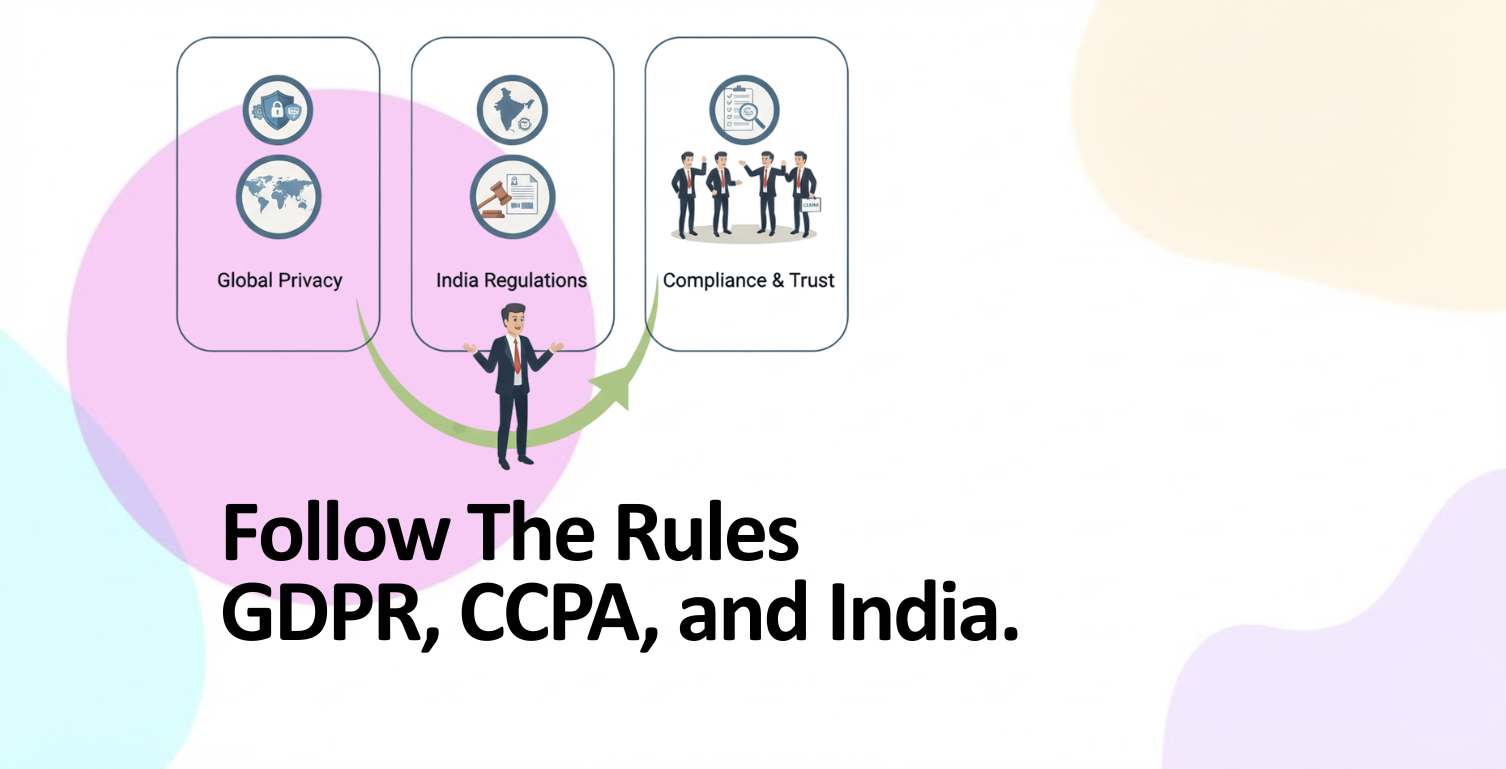
Complete data privacy guide 2025: GDPR fines €10 million or 2% annual revenue (tier 1 violations), €20 million or 4% revenue (tier 2), CCPA penalties $2,663-$7,988 per violation (2025 adjusted rates), India DPA fines ₹10,000-₹250 crore depending on breach type, user consent requirements, breach notification timelines (72 hours GDPR, 30 days CCPA, 30 days India), data minimization, consent withdrawal, children’s data protection, international data transfers.
Table of Contents
- Why Data Privacy Matters: Business Impact
- GDPR: Europe’s Gold Standard (And It Applies Globally)
- CCPA & CPRA: California’s Expanding Rights
- India’s Digital Personal Data Protection Act 2023
- Consent Management: Getting It Right
- Breach Response: Notification & Recovery
- Building Your Compliance Framework
Why Data Privacy Matters: Business Impact
Data privacy is no longer optional. It’s a business imperative. Companies handling customer data are sitting on legal time bombs.
The Financial Reality of Non-Compliance
- GDPR record fine: Meta (Facebook) paid €1.2 billion in 2023 for data transfer violations. Amazon paid €746 million in 2021. Not small fines. Not one-time penalties. Ongoing regulatory scrutiny
- CCPA largest penalty: Healthline paid $1.55 million in 2025 for improper data use. California AG continues escalating enforcement
- Data breaches cost: Average breach costs companies ₹2-5 crore in forensics, notification, credit monitoring, lawsuits, and lost reputation. One breach can kill a startup
Who Gets Regulated?
- GDPR: ANY company processing data of EU residents (even if company is in India). Global regulation
- CCPA/CPRA: ANY company handling data of California residents. Even if you’re not in California
- India DPA: ANY company processing data of Indian residents. New law (2023) but enforcement ramping up
GDPR: Europe’s Gold Standard (And It Applies Globally)
GDPR sets the strictest privacy standard globally. If you’re compliant with GDPR, you’re mostly compliant with others (though not entirely).
GDPR Penalties: Two Tiers
| Violation Tier | Maximum Fine (Tier 1) | Maximum Fine (Tier 2) | Examples |
|---|---|---|---|
| Lower Severity (Tier 1) | €10 million OR 2% annual worldwide revenue (whichever is higher) | N/A | Inadequate security measures (Article 32), failure to conduct data impact assessments (Article 35), failure to appoint DPO (Article 37) |
| Higher Severity (Tier 2) | N/A | €20 million OR 4% annual worldwide revenue (whichever is higher) | Invalid consent (Article 7), violation of core principles (Article 5), unlawful data transfers (Articles 44-49), failure to honor user rights (Articles 12-22) |
Real GDPR Fine Examples (2025)
- Amazon Europe Core: €746 million (2021) — Unlawful data processing and transfers. Still the record
- Meta (Facebook): €1.2 billion (2023) — Invalid data transfer mechanism, inadequate consent. Second-largest GDPR fine ever
- TikTok Europe: €345 million (2023) — Children’s data inadequate safeguards
- Schrems II enforcement: 2024 saw €1.2 billion in fines for data transfer violations post-Schrems II ruling
Key GDPR Requirements (Simplified)
| Requirement | What It Means | Failure = Fine Tier |
|---|---|---|
| Lawful Basis | You need a legal reason to process data (consent, contract, legal obligation, vital interest, public task, or legitimate interest). Can’t just collect “because we want to” | Tier 2 (€20M or 4% revenue) |
| Explicit Consent | Consent must be freely given, specific, informed, and unambiguous. Pre-ticked boxes = invalid | Tier 2 (€20M or 4% revenue) |
| Data Minimization | Collect only data you need. If collecting 50 fields but using 5, that’s violation | Tier 1 (€10M or 2% revenue) |
| Breach Notification | Notify supervisory authority within 72 hours of becoming aware of breach. Tell users if high risk | Tier 1 (€10M or 2% revenue) |
| Data Security | Reasonable technical/organizational measures (encryption, access controls, regular backups) | Tier 1 (€10M or 2% revenue) |
| User Rights | Right to access, rectify, erase, restrict, port, object. Must honor within 30 days | Tier 2 (€20M or 4% revenue) |
CCPA & CPRA: California’s Expanding Rights
CCPA (California Consumer Privacy Act) started in 2020. CPRA (California Privacy Rights Act) expands it starting 2025. Penalties increased.
CCPA/CPRA Penalties (2025 Updated Rates)
| Violation Type | Administrative Fine (2025) | Private Right of Action (Consumer Lawsuit) | Remarks |
|---|---|---|---|
| Unintentional Violation | Up to $2,663 per violation | N/A (no private right) | Businesses get 30-day cure period to fix (optional) |
| Intentional Violation | Up to $7,988 per violation | N/A (no private right) | No cure period allowed |
| Data Breach (CCPA Only) | N/A | $107-$799 per consumer per incident or actual damages (2025 rates) | Consumer can sue directly. Unlimited liability |
| Children’s Data Violation | Penalties 3x higher | Consumer can sue | Data of consumers under 16 = severe penalties |
CCPA vs CPRA: What Changed (2025)
- Removed 30-day cure period: Used to get 30 days to fix violations. Now enforcer can penalize immediately for intentional violations
- Penalty increases: From $2,500-$7,500 (old) to $2,663-$7,988 (2025 adjusted for inflation annually)
- Children’s data: Extra compliance obligations for data of consumers under 16 years
- Sensitive personal information: CPRA defines sensitive categories (SSN, biometric, financial, health) = stricter rules
- Right to delete: Consumers can demand permanent deletion (with exceptions). Must comply in 45 days
- Right to opt-out: Must provide easy “Do Not Sell My Personal Information” button
CCPA Compliance Checklist
- Privacy policy: Must disclose what data you collect, why, with whom you share, and how long you keep it
- Opt-out mechanism: “Do Not Sell My Personal Information” button must be prominent on homepage
- Request fulfillment: When consumer asks for data access/deletion, respond in 45 days
- No discrimination: Can’t penalize users for exercising privacy rights (can’t block service or charge more)
- Vendor contracts: Any vendor processing California resident data must sign data processing agreement
India’s Digital Personal Data Protection Act 2023
India’s data protection law is new (effective 2023-2024) and enforcement is ramping up. It’s stricter than CCPA but less strict than GDPR.
India DPA Penalties (Maximum Amounts)
| Type of Breach | Maximum Penalty | Enforcer | Examples |
|---|---|---|---|
| Failure to implement security safeguards (Section 8) | Up to ₹250 crore (~$30.2M USD) | Data Protection Board of India (DPBI) | No encryption, weak passwords, no access controls, unpatched servers |
| Failure to notify breach (Section 8) | Up to ₹200 crore (~$24.2M USD) | DPBI | Data breach happened but didn’t notify users or board within 30 days |
| Breach of children’s data obligations (Section 9) | Up to ₹200 crore | DPBI | Processing data of children <18 without verifiable parental consent |
| Breach by significant data fiduciary (Section 10) | Up to ₹150 crore (~$18.1M USD) | DPBI | Large platforms not implementing additional obligations |
| Other breaches | Up to ₹50 crore (~$6M USD) | DPBI | Violating any other provision of the Act |
| Minor technical violations | Up to ₹10,000 | DPBI | Procedural lapses without data harm |
India DPA Key Requirements
- Consent required: Must get explicit, free, and specific consent before processing any personal data
- Breach notification: Notify Data Protection Board of India (DPBI) and affected users within 30 days of becoming aware of breach
- Data minimization: Collect only data you actually need for stated purpose
- Children protection: If processing data of users <18 years, need verifiable parental consent (strict requirement)
- Retention limits: Can’t keep personal data indefinitely. Must delete after purpose served (or consent withdrawn)
- User rights: Right to access, correct, erase, and port data. Must respond in reasonable time
Who Is Significant Data Fiduciary (SDF)?
- Definition: Large platforms that process data of millions of Indians and have significant impact on digital data ecosystem
- Extra obligations: SDFs must implement data protection impact assessments, grievance redressal mechanisms, provide transparency reports, implement privacy by design
- Government will notify: DPBI will notify which platforms are SDFs. Once notified, penalties jump (₹150Cr instead of ₹50Cr)
Consent Management: Getting It Right
Consent is THE foundation of modern privacy law. Get it wrong and you face Tier 2 GDPR fines (€20M or 4% revenue). This is non-negotiable.
What GDPR/CCPA/India DPA Consider Valid Consent
| Requirement | GDPR Standard | CCPA Standard | India DPA |
|---|---|---|---|
| Free Choice | Must not be condition of service (except consent necessary for core function) | No conditioning service on consent to sell data | Must be freely given |
| Explicit | Affirmative action required (ticked boxes=invalid). “Opt-in” | Must have clear opt-out. Default: no sale | Explicit, informed, unambiguous |
| Informed | User must know what they’re consenting to (plain language, transparent) | Privacy policy must be clear | User aware of purpose, scope, duration |
| Granular | Separate consent for different purposes/categories (can’t use one blanket consent) | Different opt-outs for different uses | Specific to each purpose |
| Withdrawal Easy | Must be as easy to withdraw as to give (withdraw button must be prominent) | Withdrawing must be as easy as opting in | Easy withdrawal mechanism |
| Verifiable | Must maintain evidence: when, how, what user consented to | Must show records of consumer choice | Keep proof of consent on file |
Consent Violations That Trigger Big Fines
- Pre-ticked boxes: Users arrive at form with consent boxes already checked. Illegal in GDPR/India DPA. Fine: €10-20M or 2-4% revenue
- No opt-out button: Users can’t opt out of data sharing. Illegal in CCPA. Fine: $2,663-$7,988 per violation (can be thousands if affecting thousands)
- Bundled consent: “Accept consent to access service” — can’t bundle unrelated purposes. Must offer granular options
- Dark patterns: Making withdrawal hard (3 clicks to accept, 15 clicks to withdraw). Illegal. Fine: €10-20M under GDPR
- Invalid children’s consent: Processing child data without parental consent. India DPA: ₹200 crore fine
Practical Consent Implementation
Consent Management Best Practices
1. Consent Management Platform (CMP): Use tools like OneTrust, TrustArc, or Cookiebot to manage consents. Records timestamps, user choices, IP address. Critical for defense if audited
2. Clear language: Avoid legal jargon. Tell users plainly what data you collect, why, with whom you share, how long you keep
3. Separate checkboxes: Don’t use single “Accept All”. Offer: (1) Essential (no consent needed), (2) Analytics, (3) Marketing, (4) Cookies. User checks independently
4. Easy withdrawal: Provide “Withdraw Consent” option equally prominent as “Give Consent”
5. Record everything: Store consent logs: user ID, timestamp, what they consented to, IP, browser. Keep 3+ years
6. Parental consent for children: If user <18, get parent email, send verification link, only process after parent confirms
Breach Response: Notification & Recovery
Data breaches happen. How you respond matters legally and financially. Slow response = heavier fines.
Breach Notification Timelines (Comparison)
| Regulation | Timeline | Who to Notify | What to Disclose | Late Notification Fine |
|---|---|---|---|---|
| GDPR | 72 hours from becoming aware of breach | Data Protection Authority (DPA). Affected users if high risk | Nature of breach, categories & approx. number of data subjects, likely consequences, measures taken or proposed | €10M or 2% revenue (failure to notify = Tier 1 violation) |
| CCPA | Without unreasonable delay. Interpreted as “within 30 days” | California Attorney General (if >500 CA residents). All affected users | Date of breach, categories of personal information exposed, general description of what happened | $2,663-$7,988 per violation + consumer private right of action ($107-$799 per person) |
| India DPA | Within 30 days of becoming aware | Data Protection Board of India (DPBI). Affected data principals | Nature of breach, data compromised, likely impact, remediation measures | ₹200 crore for breach failure to notify |
Breach Response Costs (Real Numbers)
- Forensic investigation: ₹20-50 lakh to determine what was breached, how, when
- Breach notification: If 1 million users affected = ₹50 lakh in notification costs (emails, calls, SMS)
- Credit monitoring: If financial/health data breached, offer 2-3 years free credit monitoring = ₹1-2 crore for large breach
- Regulatory fines: €10-20 million GDPR, $1-10 million CCPA, ₹50-200 crore India DPA (depending on breach severity)
- Lawsuits: ₹5-50 crore in class action settlements
- Total breach cost (large company): ₹10-100+ crore
Breach Response Checklist (72-Hour Window)
- Hour 0-6: Confirm breach. Isolate affected systems. Preserve evidence. Activate incident response team
- Hour 6-24: Determine scope (what data, how many people, confirmed or suspected). Launch forensic investigation
- Hour 24-48: If GDPR: prepare notification to DPA. If CCPA: notify California AG. If India: notify DPBI
- Hour 48-72: Send notifications to affected users (GDPR 72-hour deadline). Public disclosure if required
- Day 4-30: Provide credit monitoring/remediation. Update privacy policy. Implement fixes. Document everything
Building Your Compliance Framework
You can’t comply with privacy laws reactively. You need a framework built in from day 1.
Privacy by Design (GDPR Requirement)
What It Means
Privacy must be built into product architecture, not bolted on later. Before launching any feature that touches user data, ask:
- Do we have legal basis to collect this data? (consent, contract, legal obligation, vital interest, public task, legitimate interest)
- Is this data minimized? (Are we collecting only what’s essential?)
- How long do we keep it? (Retention policy defined?)
- Who accesses it? (Access controls in place?)
- Is it encrypted? (In transit and at rest?)
- Can users exercise rights? (Can they access, correct, delete, port?)
Compliance Checklist by Business Type
SaaS / B2B Software
Must have: Data Processing Agreement (DPA) with all customers. Privacy policy. Data retention policy. User access/deletion functionality. Encryption
Should have: Consent management for optional analytics. Data Protection Impact Assessment (DPIA) for EU customers. Cookie consent banner
Cost: ₹5-15 lakh first year (legal review, DPA templates, consent tool, security audit)
E-commerce / B2C Platform
Must have: Privacy policy. Explicit consent for marketing emails. “Unsubscribe” button on every email. Payment data PCI-DSS compliance
Should have: CCPA “Do Not Sell” button if US customers. India DPA compliance (increasingly important). Customer data portal (view/delete)
Cost: ₹3-8 lakh first year (PCI compliance, privacy policy, email consent tool)
Fintech / Payments
Must have: All of above + Data Protection Impact Assessment (DPIA). Financial data encryption (AES-256+). Regular penetration testing. Incident response plan
Should have: Data residency (store data in specific countries if required). Audit logs for all data access. Annual third-party security audit
Cost: ₹20-40 lakh first year (DPIA, security audit, incident response setup, legal review)
Documentation (Critical for Defense)
- Privacy policy: Plain English, explains what data you collect, why, with whom, how long. Required by all 3 laws
- DPA (Data Processing Agreement): If you hire processors (cloud, analytics, payment), they must sign DPA. GDPR requires this
- DPIA (Data Protection Impact Assessment): For high-risk processing (children, health, financial). Document risks + mitigation
- Consent records: Timestamps, user choices, IP, browser. Keep 3+ years. Auditors will ask for this
- Incident response plan: Written plan: how to detect breach, investigate, notify users/authorities within timelines
- Data inventory: What personal data do you collect, where do you store it, who accesses it. Update quarterly
Key Takeaways: Data Privacy Compliance Essentials
1. Three major privacy laws now apply globally: GDPR (EU + worldwide scope), CCPA/CPRA (California + nationwide scope), India DPA (India scope). Ignorance is not a defense
2. GDPR fines are massive: €10M or 2% revenue (Tier 1), €20M or 4% revenue (Tier 2). Total GDPR fines since 2018 = €5.88 billion. Meta paid €1.2 billion alone in 2023
3. CCPA penalties increased 2025: From $2,500-$7,500 to $2,663-$7,988 per violation (adjusted annually for inflation). No 30-day cure period anymore. Immediate enforcement for intentional violations
4. India DPA fines range ₹10K-₹250 crore: Failure to secure data = ₹250 crore. Failure to notify breach = ₹200 crore. Children’s data breach = ₹200 crore. Other breaches = ₹50 crore. Enforcement ramping up 2025+
5. Consent is the foundation: Invalid consent = Tier 2 GDPR fine (€20M or 4% revenue). Pre-ticked boxes illegal. Dark patterns illegal. Must be granular, easy to withdraw, verifiable
6. Breach notification timelines are strict: GDPR 72 hours (to DPA), CCPA 30 days (to Attorney General), India DPA 30 days (to DPBI). Late notification = additional fines
7. Data breaches cost ₹2-100+ crore: Forensics (₹20-50L), notification (₹50L for 1M users), credit monitoring (₹1-2Cr), regulatory fines (€10-20M GDPR, $1-10M CCPA, ₹50-200Cr India DPA), lawsuits (₹5-50Cr)
8. “Privacy by design” is mandatory: GDPR requires it. Before launching any feature touching user data, do DPIA (Data Protection Impact Assessment), document legal basis, encryption, access controls, retention policy
9. Documentation = defense: Keep consent records (timestamps, user choices, IP), DPAs with all processors, privacy policy, incident response plan, data inventory. Auditors will ask. Being audit-ready saves millions
10. Compliance costs ₹3-40 lakh first year: Depends on business type. SaaS: ₹5-15L. E-commerce: ₹3-8L. Fintech: ₹20-40L. Includes legal review, DPA templates, consent tool, security audit, DPIA
11. GDPR applies globally: Even if your company is in India, if you handle EU user data, you must comply with GDPR. Same for CCPA (if handling California resident data). These are territorial laws, not company-location laws
12. Significant Data Fiduciary (SDF) in India: If you process data of millions + have significant impact on digital ecosystem, DPBI will notify you’re SDF. SDF penalties jump 3x (₹150Cr instead of ₹50Cr)
13. Children’s data = stricter rules: GDPR, CCPA, India DPA all require extra protection for children <18. Parental consent mandatory in India DPA. Violations = maximum penalties
14. Right to delete / right to be forgotten: Users can demand deletion of their data (limited exceptions: legal obligation, public task). Must delete within 30-45 days. Can’t refuse
15. Action plan: (1) Audit current data practices (what are we collecting, why, where stored?). (2) Map to GDPR/CCPA/India DPA requirements. (3) Fix consent mechanism (if pre-ticked = illegal). (4) Write privacy policy. (5) Prepare breach response plan. (6) Implement encryption. (7) Get annual security audit. Start now = costs ₹5-40L. Wait = costs €10-20M + reputational damage
