
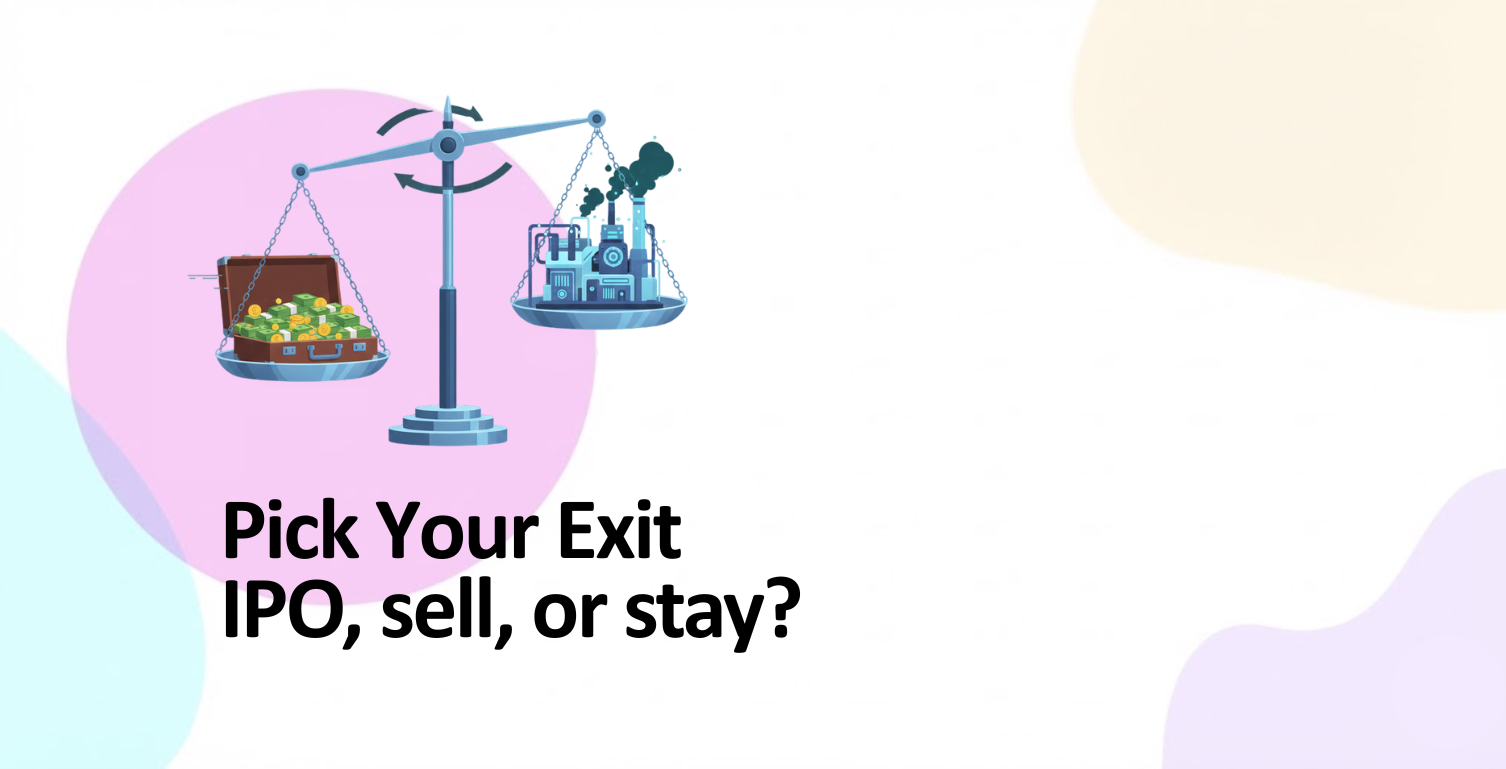
Master exit strategy decisions (2025): IPO (18-24 months, $4-10M cost, 6.1x EV/Revenue public median), acquisition (80% of tech exits, 3-6 month timeline, $120M fintech average), staying independent (bootstrapping, 2x likely to hit profitability by year 2). Post-exit founder life: liquidity, founder experience, equity options.
Table of Contents
- The Three Paths: Strategic Comparison
- IPO Path: Timeline, Costs, Requirements
- Acquisition Path: Timeline, Valuation, Buyer Types
- Staying Independent: Bootstrapping & Profitability
- Valuation Multiples by Industry (2025)
- Choosing Your Path: Decision Framework
- Post-Exit Life: Founder Experience
- Timing & Market Conditions (2025 Reality)
- Exit Preparation Checklist
The Three Paths: Strategic Comparison
There are three fundamental exit paths for founders and investors: IPO (public markets), acquisition (strategic buyer), or staying independent (bootstrap to profitability). Each has radically different timelines, valuations, and post-exit lives. There is no “best” path. Only the path that aligns with your goals
The 2025 reality: 80% of tech startups exit through acquisition. 20% through IPO. Less than 5% stay independent long-term. This tells you something: acquisitions are the most common exit, not the exception
| Factor | IPO | Acquisition | Independent |
|---|---|---|---|
| Timeline | 18-24 months from start | 3-6 months | Indefinite (ongoing business) |
| Costs | $4-10M upfront + $1-2M/year compliance | Due diligence & legal (varies) | $0 (self-funded or debt) |
| Founder Control | Board + public shareholders (medium control) | Acquirer (usually lost) | Complete control (high) |
| Liquidity Timeline | Immediate (IPO day) | Immediate (closing) | None unless dividend or secondary sale |
| Post-Exit Role | Usually stay as CEO or chairman (variable) | Often leaving company (founder often exits) | Stay and run business |
| Valuation Range | $1B+ (usually higher multiples) | $50M-$1B (variable) | N/A (no exit event) |
IPO Path: Timeline, Costs, Requirements
An IPO (Initial Public Offering) means taking your company public. You raise capital from the public markets. Existing investors (including founders) can sell shares and get liquidity. You remain CEO but lose some control to public shareholders and board. You become subject to SEC regulations, quarterly earnings pressure, and annual audits
IPO Timeline: What You Actually Need to Know
Preparation phase (6-12 months before IPO roadshow): Get audit-ready financials. Build finance team. Create IPO governance structure (board, audit committee, compensation committee). Select underwriters (Goldman Sachs, Morgan Stanley, etc.). These decisions are critical
IPO process (6-12 months): File S-1 with SEC. SEC reviews and comments. You iterate. Once approved, begin roadshow (pitch to institutional investors). Price IPO. File final documents. IPO day happens
Total timeline: 18-24 months from start to IPO day
IPO Costs: Real Numbers
| Cost Category | Amount | Notes |
|---|---|---|
| Investment Banking Fees | $20-30M (2-3% of IPO size) | If raising $1B, you pay 2-3% to underwriters |
| Legal Fees | $2-4M | IP counsel, securities counsel, governance |
| Accounting & Audit | $1-2M | Getting audit-ready, Sarbanes-Oxley compliance |
| Printing & Logistics | $500K-$1M | Prospectus, roadshow materials, filings |
| Miscellaneous (insurance, etc.) | $500K-$1M | D&O insurance, transition insurance |
| Total Upfront IPO Cost | $4-10M | This is before annual compliance costs |
| Annual Compliance (Post-IPO) | $1-2M/year | Audits, SEC filings, investor relations, board |
IPO Requirements: What Investors Need to See
- $100M+ ARR: Most IPOs are at $100M-$300M ARR. Smaller IPOs exist but are rare. You need scale
- Clear profitability path: Don’t need to be profitable now. But investors need to see path to profitability within 3-5 years
- Predictable revenue: SaaS companies need strong ARR + NRR. Revenue growth should be 20%+ YoY. Revenue should be recurring (not one-time project revenue)
- Market leader position: You should be #1 or #2 in your market. Investors want to buy proven winners, not gamblers
- Experienced management team: CEO, CFO, COO need experience. IPO investors care about team as much as product
- Clean cap table: No lingering founder disputes. No weird convertible notes. Clear equity structure
IPO Valuation Reality (2025)
Public SaaS companies trade at 6.1x EV/Revenue median (2025). If you have $200M ARR with 75% gross margin, your enterprise value at IPO would be approximately $1.2B. But this is market-dependent. In good markets, multiples expand. In bad markets, they compress
2024-2025 IPO market reality: The IPO market was frozen in 2022-2023. It’s recovering in 2024-2025, but slowly. Fewer IPOs are happening, but valuations are stable when companies do IPO
Acquisition Path: Timeline, Valuation, Buyer Types
An acquisition (M&A) means a larger company buys your company. You sell 100% of the company (or founder’s stake) to the buyer. The acquirer takes over operations. Timeline is fast (3-6 months). Most founders exit post-close. You get liquidity immediately
2025 reality: 80% of tech startups exit through acquisition, not IPO. This is the default exit path
Acquisition Timeline
- Month 1-2: Buyer interest & NDA Strategic buyer approaches. Mutual interest. You sign NDA
- Month 2-3: Diligence Buyer reviews: finances, customer contracts, code, IP, legal. This is intensive. Budget 200+ hours of founder time
- Month 3-4: Letter of intent (LOI) Buyer makes offer. Price, terms, conditions. You negotiate. LOI outlines major terms
- Month 4-5: Final negotiation & closing docs Lawyers draft definitive agreement. You negotiate final terms. Working capital adjustments, earnout, reps/warranties
- Month 5-6: Close Money transfers. Deal closes. Founder’s employment agreement signed (if staying). Usually 30-day post-close working period
Acquisition Valuation: By Industry (2025 Data)
| Industry | Typical EV/Revenue Multiple | Average Deal Size | Market Maturity |
|---|---|---|---|
| AI/ML Companies | 10-20x (premium multiples) | Varies ($100M-$1B+) | Hot market, high premiums |
| Health Tech | 28.5x (HIGHEST) | $200M-$500M | Strategic importance, premium |
| Cybersecurity | 22.3x | $300M-$1B | High strategic value |
| Fintech | 4.2x EV/Revenue | $120M average | Consolidating, lower multiples |
| SaaS (B2B) | 4.7x (private deals), 6.1x (public) | $100M-$500M | Mature, steady multiples |
| eCommerce | 2-5x | $50M-$200M | Low multiples, competitive |
Buyer Types & Motivations
- Strategic acquirers: Larger company buying you for product/tech (Google buying Waze). Usually highest prices. They have synergy (can cross-sell to their customer base). Acquires because 1) access to tech, 2) access to customers, 3) access to talent, 4) eliminate competition
- Financial acquirers (PE): Private equity firms buying you for cash flow or growth potential. They expect 3-5x return on their investment in 3-7 years. Often more sophisticated about negotiations. Don’t overpay
- Tuck-ins: Larger company buying you to integrate into existing product. Often lower price because they’re eliminating redundancy. Example: Figma acquiring UI Kit company
- Acquihires: Buying you primarily for the team. Price is usually lower (based on headcount + talent). Company shuts down, team joins acquirer. Example: Stripe acquiring teams
Real example (2025): Health Tech company with $20M ARR could get acquired at 28.5x = $570M valuation. Same fintech company at $20M ARR gets acquired at 4.2x = $84M valuation. Same revenue, 6.8x valuation difference based on industry multiples
Staying Independent: Bootstrapping & Profitability
Staying independent means you never exit. You build a profitable company and run it indefinitely. Or you raise minimal capital (no VC) and stay in control. You keep 100% equity. This is increasingly common in 2025
Bootstrapping: The Reality
Bootstrapping definition: Starting and growing your company using personal savings + reinvested profits. No outside investors. Full control. This is not “poor” or “struggling.” It’s a deliberate choice to stay independent
2025 Bootstrapping Truth: Bootstrapped SaaS startups are 2x more likely to hit profitability by year 2 vs VC-funded startups. Founders who own 100% equity are 3x more likely to build sustainable, profitable companies. Bootstrapped companies often grow slower but are more profitable
Bootstrapping Reality: What Works vs Doesn’t
| Bootstrap Well If: | Bootstrap POORLY If: |
|---|---|
| Low upfront capital needed (SaaS, services) | High upfront capital needed (biotech, manufacturing, hardware) |
| Can reach profitability within 18-24 months | Need 5+ years to profitability |
| Market is large but non-urgent (can grow slow) | Winner-take-most market (need to move fast to win) |
| Founder has capital ($50K-$500K personal savings) | Founder has no capital or runway pressure |
| You want control and full equity | You want fast scale and outside guidance |
Bootstrapping Examples That Work
Basecamp (formerly 37signals): Built without raising venture capital. Profitable from early on. Founded in 2003, still independent. $100M+ revenue, 100+ employees, extreme profitability
Notion (partially): Started bootstrapped. Raised Series A only after hitting product-market fit and profitability. Stayed lean and founder-focused
Serum Institute of India: Bootstrapped biotech. Now valued at $16B+ without ever raising VC. Family-owned, profitable, scaled globally
The Independent Life: What It Means
- No board: You answer to no one. No quarterly pressure. No VCs demanding 10x return
- Slower growth, but more sustainable: You can’t hire 100 people in 12 months. But the people you hire will stay longer
- 100% upside (no dilution): Every dollar of profit is yours. No investors to cut checks to. This compounds over time
- No liquidity event: You don’t get a check on “exit day.” But you get monthly profit checks forever
- Founder stays involved: Most independent founders run their companies for 10+ years. It becomes their legacy
Valuation Multiples by Industry (2025)
| Industry/Category | EV/Revenue Multiple | EV/EBITDA Multiple | Notes (2025) |
|---|---|---|---|
| AI/LLM Vendors | 54.8x (HIGHEST) | N/A (pre-profitable) | Premium for transformative tech. But 2025 pullback as growth moderates |
| Health Tech AI | 28.5x | N/A | Strategic importance in healthcare. Highest non-AI multiple |
| Data Intelligence/Analytics | 25.7x | N/A | Demand for AI-powered analytics. Premium multiples sustained |
| Cybersecurity AI | 22.3x | N/A | Growing importance. Solid multiples |
| SaaS (B2B) – Private Deals | 4.7x | 12.1x (fintech) | M&A multiples lower than public. More conservative pricing |
| SaaS (B2B) – Public Companies | 6.1x | N/A | Public multiples higher than private. More liquidity premium |
| Fintech | 4.2x | 12.1x | Down from 5.0x in 2024. Consolidation, focus on profitability |
| eCommerce | 2-5x | N/A | Low multiples. Mature, competitive market |
| Early-stage startups (Seed/A) | 6-40x | N/A | Extreme range. Depends on growth rate and category |
Key insight: AI companies command 4-5x higher multiples than traditional SaaS. Health Tech AI commands 28.5x. Traditional eCommerce commands 2-5x. Industry and category matter more than revenue size
Choosing Your Path: Decision Framework
Choose IPO Path if:
• You want maximum valuation (and can reach $100M+ ARR)
• You want to stay as CEO post-exit (most IPO founders do)
• You want public market validation (prestige, brand, attract talent)
• You have 18-24 months runway to prepare
• Your market is receptive to public companies (SaaS, FinTech, HealthTech)
• You can tolerate quarterly earnings pressure and public scrutiny
Choose Acquisition Path if:
• You want fastest exit (3-6 months vs 18-24 months)
• You’re comfortable leaving the company post-close
• You have strategic buyer interested in you (reduces timeline, increases price)
• You want simplicity (no SEC filings, no quarterly earnings)
• Your company is a strategic fit for a larger acquirer
• You want certainty in valuation (negotiated, not market-dependent)
Choose Independent Path if:
• You want 100% control and never want to exit
• You can reach profitability within 18-24 months
• You don’t need VC capital (have personal capital or early revenue)
• You want to build a sustainable long-term business
• You dislike board meetings, investor pressure, dilution
• Your market doesn’t require VC scale to win
Post-Exit Life: Founder Experience
IPO Post-Exit Founder Life
Best case: You stay as CEO. You get to run your company (for now). You get liquid wealth. You get credibility. Downside: quarterly earnings pressure, board oversight, public scrutiny. You’ll spend 30% of time on investor relations, not product
Worst case: Board replaces you within 3 years with “professional CEO” because stock price disappoints. You became chairman/advisor (reduced power). You’re still working, but less control
Reality: 50% of IPO founders stay as CEO 5+ years. 50% get replaced or transition to other roles within 3-5 years
Acquisition Post-Exit Founder Life
Best case: You negotiate 1-2 year earn-out. You stay post-close. Get paid $X at close, $Y in earn-out. You lead a business unit at acquirer. You transition team. After 2 years, you’re free. Often founders start next company
Worst case: You’re replaced immediately. Your team is restructured. 30% of your team leaves. You realize you should have negotiated better post-close terms. You get the money but lose the company
Reality: 70% of acquired founders stay 12-24 months. 30% leave immediately or within 6 months
Independent Founder Life
Best case: You stay in your company for 10+ years. You keep building. You stay profitable. Every year you pocket profit. No board meetings. Full control. Personal legacy
Reality: Some founders get bored after 5-10 years and want to sell. Some stay for 20+ years. It’s your choice. No “exit” date. You decide when/if to exit
Timing & Market Conditions (2025 Reality)
2025 IPO Market: The IPO market is recovering from 2022-2023 freeze. It’s open but not hot. Companies that IPO in 2025 are strong performers (Google, Nvidia-like). Weaker companies are still getting rejected by public markets. Lesson: if you’re not exceptional, acquisition is more realistic
2025 M&A Market: Strategic M&A is strong. Fintech had 80 deals in September 2025 (5.3% YoY increase). AI companies are hot (premium multiples). Traditional SaaS is consolidating. Total deployable private capital: $3.6 trillion. Buyers have capital. Good time to sell
2025 Bootstrapping Trend: More founders are choosing to bootstrap. “No VC, no dilution” is gaining traction. Notion, Basecamp success stories inspire others. Bootstrapping is no longer seen as “less ambitious.” It’s a deliberate choice
Key 2025 lesson: The path forward depends on timing, capital availability, and market sentiment. In 2022, IPO was dead. In 2025, it’s alive but picky. M&A is consistently available. Bootstrapping is increasingly viable
Exit Preparation Checklist
Financial Readiness
☐ Last 3 years of audited/reviewed financials (clean, no red flags)
☐ Monthly financial metrics dashboard (ARR, MRR, CAC, LTV, churn)
☐ Revenue visibility (contracts, ARR backlog, pipeline visibility)
☐ EBITDA or clear path to profitability (investors care about unit econ)
☐ Tax returns filed on time (no IRS issues)
Legal Preparation
☐ Clean cap table (clear ownership, no surprises)
☐ All stock option grants documented (option pool allocated)
☐ IP assigned to company (all founders assigned IP)
☐ No pending lawsuits or disputes
☐ Material contracts reviewed (customer contracts, vendor contracts, employment agreements)
☐ Standard NDA/customer agreements (no weird terms)
Operational Readiness
☐ Customer concentration <40% (no single customer dependency)
☐ Documented product roadmap (3-12 month outlook)
☐ Engineering documentation (code, architecture, scalability)
☐ Customer retention metrics (M1, M3, M6 cohort analysis)
☐ Management team stable (no departures in next 6 months)
Strategic Readiness
☐ Clear competitive positioning (why you vs competitors)
☐ Market traction (proof of product-market fit)
☐ Growth trajectory (consistent, predictable growth)
☐ Identify potential acquirers or IPO underwriters (who cares about you?)
☐ Board composition ready (experienced board for IPO path)
Key Takeaways: Exit Strategy
1. Three paths: IPO (18-24 months, $4-10M cost), Acquisition (3-6 months, fastest), Independent (no exit, build forever): Choose based on goals, capital available, market conditions. 80% of startups exit via acquisition
2. IPO requires $100M+ ARR, clear profitability path, market leadership, experienced team, clean cap table: This is hard. Only 20% of startups IPO. Only ~500 companies IPO globally per year
3. IPO timeline is 18-24 months (not quick): IPO costs $4-10M upfront + $1-2M/year compliance. This is expensive. Only do if raising $200M+ capital
4. IPO valuation is based on public multiples: SaaS 6.1x EV/Revenue, AI 10-20x, Health Tech 28.5x, eCommerce 2-5x: Know your multiple. $100M ARR at 6x = $600M IPO value
5. Acquisition is the most common exit (80% of tech): Timeline is 3-6 months (fast vs IPO). You negotiate valuation with buyer, get immediate liquidity, usually leave company
6. Acquisition multiples vary by industry: AI 10-20x, Health Tech 28.5x, Cybersecurity 22.3x, Fintech 4.2x, SaaS 4.7x, eCommerce 2-5x: Industry matters more than revenue size. Same $50M ARR company gets 28x ($1.4B) in Health Tech or 4x ($200M) in eCommerce
7. Acquisition buyers: Strategic (highest price, synergies), PE (3-5x returns in 3-7 years), tuck-ins (lower price, integration), acquihires (lowest, buying team). Different buyer types = different prices and post-exit experiences
8. Staying independent means bootstrapping to profitability: 2x more likely to hit profitability by year 2 vs VC-funded. Founders with 100% equity are 3x more likely to build sustainable companies
9. Bootstrapping works for low-capital businesses (SaaS, services) but fails for high-capital businesses (biotech, hardware): Know your category. Bootstrap if you can reach profitability within 18-24 months
10. IPO founder often stays as CEO but loses control to board + public shareholders: 50% of IPO founders get replaced within 5 years. IPO is not “winning.” It’s a new game with new rules
11. Acquisition founder usually leaves within 12-24 months: You negotiate earn-out to stay 1-2 years, then you’re free to start next company. Most founders who sell want to move on
12. Independent founder runs company 10+ years or more: No exit date. You decide when/if to exit. Some independent founders eventually sell. Some never do
13. 2025 market reality: IPO market recovering but picky. M&A market strong (fintech up 5.3% YoY). Bootstrapping trending upward. Best time to sell is when buyer wants you (not a forced timeline)
14. Choose IPO if you want maximum valuation + stay as CEO. Choose acquisition if you want speed + certainty. Choose independent if you want 100% control + forever business. No single “best” path
15. Pre-exit checklist: Clean financials (3-year audit), clean cap table (clear ownership), IP assigned (founders assigned IP), customer contracts (no surprises), profitability path (unit economics work), management team stable (no departures coming). Get these right or exit gets complicated/delayed
16. IPO costs are $4-10M upfront + $1-2M annually for compliance: Only do if raising $200M+. For $50M raise, acquisition is better
17. Acquisition timeline is 3-6 months: Fast compared to IPO. Month 1-2 interest + NDA, Month 2-3 diligence, Month 3-4 LOI, Month 4-5 final negotiation, Month 5-6 close. Plan accordingly
18. Founder liquidity matters: IPO = immediate liquidity at close. Acquisition = immediate at close (usually). Independent = no liquidity unless dividend or eventual sale. Different emotional impacts
19. Post-exit founder life varies by path: IPO = stay as CEO (usually) but lose control. Acquisition = leave within 2 years (usually). Independent = run company forever. Know what life you want
20. Action plan: (1) Define your goal (maximum valuation vs speed vs control). (2) Choose path that aligns with goal. (3) Build toward that path (IPO = profitability focus, Acquisition = strategic fit, Independent = lean operations). (4) Start exit prep 12-18 months before actual exit. (5) Execute when market/timing is right. Planned exit > forced exit
