
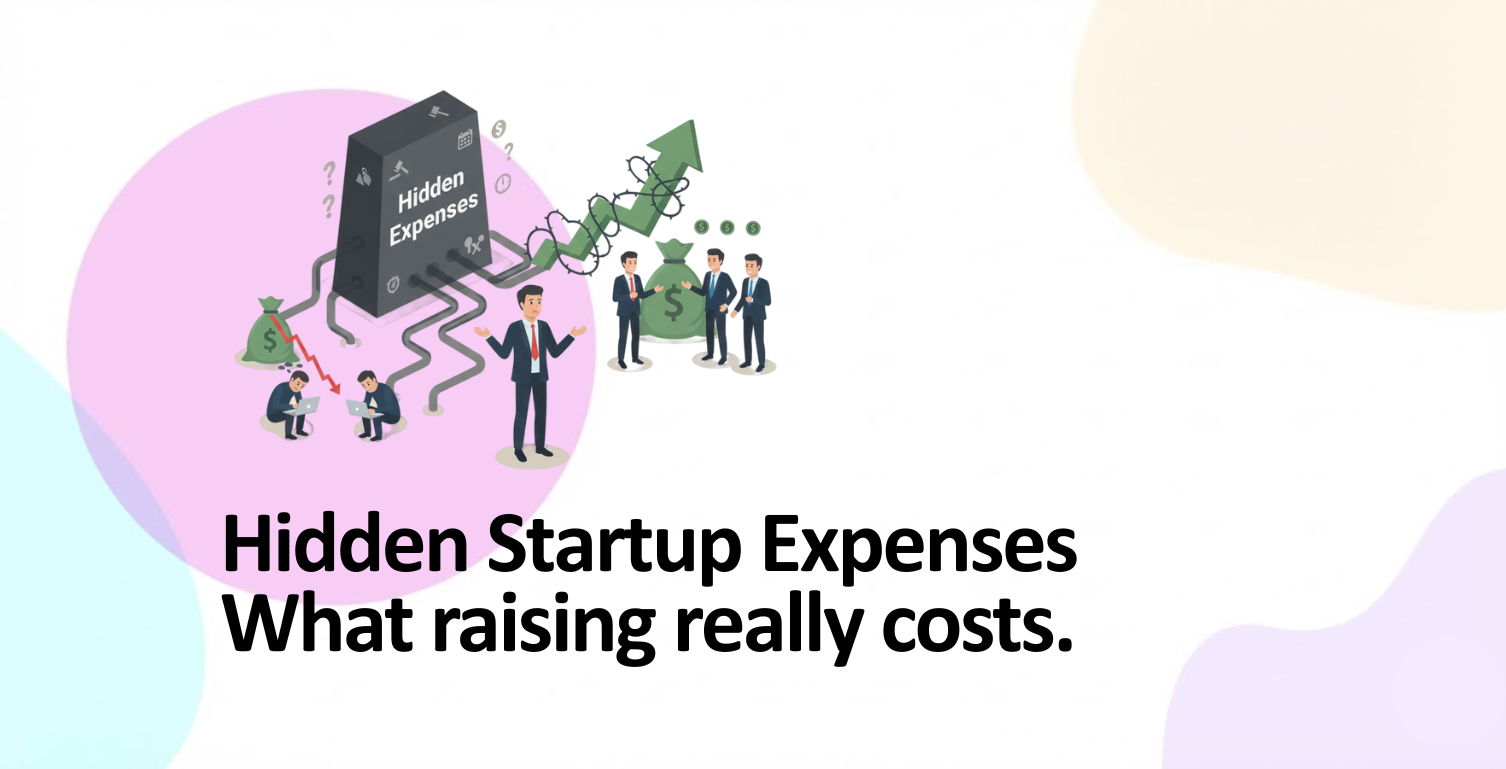
Complete fundraising cost breakdown 2025 India: legal fees SAFE ₹30-50K (simplified) vs term sheet ₹50-100K, accountant due diligence ₹15-75K (Seed to Series C), travel ₹2-10L, time cost 3-6 months (14% founder capacity), opportunity cost ₹20-40L+ (lost revenue/growth opportunities). Total Seed ₹3-5L, Series A ₹5-15L, Series B ₹10-30L.
Table of Contents
Why Fundraising Costs Matter
Most founders know they’ll pay legal fees and travel costs. What they don’t know: the total cost of fundraising can be ₹3-30L+ depending on stage. And the hidden costs (time, opportunity) often dwarf the explicit costs.
The Total Cost of Fundraising (Usually Hidden)
- Explicit costs (you know about): Legal fees, accounting, travel, virtual data room, pitch deck design
- Implicit costs (you don’t track): Founder time (lost business hours), opportunity cost (revenue not generated while pitching), stress and distraction
- Real impact: For many startups, implicit costs > explicit costs. Founder spends 50% time fundraising for 6 months. That’s ₹30L+ in lost opportunity cost
Why Understand Costs Upfront?
- Budget planning: Know how much cash to reserve for fundraising. Don’t blow through runway on legal
- Timeline planning: Know how many hours founder needs to block. Plan team coverage
- Efficiency decisions: SAFE vs term sheet? ₹20-50K difference. Worth optimizing
- ROI calculation: Raising ₹5Cr at 8% dilution = ₹40L cost. Is it worth it? For most, yes. For some smaller rounds, maybe not
Legal Fees: SAFE vs Term Sheet
Legal fees are often the biggest explicit cost of fundraising. They vary wildly depending on document type and complexity. SAFE is cheapest, term sheet is most expensive.
SAFE (Simple Agreement for Future Equity)
What It Is
- SAFE: One-page agreement (originally from Y Combinator). Investor gives money now, gets equity later at next funding round
- No valuation negotiation. No liquidation preference. Simplest possible investment mechanism
- Used for: Pre-seed, seed, sometimes bridge rounds. Early stage when speed matters
Legal Cost for SAFE
| Work Type | Cost (India 2025) | What’s Included | Time Required |
|---|---|---|---|
| SAFE review (investor’s) | ₹20-30K | Lawyer reviews standard SAFE template. Minimal customization | 3-5 days |
| SAFE customization (if needed) | ₹10-20K additional | Minor tweaks to template (company name, investor details, minor terms) | 2-3 days |
| Multiple SAFEs (5-10 investors) | ₹30-50K total | Template once, apply to multiple investors. Minimal incremental cost | 1-2 weeks |
| Negotiation & changes | ₹10-20K per investor (extra) | If investor wants material changes to terms. Usually minimal | 1-2 weeks |
Term Sheet (Series A / B Style)
What It Is
- Term sheet: 5-15 page legal document with valuation, liquidation preference, board seats, anti-dilution, protective provisions
- Everything negotiated: Price, control, governance, rights
- Used for: Series A, B, C, institutional rounds. Most important legal document in startup life
Legal Cost for Term Sheet
| Work Type | Cost (India 2025) | Typical Hourly Rate | Time Required |
|---|---|---|---|
| Term sheet drafting (by VC) | Usually VC bears cost (founder doesn’t pay) | — | 1-2 weeks VC side |
| Term sheet review (founder’s lawyer) | ₹40-60K | ₹400-600/hour (mid-tier firm) | 1-2 weeks |
| Term sheet negotiation & redlines | ₹30-50K additional | ₹400-600/hour | 2-4 weeks (back-and-forth) |
| Shareholder Agreement drafting | ₹50-100K | ₹500-700/hour (more complex) | 3-4 weeks |
| Schedule of Shareholders / Cap Table review | ₹20-30K | ₹400-600/hour | 1-2 weeks |
| TOTAL term sheet + agreement + cap table | ₹140-240K | 8-12 weeks |
Comparison: SAFE vs Term Sheet Cost
- SAFE cost: ₹30-50K (for multiple investors)
- Term sheet cost: ₹140-240K (full legal package)
- Difference: ₹90-190K savings with SAFE. Huge
- Trade-off: SAFE is simpler, faster, cheaper. But term sheet gives you more control over governance and terms. Worth the cost for Series A+
How to Reduce Legal Costs
- Use standard templates: Y Combinator SAFE or Fenwick standard term sheet. Don’t ask lawyer to draft from scratch
- Use mid-tier law firms, not fancy ones: ₹300-500/hour mid-tier vs ₹800-1500/hour fancy firms. Same quality for most startups
- Pre-negotiate major terms with VC before engaging lawyer: If you nail down valuation, board seats, liquidation before legal review, lawyer just documents. Faster, cheaper
- Batch multiple investors in SAFE: If raising from 5 angel investors with SAFE, one template ≈ ₹30-50K total. Not ₹30K each
Accounting & Due Diligence: The Hidden Cost
Most founders don’t realize accountants and due diligence firms are expensive. But investors require clean books. This cost compounds with every round.
Due Diligence Costs by Round (2025 India)
| Funding Stage | Typical Investment Size | Due Diligence Cost | % of Raised | Work Included |
|---|---|---|---|---|
| Pre-seed | ₹20-50L | ₹0-5K (optional) | 0-0.25% | Angel investor minimal checks. No formal DD |
| Seed | ₹50-200L | ₹10-25K | 0.1-0.25% | Financial audit, cap table review, basic compliance |
| Series A | ₹2-5Cr | ₹25-50K | 0.05-0.1% | Full financial audit, legal DD, cap table, IP review |
| Series B | ₹5-15Cr | ₹50-100K | 0.03-0.1% | Comprehensive audit, contract review, compliance, customer analysis |
| Series C+ | ₹15Cr+ | ₹100-200K+ | 0.02-0.1% | Deep dive financial, legal, operational, market analysis |
What Accountants Do During Due Diligence
- Financial statement audit: Verify P&L, balance sheet, cash flow. Check for fraud, mistakes, hidden liabilities
- Revenue validation: Spot check customer contracts, payment records. Confirm revenue is real (not fabricated)
- Burn rate analysis: Runway calculation, cash flow forecast, expense breakdown
- Unit economics: CAC, LTV, payback period calculations. Are customers profitable?
- Tax compliance: GST filings, TDS, ITR accuracy. Any penalties or issues?
- Cap table verification: All shares accounted for, vesting schedules accurate, no surprises on dilution
Cost Variations (Same Round, Different Scenarios)
- Clean books (same accountant for 2+ years): ₹25-40K due diligence cost. Fast
- Messy books (excel spreadsheets, no audit trail): ₹50-100K+ due diligence cost. Time consuming
- Multiple entities (India + US, different entities): ₹80-150K+ due diligence cost. Complex
- Lawsuit or compliance issue history: ₹100K+ due diligence cost. Investors cautious, deep investigation
How to Minimize Due Diligence Costs
- Hire accountant EARLY (day 1): Clean books from start = lower DD cost later. Messy books = expensive to clean
- Keep meticulous records: Invoice all customers, receipt all expenses, track cap table in software (not spreadsheet)
- Use bookkeeping software from day 1: Zoho Books, Wave, QuickBooks. Makes audit trail automatic. DD faster
- Annual audit if possible: Even if not required. Investors trust audited numbers. Saves DD cost
Time Cost: 3-6 Months of Founder Capacity
Fundraising takes time. Lots of it. For a founder earning ₹40L/year salary, this time has real cost. Most founders underestimate the impact.
Typical Fundraising Timeline (3-6 Months)
- Months 1-2: Preparation – Pitch deck, data room setup, practice pitches, warm introductions = 30-40% founder time
- Months 2-4: Active fundraising – Investor meetings, due diligence, negotiations = 50-70% founder time
- Months 4-6: Final push + closing – Term sheet negotiation, legal docs, final investor calls = 40-60% founder time
- Average over 6 months: 40-50% founder time
The Hidden Time Cost (Financial Impact)
- Founder salary: ₹40L/year = ₹3.3L/month = ₹165K/day
- Fundraising period: 6 months at 45% average capacity = 2.7 months (1/3 year) of full-time
- Equivalent cost: ₹40L × (2.7 / 12) = ₹9L in opportunity cost of founder salary
- Business impact cost: In 6 months of 45% distraction, founder not building product, not growing business. Revenue growth slows. Add another ₹20-30L in opportunity cost
- TOTAL TIME COST: ₹30-40L in lost opportunity (salary + business impact)
Real Impact by Founder Type
| Founder Role | Typical Annual Value | Fundraising Time Cost (6 months, 45%) | Notes |
|---|---|---|---|
| CEO/Product founder | ₹40L/year | ₹9L (time only) | Plus lost product innovation, hiring delays |
| Technical founder | ₹50L/year | ₹11L (time only) | Plus delayed product releases, technical debt builds |
| Multiple founders (3 people) | ₹120L combined | ₹27L (time only) | If all spend 45% time on fundraising |
How Founders Typically Underestimate Time Cost
- “I’ll fundraise on the side.” Reality: 50% capacity needed. Impossible to do on side
- “It’s only 6 months.” Reality: 6 months of 45% distraction = slow product progress, slower revenue growth, slower business progress
- “Team will cover.” Reality: Team also distracted. New hire onboarding delayed, roadmap confusion, execution slows
Travel & Logistics Costs
Investors are concentrated in metro cities. Most founder meetings require travel. Add up the costs and it’s significant.
Travel Cost Breakdown (Typical Seed/Series A Round)
- Destination cities: Delhi (60% of India VCs), Bangalore (40%), Mumbai (20%), occasional Hyderabad/Pune
- Number of trips: 15-25 investor meetings = 8-12 trips (multiple meetings per trip)
- Per trip cost (Delhi from outside):
| Expense Item | Cost | Frequency (12 trips) | Total |
|---|---|---|---|
| Flight (Bangalore→Delhi roundtrip) | ₹8,000 | 12 trips | ₹96,000 |
| Hotel (2 nights/trip) | ₹3,000/night × 2 | 12 trips × 2 nights = 24 nights | ₹72,000 |
| Food & local transport | ₹2,000/day | 24 days | ₹48,000 |
| Other (Uber, meals with investors, misc) | — | — | ₹30,000 |
| TOTAL TRAVEL (per trip from outside Delhi) | ₹2,46,000 | ||
Travel Cost Variations
- If in Delhi (base city): Much lower. Mostly local travel ₹20-30K for 12 trips (cab/Uber only)
- If remote (multiple cities): Could be ₹3-5L if traveling to 2-3 cities (Delhi + Bangalore + Mumbai)
- If virtual meetings: Almost ₹0 travel cost. But effectiveness lower. Most VCs want in-person at some point
How to Reduce Travel Costs
- Batch meetings geographically: If in Bangalore, schedule all Delhi meetings in 1-2 trips (Mon-Wed), not spread over 6
- Negotiate mixed virtual: “First meeting virtual, if interested → in-person follow-up.” Saves trips early
- Use co-working network: Many VC offices co-located in Delhi NCR. Multiple meetings same day, same area
- Invite VCs to your city sometimes: Some VCs travel to Bangalore. Occasional events = meetings without you traveling
Opportunity Cost: What You’re Giving Up
Opportunity cost is the hardest to quantify but often the biggest cost of fundraising. What would you build if not fundraising?
Revenue Opportunity Cost
- Scenario: SaaS company doing ₹50L MRR (₹6Cr ARR). Founder does 45% fundraising for 6 months
- Impact: Sales team loses founder’s mentorship. Feature roadmap delayed 2 months. Churn increases slightly (1% higher monthly)
- Financial impact:
- Sales delay: ₹50L MRR × 0.5 months lost growth = ₹25L revenue loss
- Churn increase: 1% more churn on ₹6Cr ARR = ₹60L annual revenue loss (but spread over year, so ₹30L impact during 6 months)
- Feature delay: Delayed features cost ₹20L in lost upsells / expansion
- TOTAL REVENUE OPPORTUNITY COST: ₹75L
Product Opportunity Cost
- Scenario: Technical founder 50% capacity on fundraising means 50% on product. Critical features delayed
- Impact:
- Feature X delayed 2 months = 2 months of competitor lead time
- Technical debt accumulates = hiring harder later, onboarding slower
- Bug fixes slower = customer churn risk increases
- HARD TO QUANTIFY, but real cost: competitive disadvantage
Psychological Opportunity Cost
- Founder burnout: 6 months of 50%+ distraction is exhausting. Quality of work decreases. Decisions become worse
- Team uncertainty: Team unsure if founder is committed to product or just chasing money. Morale dips
- Customer risk: If customers sense founder is fundraising, they worry about company stability. Churn risk
Total Opportunity Cost (Realistic Estimate)
- Time value (salary cost): ₹9L
- Revenue opportunity (slowed sales): ₹50L (estimated)
- Product opportunity (delayed features, competitive): ₹30L (estimated)
- Psychological/team impact: ₹10-20L (estimated)
- TOTAL OPPORTUNITY COST: ₹99-119L (roughly ₹1Cr)
The Breakeven Question
- If raising ₹5Cr: At 20% dilution, ₹1Cr opportunity cost is 20% of round value. Still worth it (4:1 return)
- If raising ₹50L: At 10% dilution, ₹1Cr opportunity cost is 200% of round value. Probably not worth it
- Rule of thumb: If opportunity cost > 25% of capital raised, maybe delay fundraising. Focus on growth first
Total Fundraising Budget by Stage
Here’s the complete picture: explicit costs + implicit costs = real cost of fundraising.
Seed Round (₹50-200L Raising Target)
| Cost Category | Amount | Notes |
|---|---|---|
| Legal (SAFE) | ₹30-50K | Standard SAFE template, minimal customization |
| Accounting/DD | ₹10-25K | Basic audit, cap table review, compliance check |
| Travel | ₹50-150K | Depends on location (Delhi based = lower, remote = higher) |
| Other (pitch deck, data room setup) | ₹20-50K | Design, tools, software subscriptions |
| Explicit Total | ₹1.1-2.75L | |
| Time cost (3-4 months, 45% capacity) | ₹15-25L | Founder salary value + team distraction |
| Opportunity cost (revenue/product) | ₹30-50L | Slowed sales, delayed features, competitive disadvantage (estimated) |
| TOTAL IMPLICIT | ₹45-75L | |
| TOTAL FUNDRAISING COST (EXPLICIT + IMPLICIT) | ₹46-77L | |
| % of Round Raised | 4-20%* (depending on size) | |
*If raising ₹50L: cost is 8-15% of round. If raising ₹200L: cost is 2-4% of round.
Series A (₹2-5Cr Raising Target)
| Cost Category | Amount | |
|---|---|---|
| Legal (Term sheet + SHA) | ₹140-240K | |
| Accounting/DD | ₹25-50K | |
| Travel | ₹200-400K | |
| Other (pitch deck refresh, data room, pitch practice) | ₹50-100K | |
| Explicit Total | ₹4.15-7.9L | |
| Time cost (4-5 months, 50% capacity) | ₹30-45L | |
| Opportunity cost | ₹50-100L | |
| TOTAL IMPLICIT | ₹80-145L | |
| TOTAL FUNDRAISING COST | ₹84-153L | |
| % of Round Raised | 3-7%* | |
*If raising ₹2Cr: cost is 5-7%. If raising ₹5Cr: cost is 3-5%.
Series B (₹5-15Cr Raising Target)
| Cost Category | Amount | |
|---|---|---|
| Legal | ₹200-400K | |
| Accounting/DD | ₹50-100K | |
| Travel | ₹300-600K | |
| Other (external advisor retainers, etc) | ₹50-150K | |
| Explicit Total | ₹6-12.5L | |
| Time cost (5-6 months, 50-60% capacity) | ₹40-60L | |
| Opportunity cost | ₹80-150L | |
| TOTAL IMPLICIT | ₹120-210L | |
| TOTAL FUNDRAISING COST | ₹126-222L | |
| % of Round Raised | 1-3%* | |
*If raising ₹5Cr: cost is 2.5%. If raising ₹15Cr: cost is 1%.
Key Takeaways: Fundraising Budget Mastery
1. Fundraising has explicit costs (legal, accounting, travel) and implicit costs (time, opportunity). Implicit often > explicit. Total cost ₹50-220L by stage.
2. SAFE legal fees ₹30-50K (simple, one-page). Term sheet ₹140-240K (full legal package). Use SAFE for seed, term sheet for Series A+. Pick right document to control costs.
3. Due diligence accounting costs: Seed ₹10-25K, Series A ₹25-50K, Series B ₹50-100K, Series C+ ₹100-200K+. Percentage of capital raised decreases at larger rounds (economics of scale).
4. Clean books from day 1 save DD costs later. Messy books cost 2-4x more to audit. Hire accountant immediately, not before fundraising. Proactive > reactive.
5. Travel costs typically ₹1-2L for Seed (12-15 investor trips), ₹2-4L for Series A (20-25 trips), ₹3-6L for Series B (30+ trips). Less if in Delhi, more if remote.
6. Time cost: 3-6 months at 40-50% founder capacity = ₹15-60L+ (opportunity cost of founder salary + team distraction). Most founders dramatically underestimate.
7. Fundraising timeline: 3-4 months typical, sometimes 6+. 3-6 months of 45% distraction = ₹30-40L+ in opportunity cost (lost revenue, delayed product). Real impact on business.
8. Opportunity cost breakdown: time value ₹10-20L, revenue impact ₹30-100L, product impact ₹20-50L, psychological impact ₹10-20L per round. Total ₹70-190L estimated.
9. Breakeven analysis: if opportunity cost >25% of capital raised, consider delaying fundraising. Seed ₹50L: cost is 8-15% of round (worth it). Series A ₹2Cr: cost is 5-7% (worth it).
10. Explicit fundraising budget: Seed ₹1-3L, Series A ₹4-8L, Series B ₹6-12L. If budget not available, consider SAFE over term sheet (save ₹100K+). Costs vs value trade-off.
11. Cost as % of round: Seed 4-20%, Series A 3-7%, Series B 1-3%. Larger rounds have better economics (fixed costs spread over larger amount). More efficient as you grow.
12. Total cost (explicit + implicit): Seed ₹46-77L (~8% of round), Series A ₹84-153L (~5% of round), Series B ₹126-222L (~2% of round). Declining as fraction of capital.
13. How to reduce costs: use standard SAFE/term sheet templates, hire mid-tier law firms (not fancy), batch investor meetings geographically, keep clean books from day 1. Saves ₹50-150K per round.
14. Biggest controllable cost: time/opportunity. If founder can reduce distraction from 50% to 30%, saves ₹30-50L in opportunity cost. Delegate more, trust team.
15. Action: Budget ₹2-5L explicit costs for seed, ₹5-10L for Series A, ₹10-20L for Series B. Plan for 4-6 month timeline. Expect 40-50% founder capacity for 6 months. Fundraising is expensive. Plan accordingly.
