
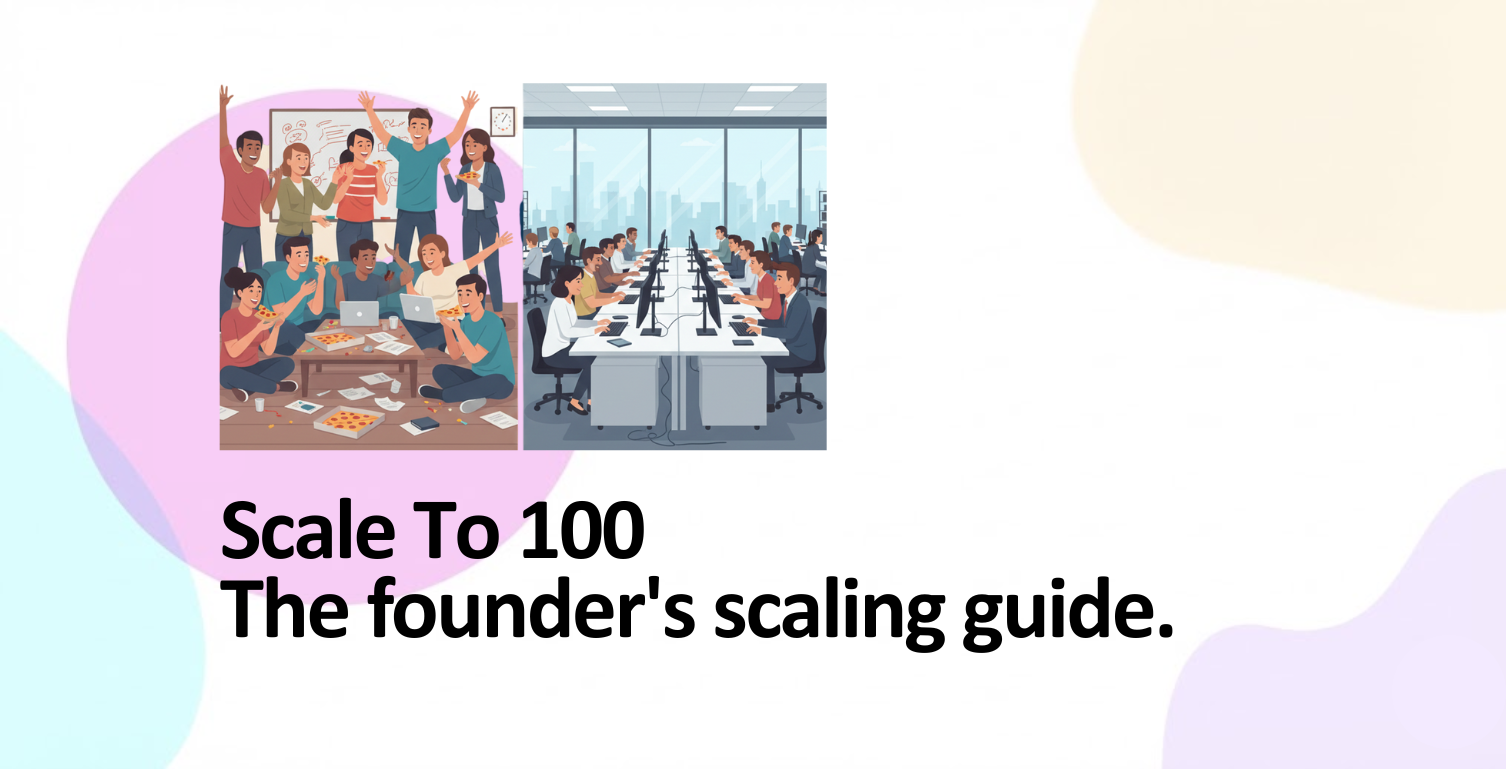
Master the 10→100 scaling transition (2025): Shift from flat to functional org structure, hire 75-90 people in 18-24 months, build manager layer (VP/Head roles), preserve culture through “first 10 hires are critical,” implement systems (OKRs, KPIs, communication), solve founder communication challenges, avoid common hiring mistakes.
Table of Contents
- The Inflection Point: Why 10→100 is the Hardest Scaling
- Organizational Structure Shift: Flat to Functional
- The Critical First 10 Hires: Culture Founders
- Hiring the Next 75-90 People: Scaling Recruitment
- Building Your Manager Layer: The VP/Head Transition
- Preserving Culture at Scale: From Direct to Documented
- Systems & Processes: OKRs, KPIs, Operations Manual
- Communication Breakdown: When All-Hands Stops Working
- Common Hiring Mistakes: What Founders Get Wrong
- 18-Month Timeline: Phase-by-Phase Roadmap
- The Complete Scaling Checklist (10→100)
The Inflection Point: Why 10→100 is the Hardest Scaling
The jump from 10 to 100 people is the hardest scaling transition your startup will face. Not 100 to 1,000. Not 1 to 10. The 10→100 inflection is where everything changes at once: how you communicate, how you make decisions, who reports to whom, how culture persists, how you hire, everything
With 10 people, you sit in one room. Everyone knows everything. You can make decisions in 5 minutes. Decisions by consensus. With 100 people, you can’t fit in one room. Knowledge is siloed. Decision-making is slow. You need hierarchy. Some people don’t know others exist
The research: MIT researcher Robin Dunbar found that organizations under 150 people can be managed by “peer pressure” (informal culture). Above 150, you need formal management systems. But the real inflection happens at 20-30 people (when flat structure breaks), and then again at 50-75 (when you need real management structure)
Most founders are not prepared for this. You were good at hiring 10 people. You need to become good at hiring 100. You were good at face-to-face leadership. You need systems-based leadership. You were the product expert and strategy lead. Now you’re a CEO managing VPs
Organizational Structure Shift: Flat to Functional
Your org structure must evolve as you scale. The flat structure that worked at 10 people will crush you at 100
Flat Structure (10 People)
What it looks like: Everyone reports to founder. Few hierarchy levels. Flexible roles. People wear multiple hats
Example org chart:
Founder (CEO) → Engineers, Product, Marketing, Sales, Operations (all individual contributors)
Pros: Fast decisions. Strong alignment. Direct communication
Cons: Doesn’t scale past 15-20 people. Founder becomes bottleneck
Functional Structure (100 People)
What it looks like: Organized by function (Engineering, Sales, Marketing, Operations). Each function has a head (VP/Head) who manages teams
Example org chart:
CEO → VP Engineering (manages 20 engineers) → VP Sales (manages 15 AEs + SDRs) → VP Marketing → VP Operations → CFO
Pros: Clear hierarchy. Specialization. Scalable. Reduced founder bottleneck
Cons: Slower decisions. Silos between functions. More overhead
Transition Timeline
| Company Size | Org Structure | Reporting Lines | Manager Span |
|---|---|---|---|
| 10 people | Flat (everyone → CEO) | 1 level (founders + IC) | Founder manages 9 people (too broad) |
| 20-25 people | Flat with leads (lead per function) | 2 levels (founder → leads → ICs) | Founder manages 5-6 lead ICs |
| 40-50 people | Transitioning to functional | 2-3 levels (founder → VPs/Heads → team leads → ICs) | VP manages 10-15 people |
| 75-100 people | Functional (by department) | 3-4 levels (CEO → VPs → Directors → team leads → ICs) | VP manages 15-20, Director manages 8-10 |
Key insight: You can’t wait until you hit 100 to build functional structure. You need to start the transition at 20-25 people (when hiring leads), accelerate at 40-50 (hiring VPs), and complete at 75-100
The Critical First 10 Hires: Culture Founders
Your first 10 hires are non-negotiable. They will define your culture for the next 90 people. Get them wrong and you build the wrong foundation
Why Founders Must Hire Their First 10
Don’t delegate. Don’t use recruiters. You (the founder) must hire the first 10 people personally. Here’s why:
- Culture fit is everything: Only you know the vision clearly enough to evaluate cultural fit. Recruiters evaluate skills. You evaluate vision alignment + cultural fit + growth potential. The first 10 people are co-founders of culture
- Quality sets the bar: Your first 10 people set the quality bar for the next 90. Hire A players in your first 10, everyone after is compared against them. Hire B players, and your standard drops
- Avoid “brilliant jerks”: Smart people who don’t share values. They might be incredible on paper but poison the culture. Only the founder can veto these. A recruiter won’t
- Mission transmission: Early hires need to hear directly from you what the company is about. This can’t be outsourced. Mission understanding drives early execution
- Founder accountability: If you hire the first 10 yourself, you own the outcomes. You can’t blame HR or recruiters if culture becomes toxic. This accountability ripples through your company
What to Look for in First 10
| Hiring Criterion | Ideal Trait | How to Assess | Red Flag |
|---|---|---|---|
| Vision Alignment | They articulate your vision without you saying it | Ask “Why are you interested in this problem?” Listen for intrinsic motivation | They’re coming for money/title, not mission |
| Growth Mindset | See failure as learning, not as permanent | Ask “Tell me about a time you failed” and listen for growth language | They blame others for failures |
| Scrappiness | Can wear multiple hats, figure things out | Ask “How would you approach X with no resources?” Look for creativity | They need perfect job description, won’t adapt |
| Integrity | Say what they mean, mean what they say | Listen for consistency in story. Check references deeply | Story changes mid-interview, references are hard to reach |
| Coachability | Take feedback and iterate | Ask “How do you take critical feedback?” and give them feedback in interview | They get defensive, dismiss feedback |
Hiring the Next 75-90 People: Scaling Recruitment
Once you have your first 10, you now hire 75-90 more. This is where process matters. You can’t do this personally. You need system
Hiring Process at Scale (11-100)
- Month 1-6 (employees 11-30): You + your lead team hire
- You still interview final candidates (founders should approve all hires through ~employee 30)
- Your heads/leads do screening and initial interviews
- Process: Resume → Phone screen → 2-3 interviews → offer
- Month 6-12 (employees 31-60): Bring in recruiting specialist or recruiting manager
- Recruiting person manages pipeline, screening
- Functional leads interview (Engineering lead interviews engineers)
- Founder spot-checks culture fit on ~50% of hires
- Process becomes more systematic (job descriptions, scorecards, reference checks)
- Month 12-18 (employees 61-90): Add recruiting team capacity
- Recruiting lead + 1-2 recruiting coordinators
- Recruiting lead sources, screens, coordinates interviews
- Functional leads interview, founder approves culture-critical roles
- Structured process (4+ interviews, references, assessments for key roles)
Common hiring mistakes at scale: Hiring too fast (chasing hiring targets vs quality), losing cultural standards (new hires don’t know culture), poor onboarding (high turnover), equity being too cheap (can’t attract talent), roles not clearly defined (wrong fit)
Building Your Manager Layer: The VP/Head Transition
Between 25-50 employees, you must hire your first VPs/Heads (VP Engineering, Head of Sales, VP Marketing, VP Operations). These are critical hires
When to Hire Each Function Lead
| Role | Typical Hire At (Headcount) | Why This Timing | Reporting To |
|---|---|---|---|
| VP Engineering | 8-10 engineers (typically 30-35 person company) | Founder can’t manage 8+ engineers effectively. Need technical leader to manage team, architecture, hiring | CEO |
| Head of Sales | When you have 3-5 AEs (typically 40-50 person company) | Can’t scale sales with founder selling. Need dedicated leader for pipeline, coaching, hiring | CEO |
| VP Marketing | When you need to scale demand gen (typically 50-60 person company) | Demand gen and brand coordination needs dedicated leader | CEO or Head of Sales |
| VP Operations / CFO | When you’re raising Series B or hitting $10M ARR (typically 60-80 person company) | Finance, accounting, HR, legal coordination requires dedicated leadership | CEO |
Critical insight: These VPs are not just individual contributors with a fancy title. They are team builders. VP Engineering doesn’t just code. They manage 10-20 engineers. They hire engineers. They set engineering culture. This is a different skillset than individual contribution
Preserving Culture at Scale: From Direct to Documented
Culture doesn’t scale by osmosis. At 10 people, culture is implicit (everyone knows what we stand for). At 100 people, culture must be explicit (it’s documented)
The Four Stages of Culture at Scale
Stage 1 (10 people): Culture is implicit and lived Everyone is in the room. Culture is in the founder’s head. It’s transmitted by example, not words
Stage 2 (25-30 people): Culture becomes explicit. You start saying what you stand for First values document. First cultural hiring discussion. “We are scrappy, customer-obsessed, trust-based”
Stage 3 (50-75 people): Culture is documented and systematized Values written down. Hiring scorecard reflects values. Onboarding explicitly teaches culture. Culture stories get told (folklore emerges)
Stage 4 (100+ people): Culture is reinforced through systems and stories Regular culture conversations. Culture committee. Stories of people embodying values. Consequences for violating values. Culture is decentralized to managers
Tools for Scaling Culture
- Documented values (10-20 person stage): Write down 4-5 core values. Make them specific. Not just “innovation” but “we disagree respectfully and evolve faster than the market”
- Onboarding program (25+ person): New hires need to hear culture directly. 1:1 with founder on day 1. Culture values in onboarding docs. Team lunch to meet teammates
- All-hands meetings (30+ people): Weekly or bi-weekly. Company updates + culture reinforcement. Tell stories about people exemplifying values
- Hiring scorecard (40+ people): Every candidate evaluated on values + skills. Both matter. You can teach skills. You can’t teach values
- Operations manual (60+ people): Document how things get done. Decision-making process. How meetings work. Norms around communication
Systems & Processes: OKRs, KPIs, Operations Manual
At 100 people, you can’t run on founder intuition. You need systems: OKRs (quarterly goals), KPIs (metrics), Operations Manual (how we work)
Critical Systems to Build
| System | What It Is | Implement By (Headcount) | Benefit |
|---|---|---|---|
| OKRs (Objectives & Key Results) | Quarterly goals (1-3 objectives per team, 3-5 key results per objective). Cascades from company down | 40-50 person stage | Alignment across teams. Clear priorities. Transparency |
| KPIs (Key Performance Indicators) | Metrics you track weekly/monthly (MRR, CAC, NRR, Churn, Burn, etc.). Dashboards for each team | 30-40 person stage | Data-driven decisions. Early warning of problems. Accountability |
| Operations Manual | Documented processes (how we hire, how we make decisions, meeting cadence, communication norms) | 50-60 person stage | Consistency. Reduces confusion. Accelerates onboarding |
| Performance Management System | 1:1 meetings, periodic reviews (quarterly), feedback loops | 40-50 person stage | Growth for people. Early warning on performance issues. Fairness |
| Meeting Rhythm | Regular meetings (All-hands weekly, one-on-ones weekly, leadership standup daily, etc.) | 20-30 person stage | Predictable communication. Keeps team aligned |
Communication Breakdown: When All-Hands Stops Working
Your all-hands meeting that worked great at 20 people breaks at 50. Your Slack channel where everyone discussed everything becomes noise at 100. You need a communication strategy at scale
Communication System by Size
- 10-20 people: Slack + All-hands Everyone in Slack channels. All-hands weekly (30 min). Direct communication everywhere
- 20-40 people: Slack + All-hands + Team meetings #all-company for all-company updates. #engineering, #sales, #marketing for team-specific chat. All-hands every other week (45 min). Team meetings weekly
- 40-75 people: Structured communication + All-hands + Cascading meetings All-hands monthly or bi-weekly (1 hour, livestreamed for remote). Department all-hands bi-weekly. Team meetings weekly. Slack channels strict (no off-topic in #all-company)
- 75-100+ people: Formal communication hierarchy CEO all-hands monthly. VPs communicate to reports weekly. Written updates become critical (blog posts, emails). Slack used strategically, not for real-time decisions
Common mistake: Founders try to maintain direct communication with all 100 people. You can’t. You must cascade communication through VPs/managers. This is uncomfortable for founders (feels disconnected), but it’s the only way to scale. Your managers are responsible for cascading your message
Common Hiring Mistakes: What Founders Get Wrong
| Mistake | Why It Happens | Impact | Fix |
|---|---|---|---|
| Hiring too fast | Pressure to hit headcount targets, runway anxiety, investor expectations | Hire wrong people, dilute culture, high turnover, wasted onboarding | Hire to specific need, not targets. Slow hiring is better than fast hiring |
| Prioritizing skills over cultural fit | Founders don’t know how to evaluate culture. It feels soft vs skills (which are hard to assess) | “Brilliant jerks” poison culture. Team dysfunction. Good people leave because of them | Spend 50% of interview on culture fit. Make it equal weight to skills |
| Undervaluing equity/comp | Founders want to preserve equity. Don’t know market rates. Expect loyalty instead of payment | Can’t attract talent. Lose top performers to competitors paying more. High turnover | Pay market rate (use Levels.fyi, CFE for benchmarks). Equity is bonus, not salary replacement |
| Poor onboarding | Founders think onboarding is HR’s job. Don’t structure it | New hires don’t know context, culture, decisions slow. Ramp time 6 months instead of 4 | Create onboarding checklist. First week planned. Buddy system. Founder intro call |
| Hiring clones | Comfort bias. Founders hire people like them | Lack of diversity in thought. Echo chamber decisions. Miss markets/customer perspectives | Deliberately hire different thinking styles. Value disagreement. Different backgrounds |
| Not delegating hiring as you scale | Founders think only they can evaluate culture | Founder becomes bottleneck. VPs can’t hire teams. Growth plateaus | Train managers to hire at ~30 person stage. They become “founders of their department” |
18-Month Timeline: Phase-by-Phase Roadmap
Phase 1: Foundation (Months 1-6, 10→30 people)
- Hire first 10 personally (you do all interviews)
- Document cultural values (first values draft)
- Establish weekly all-hands meeting
- Start implementing weekly 1:1s with direct reports
- Create basic onboarding process
- Define first KPIs (revenue, customer count, engagement metrics)
Phase 2: Structure (Months 6-12, 30→60 people)
- Hire first VPs/Heads (VP Engineering, Head of Sales, etc.)
- VPs hire their own teams (you spot-check culture fit)
- Transition organizational structure from flat to functional
- Implement OKR system (quarterly goal-setting)
- Create hiring scorecard reflecting values
- Establish team meetings cadence (daily standup for engineering, weekly for sales, etc.)
- Start documenting processes (operations manual begins)
Phase 3: Scale (Months 12-18, 60→100 people)
- Complete functional org structure (all VPs hired, clear teams)
- Bring in recruiting person/manager
- Finish operations manual (how decisions get made, meeting norms, communication standards)
- Implement performance management system (quarterly reviews)
- Create culture committee (employees who evangelize culture)
- Shift all-hands from weekly to bi-weekly or monthly (still important but less frequent)
- Implement strict communication systems (Slack channels, email norms, etc.)
The Complete Scaling Checklist (10→100)
Organization (Check boxes as you complete)
☐ Create target-state org chart for 100 people
☐ Hire VP Engineering (around 30 person stage)
☐ Hire Head of Sales (around 40 person stage)
☐ Hire VP Operations / CFO (around 60 person stage)
☐ Hire VP Marketing (around 50 person stage)
☐ Create clear reporting lines and decision-making matrix
☐ Define manager span of control (typically 6-10 direct reports)
Culture (Check boxes as you complete)
☐ Document 4-5 core values (specific, not generic)
☐ Create hiring scorecard reflecting values (50% skills, 50% culture fit)
☐ Implement structured onboarding (first week agenda, buddy, founder intro)
☐ Establish weekly all-hands meeting (shift to bi-weekly/monthly at 75+)
☐ Create operations manual (documented processes)
☐ Implement performance management system (1:1s, feedback loops, quarterly reviews)
☐ Tell culture stories at all-hands (people embodying values)
☐ Create culture committee (3-5 employees evangelizing culture)
Systems (Check boxes as you complete)
☐ Implement OKR system (quarterly goal-setting, 3-month cycles)
☐ Define and track KPIs (revenue, CAC, NRR, Churn, engagement, etc.)
☐ Create KPI dashboards (visible to whole company)
☐ Establish meeting cadence (daily, weekly, bi-weekly, monthly meetings scheduled)
☐ Implement project management tools (Asana, Monday, Jira, etc.)
☐ Create decision-making framework (who decides what)
☐ Document communication norms (email vs Slack vs meetings)
☐ Implement expense management system (spend tracking, approval process)
Hiring (Check boxes as you complete)
☐ Hire first 10 personally (founder does all interviews)
☐ Develop job descriptions for each role
☐ Create interview process (phone screen, 2-3 rounds of interviews, references)
☐ Define interview questions assessing values + skills
☐ Bring in recruiting coordinator (40-50 person stage)
☐ Train managers to hire (delegating hiring to VPs/Heads)
☐ Create equity compensation framework (consistent across roles)
☐ Set up feedback loop from hires (“How was your interview experience?”)
Communication (Check boxes as you complete)
☐ Implement Slack workspace with organized channels
☐ Create all-hands meeting schedule (weekly, then bi-weekly at 50+, monthly at 75+)
☐ Establish 1:1 meeting cadence (weekly, 30 min per direct report)
☐ Create team-level meeting schedule (engineering standup, sales huddle, etc.)
☐ Document communication norms (respond times, email vs Slack, decision announcements)
☐ Implement CEO monthly newsletter or blog (transparent updates as size increases)
☐ Create feedback mechanisms (anonymous feedback form, suggestion box, skip-level 1:1s)
Key Takeaways: Scaling 10→100
1. 10→100 is the hardest inflection point: Bigger inflection than 1→10 or 100→1000. Everything changes: communication, org structure, decision-making, hiring, culture
2. First 10 hires are critical: They define culture for next 90. Founder must hire them personally. No recruiters. No delegation. These are culture co-founders
3. Organizational structure must evolve: Flat structure (10 people) → functional structure (100 people). Start transition at 20-25 people (hire leads), accelerate at 40-50 (hire VPs)
4. Build your manager layer early (25-50 person stage): Hire VP Engineering, Head of Sales, VP Marketing, CFO. These VPs are team builders, not individual contributors
5. Culture doesn’t scale by osmosis: At 10 people it’s implicit, at 100 it must be explicit (documented). Values document, hiring scorecard, onboarding, culture stories, all-hands
6. You must delegate hiring by 30-40 people: Can’t stay founder-involved past that. Train VPs/managers to hire their teams. Each leader becomes “founder of their department”
7. Systems are non-negotiable at scale: OKRs (quarterly goals), KPIs (metrics), Operations Manual (processes), Performance Management. These replace founder intuition
8. Communication breaks at 50 people: All-hands stops working as primary communication. Need cascading communication, team meetings, written updates, formal communication hierarchy
9. Common hiring mistakes: Too fast, prioritizing skills over fit, undervaluing comp/equity, poor onboarding, hiring clones, not delegating. Avoid these or face high turnover and culture problems
10. Timeline: Foundation (0-6 months, hire 0→30), Structure (6-12 months, hire 30→60), Scale (12-18 months, hire 60→100). Each phase has specific milestones
11. First 10 hires: You must evaluate vision alignment, growth mindset, scrappiness, integrity, coachability. Use founder interviews for this. Only the founder can assess fit
12. VP/Head hiring timeline: VP Eng at ~30 people, Head of Sales at ~40, VP Marketing at ~50, CFO at ~60. Hiring too early = expensive salaries for roles not needed yet. Too late = you become bottleneck
13. When to bring recruiting support: Recruiting coordinator at 40-50 people, recruiting manager at 60+ people. Don’t outsource recruitment fully. Keep internal recruiting and external recruiting balanced
14. Documentation becomes critical: Operations manual, job descriptions, onboarding checklist, communication norms, decision-making framework. What was implicit now must be explicit
15. Equity strategy matters: Preserve enough for future rounds (20-30% pool), but pay market rates in cash. Equity is bonus for alignment, not salary replacement
16. Manager training is essential: Managers must learn to hire, give feedback, have 1:1s. Most founders aren’t trained managers. Train them. Delegate hiring to them early
17. Performance management at scale: Can’t manage culture by founder will alone. Need 1:1s, feedback loops, quarterly reviews, performance management system
18. Communication is the number one scaling challenge: Hard to scale direct founder communication. Cascading communication through managers is uncomfortable but necessary
19. Culture committee helps scale culture: 3-5 employees who evangelize culture, tell stories, give feedback on cultural fit. Decentralizes culture ownership
20. Action plan: (1) Months 1-6 hire 0→30, hire first 10 personally, document values, establish all-hands. (2) Months 6-12 hire 30→60, hire VPs, transition to functional structure, implement OKRs. (3) Months 12-18 hire 60→100, bring recruiting support, complete operations manual, shift to cascading communication. Phased approach wins
