
Master SaaS unit economics (2025): LTV/CAC formulas and calculations, 3:1 ratio benchmark, 6.8-month median CAC payback period, B2B vs B2C benchmarks, improving unit economics, profitability path, 2025 CAC trends (+14% increase), investor expectations.
Table of Contents
- Why Unit Economics Matter: The Foundation of Profitability
- Customer Lifetime Value (LTV): Definition & Formula
- Customer Acquisition Cost (CAC): Definition & Formula
- LTV:CAC Ratio: The Core Metric
- CAC Payback Period: How Long to Break Even
- 2025 Benchmarks: B2B vs B2C vs Vertical SaaS
- Gross Margin: The Silent Killer
- Improving LTV: 5 Levers to Pull
- Reducing CAC: 5 Strategies That Work
- 2025 CAC Trends: Rising Costs & Declining Retention
- Path to Profitability: Stage by Stage
- Unit Economics Checklist
Why Unit Economics Matter: The Foundation of Profitability
Unit economics is the single most important metric for understanding if your business is fundamentally healthy. It answers one question: “How much profit does each customer generate relative to what it costs to acquire them?”
Without strong unit economics, you cannot reach profitability, no matter how much revenue you generate. You can have $50M ARR and be losing money on every customer. You can have $5M ARR and be massively profitable. The difference is unit economics
Why investors care: Investors fund you based on growth trajectory and unit economics. A company with 50% growth and declining unit economics is less fundable than a company with 30% growth and improving unit economics. Unit economics signal whether your growth is sustainable or you’re just “growing your way to bankruptcy”
The hard truth: Most SaaS founders focus on revenue. Smart founders focus on unit economics. Revenue is vanity, unit economics is sanity
Customer Lifetime Value (LTV): Definition & Formula
Customer Lifetime Value is the total revenue (or profit) a customer generates over their entire relationship with your company
LTV Formula (Simple Version)
LTV = (Average Revenue Per User × Gross Margin) ÷ Monthly Churn Rate
Or alternatively:
LTV = Average Transaction Value × Transactions Per Year × Average Lifetime (in years)
LTV Calculation Example
| Variable | Value | Explanation |
|---|---|---|
| Monthly Recurring Revenue (MRR) per customer | $100 | Average customer pays $100/month (ARPU) |
| Gross Margin % | 70% | After COGS, you keep 70% per customer |
| Monthly Gross Margin per customer | $70 | $100 × 70% = $70 |
| Monthly Churn Rate | 5% | You lose 5% of customers each month |
| LTV (in months) | $1,400 | $70 ÷ 5% = 1,400 months of value |
| LTV (in years) | $16,800 | 1,400 months ÷ 12 = 116 years lifetime |
Key insight: Small changes in churn have massive impact on LTV. A 5% monthly churn means customer lasts 20 months. A 3% monthly churn means customer lasts 33 months. That 2% difference = 65% more LTV. Retention is king
Customer Acquisition Cost (CAC): Definition & Formula
Customer Acquisition Cost is the total cost to acquire one customer, including all marketing and sales expenses
CAC Formula
CAC = Total Sales & Marketing Expenses ÷ Number of New Customers Acquired (in period)
Sales & Marketing expenses include: Salaries, benefits, software tools, ad spend, agencies, commissions, customer success onboarding, partnerships
CAC Calculation Example
| Expense Category | Amount | Notes |
|---|---|---|
| Sales Team Salaries | $400,000 | 3 AEs × $120k + 1 Sales Manager × $140k |
| Marketing Salaries | $200,000 | 1 Marketing Manager × $120k + 1 Growth person × $80k |
| Ad Spend | $150,000 | LinkedIn, Google Ads, content syndication |
| Tools & Software | $36,000 | Salesforce, HubSpot, ad platforms, etc. |
| Events & Sponsorships | $50,000 | Trade shows, webinars, partnerships |
| Total S&M Spend | $836,000 | All acquisition costs |
| New Customers Acquired | 200 | In Q1 |
| CAC per customer | $4,180 | $836,000 ÷ 200 |
Key insight: CAC includes ALL acquisition costs, not just ad spend. Many founders only count paid ads and forget salaries. If you’re not including fully-loaded S&M costs, your CAC is artificially low
2025 CAC Benchmarks by Industry
| Industry | Typical CAC | Why |
|---|---|---|
| B2B SaaS (SMB) | $1,200 | Sales cycles 1-3 months, product-led growth possible |
| B2B SaaS (Enterprise) | $5,000-$15,000 | Long sales cycles (6-12 months), need dedicated account executives |
| Financial Services SaaS | $2,167-$4,056 | Compliance, trust-building, regulatory factors extend sales cycle |
| Vertical SaaS | $2,000-$8,000 | Niche markets = lower customer count but higher CAC per customer |
| Retail / eCommerce | $50 | Fast transactions, broad audiences, lower CAC |
| Consumer Apps | $5-$20 | Viral potential, organic growth, lowest CAC |
LTV:CAC Ratio: The Core Metric
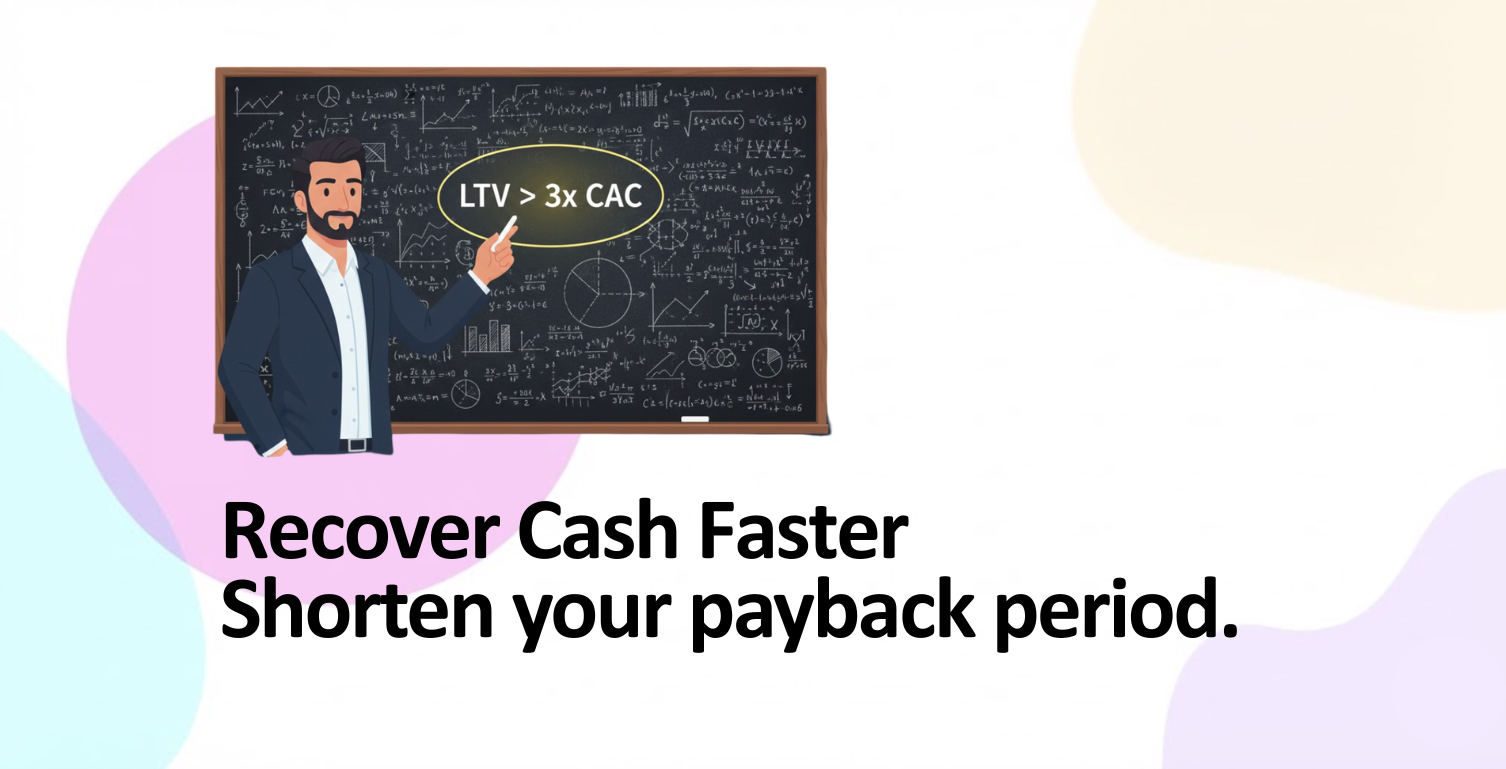
LTV:CAC ratio tells you how much value you generate per dollar spent acquiring customers
LTV:CAC Formula
LTV:CAC Ratio = Customer Lifetime Value ÷ Customer Acquisition Cost
If LTV = $16,800 and CAC = $4,180, then LTV:CAC = 4:1
This means for every $1 spent acquiring a customer, you generate $4 in lifetime value
What’s a Good LTV:CAC Ratio?
| Ratio | Assessment | Action |
|---|---|---|
| <1:1 | CRITICAL PROBLEM | You’re losing money on every customer. Stop and fix immediately |
| 1:1 to 2:1 | UNHEALTHY | Not enough margin for overhead and profitability. Need to improve urgently |
| 2:1 to 3:1 | ACCEPTABLE | Healthy for growth-stage. Can reinvest in acquisition. Breakeven economics possible |
| 3:1 to 5:1 | GOOD (GOLD STANDARD) | 3:1 is the benchmark. Enough margin for overhead, profits, reinvestment |
| >5:1 | EXCELLENT (WORLD-CLASS) | Strong economies of scale. Can grow aggressively and be profitable |
| 7:1 to 8:1 | BEST-IN-CLASS | Top-performing SaaS companies (Notion, Figma, Canva). World-class unit economics |
2025 Reality Check: Moving from a 2:1 to a 3:1 LTV:CAC ratio can nearly triple your company valuation. This single metric moves valuations more than anything else. Investors see 3:1 as “this company can be profitable.” They see 2:1 as “this company needs more capital to sustain growth”
CAC Payback Period: How Long to Break Even
CAC Payback Period measures how many months until you recover your acquisition cost through gross margin revenue from that customer
CAC Payback Formula
CAC Payback Period (months) = CAC ÷ (Monthly Revenue per Customer × Gross Margin %)
Using our earlier example:
$4,180 ÷ ($100 × 70%) = $4,180 ÷ $70 = 59.7 months (about 5 years)
This customer takes 5 years of revenue to break even on acquisition cost
Why This Matters
- Cash flow impact: If your payback is 5 years but your average customer lifetime is 3 years, you lose money on that customer
- Working capital: The longer the payback, the more capital you must raise to fund growth. A 12-month payback needs half the capital of a 24-month payback
- Investor expectations: Venture investors expect CAC payback under 18 months (ideally 12). If yours is 36+ months, you’ll struggle to raise capital
- Sustainability signal: A 6-month payback signals you can potentially be profitable by year 2. A 24-month payback signals you need to raise Series C to be profitable
2025 CAC Payback Benchmarks
| Category | Median Payback | Healthy Target | Sample Size |
|---|---|---|---|
| B2C SaaS / Consumer Apps | 4.2 months | <6 months | 4,820 companies |
| B2B SaaS (Overall) | 8.6 months | 8-12 months | 6,340 companies |
| Prosumer / SMB Tools | 6.2 months | 6-10 months | 3,340 companies |
| Early-stage ($0-50K MRR) | 4.8 months | <12 months (OK if longer) | Varies by segment |
| Scaling ($50K-200K MRR) | 7.2 months | 6-12 months | Venture-backed |
| Growth ($200K+ MRR) | 8.8 months | 8-15 months | Mature SaaS |
Key insight: 76% of SaaS companies have healthy CAC payback periods (under 12 months). If you’re above 12 months, you’re in the bottom 24% and need urgent improvement
2025 Benchmarks: B2B vs B2C vs Vertical SaaS
Distribution of SaaS Unit Economics
| Payback Tier | % of Companies | Payback Period | Characteristics |
|---|---|---|---|
| Excellent | 14% | <3 months | Viral/organic, low CAC, strong product-led growth |
| Good | 28% | 3-6 months | Efficient paid acquisition, strong positioning |
| Healthy | 34% | 6-12 months | Standard SaaS economics, venture-backed typical |
| Long | 16% | 12-18 months | Enterprise sales, high LTV offsets long payback |
| Concerning | 8% | 18+ months | Unit economics challenged, needs urgent improvement |
B2B vs B2C Comparison
| Metric | B2C Apps | B2B SaaS | Why Different |
|---|---|---|---|
| CAC Payback | 4.2 months | 8.6 months | B2C: faster activation. B2B: longer sales cycle |
| LTV:CAC Ratio | 4.2:1 | 3.8:1 | Similar ratios but achieved differently |
| Median LTV | $200-$500 | $2,000-$10,000 | B2B: longer lifetimes justify longer payback |
| Typical CAC | $5-$50 | $1,200-$8,000 | B2B requires more sales resources |
Gross Margin: The Silent Killer
Gross margin is the revenue after you pay for COGS (cost of goods sold). It’s the revenue available to cover S&M, R&D, overhead, and profit
Many founders ignore gross margin. They focus on revenue and CAC. But a company with $10M revenue at 40% gross margin ($4M gross profit) is much less healthy than a company with $5M revenue at 75% gross margin ($3.75M gross profit)
Gross Margin Impact on Unit Economics
Scenario 1: Low Gross Margin
Revenue per customer: $100, Gross Margin: 50%, CAC: $1,000
Gross margin dollars per customer: $50/month
Payback period: $1,000 ÷ $50 = 20 months
Scenario 2: High Gross Margin
Revenue per customer: $100, Gross Margin: 80%, CAC: $1,000
Gross margin dollars per customer: $80/month
Payback period: $1,000 ÷ $80 = 12.5 months
Same revenue, same CAC, but 7.5 months better payback because gross margin is 30% higher
SaaS Gross Margin Benchmarks
- World-class: 85%+ (Figma, Notion, Intercom)
- Excellent: 75-85% (most successful SaaS)
- Good: 65-75% (healthy SaaS)
- Acceptable: 55-65% (servicey SaaS, support-heavy)
- Concerning: <55% (burning money, need to fix costs)
Action: If your gross margin is below 70%, fix it before scaling sales. Scaling acquisition on low margins is throwing gasoline on a fire
Improving LTV: 5 Levers to Pull
LTV = (ARPU × Gross Margin) ÷ Churn. To increase LTV, you have three levers: increase ARPU, increase gross margin, or decrease churn
1. Increase ARPU (Average Revenue Per User)
- Raise prices: Most direct method. Even 10% price increase with 90% retention = higher LTV. If you have 60%+ NRR, you have pricing power
- Upsell & cross-sell: Sell higher tiers or additional products. If 30% of customers upgrade to higher plan, ARPU increases 20-30%
- Add-ons & features: White-glove onboarding, advanced analytics, API access = higher tier customers. These often have 30% premium pricing
- Usage-based pricing: Charge by usage or value delivered. Intercom charges per conversation resolution. Stripe charges per transaction. This aligns revenue with customer value
2. Decrease Churn (Increase Retention)
- Improve onboarding: Customers who activate in first 2 weeks have 40% lower churn. Invest in onboarding
- Proactive support: Monitor usage patterns. If customer drops from 10 logins/week to 2, reach out before they leave
- Regular features that matter: Ship features customers request. Feeling heard = 20% lower churn
- Build habits: Products where users have daily habits (Slack, Notion) have 1-2% monthly churn. Products used quarterly have 15-20% churn
3. Improve Gross Margin
- Reduce COGS: Infrastructure costs (AWS, etc.). Optimize database queries, reduce API calls, negotiate better CDN rates = 5-10% COGS reduction
- Standardize support: 24/7 human support = expensive. Self-service knowledge base, AI chatbots, community support = lower costs
- Automate fulfillment: Manual onboarding for every customer is expensive. Automate it = 20-30% lower COGS
Reducing CAC: 5 Strategies That Work
1. Product-Led Growth (PLG)
Let the product be the primary acquisition channel. Freemium (Slack, Notion), free trial (Figma), or open source (Docker)
Impact: Reduces CAC 50-80%. Freemium users who convert have 50%+ lower CAC than paid-only customers
2. Improve Sales Efficiency
- Target better ICP: Not all customers are created equal. If you focus sales on companies that are 10x more likely to buy, you cut CAC in half
- Faster sales cycle: If you cut sales cycle from 90 days to 45 days, same close rate = 50% lower CAC (because less sales time per customer)
- Higher close rate: Better qualifying reduces wasted sales time. If you go from 10% to 15% close rate, CAC drops 33%
3. Organic & Content Marketing
Build audience through content. Pay upfront (salary, writing), then acquisition is low-cost. HubSpot, Mailchimp built on inbound content
Impact: Takes 6-12 months to build, but CAC eventually drops to $100-$300 per customer (vs $2000+ for paid ads)
4. Partner & Channel Sales
Distribute through partners who sell to your ICP. Salesforce sells through consultants, integrators, resellers
Impact: CAC drops if you pay commission on sales (you only pay when customer acquired) vs paying upfront for ads
5. Community & Viral Loops
Build community. Community members refer. Customers invite team members (team uses product = more signups)
Impact: Slack’s referral loop reduced CAC 60%. Figma’s “invite teammates” feature is free acquisition
2025 CAC Trends: Rising Costs & Declining Retention
Bad news: 2025 has seen significant deterioration in unit economics across the SaaS industry
Key Trends
- CAC increased 14% in 2024: Median CAC Ratio rose to $2.00 (companies now spend $2 to acquire $1 of ARR). This is unsustainable
- Average CAC payback now 23 months (private SaaS): Up from 15 months historically. Meaning companies operate at a loss on new customers for nearly 2 years
- Retention declining despite increased spending: 75% of software companies reported declining retention rates in 2025 despite spending MORE on customer success
- CAC Ratio concentration: Gap between top and bottom performers widening. Top 20% have 3:1 CAC ratio. Bottom 20% have 0.8:1 (negative)
- AI spending impacting unit economics: AI-native companies showing -15% margins while spending heavily on compute. High growth (100%+) but no profitability
Why this matters: If you’re raising growth capital in 2025, investors are asking harder questions about unit economics. “Growing fast but with terrible unit economics” is no longer fundable. You need BOTH growth AND improving unit economics
Path to Profitability: Stage by Stage
| Stage | Typical Metrics | Focus | Unit Econ Target |
|---|---|---|---|
| Seed ($0-1M ARR) | 12-24 month payback OK, 1:1 to 2:1 LTV:CAC acceptable | Find product-market fit. Unit economics secondary to learning | CAC <$2,000, LTV >$5,000 |
| Series A ($1-5M ARR) | Payback <18 months, LTV:CAC 2:1 minimum | Improve unit economics while scaling. Sustainability matters | CAC Payback <18 months, LTV:CAC 2.5:1 |
| Series B ($5-20M ARR) | Payback <15 months, LTV:CAC 3:1 | Path to profitability clear. Focus on leverage and efficiency | CAC Payback 12-15 months, LTV:CAC 3:1, GM 70%+ |
| Series C ($20M+ ARR) | Payback <12 months, LTV:CAC 4:1+ | Profitability path clear. Scale aggressively knowing economics work | CAC Payback <12 months, LTV:CAC 4:1, FCF positive path |
| Mature ($100M+ ARR) | Payback <8 months, LTV:CAC 5-8:1 | Profitability and cash generation. Expansion revenue key | CAC Payback <8 months, LTV:CAC 6:1, FCF 10%+ margins |
The Profitability Transition
Growth Stage (Seed-Series B): Prioritize growth over profitability. LTV:CAC 2-3:1 is OK. You’re trading profit for market share
Scaling Stage (Series C-D): Transition to profitable growth. LTV:CAC should be 3-4:1. Growth + profitability both matter
Mature Stage (Pre-IPO, $100M+ ARR): Profitability is primary focus. LTV:CAC 5:1+. Growth is secondary unless TAM expansion
The transition is hard. Most founders were trained to “grow at all costs.” At Series C, it’s “grow at sustainable unit economics.” This requires discipline
Unit Economics Checklist
Measurement & Tracking:
☐ Calculate LTV with 6+ months of historical data (not estimates)
☐ Calculate CAC including fully-loaded S&M costs (salaries + benefits + tools)
☐ Calculate LTV:CAC ratio (target: 3:1 for Series B+)
☐ Calculate CAC payback period in months (target: <15 months)
☐ Track gross margin % (target: 70%+)
☐ Track monthly/annual churn rate (target: <5% monthly for B2B)
☐ Track NRR (Net Revenue Retention) – target: 110%+ for Series B+
☐ Break down CAC by acquisition channel (organic, paid ads, sales, partner)
☐ Segment CAC by customer type (SMB vs mid-market vs enterprise)
☐ Update these metrics monthly, not quarterly
Improving Unit Economics:
☐ Identify lowest-payback customer segments and double down there
☐ Set ARPU targets and track pricing power (can you raise prices 10%?)
☐ Implement churn reduction initiatives (onboarding, proactive support)
☐ Map CAC reduction roadmap (PLG, better targeting, content marketing)
☐ Identify COGS reduction opportunities (infrastructure, automation, support)
☐ Test pricing changes and measure impact on CAC, LTV, margin
☐ Create unit economic model showing path to profitability
☐ Share metrics with team (transparency drives accountability)
Investor Communication:
☐ Prepare unit economics narrative for investors (why these metrics matter)
☐ Show trend (are metrics improving or declining?)
☐ Benchmark against industry (how do you compare to competitors?)
☐ Show path to profitability (when do you break even on CAC?)
☐ Highlight expansion revenue (NRR, upsell, cross-sell)
☐ Be honest about declining payback (don’t hide if metrics getting worse)
Key Takeaways: Unit Economics at Scale
1. Unit economics is the foundation of profitability: Revenue is vanity, unit economics is sanity. $50M ARR at 40% margins can be less healthy than $5M at 80% margins
2. LTV formula: (ARPU × Gross Margin) ÷ Monthly Churn Rate: Small churn improvements = massive LTV increases. 5% churn vs 3% churn = 65% LTV difference
3. CAC formula: Total S&M Spend ÷ New Customers Acquired: Include fully-loaded costs (salaries, benefits, tools, ads). Most founders undercount and get artificially low CAC
4. LTV:CAC 3:1 is the gold standard: For every $1 spent acquiring, you generate $3 lifetime value. Moving from 2:1 to 3:1 can triple valuation
5. Median CAC payback period is 6.8 months overall, 8.6 months for B2B SaaS: Under 12 months is healthy, 18+ is concerning. B2C is 4.2 months (faster), Enterprise is 18-24 months (slower but higher LTV)
6. 76% of SaaS have healthy CAC payback (<12 months): If you’re above 12 months, you’re in bottom 24% and need urgent improvement. This is a competitive disadvantage
7. Gross margin is the silent killer: 40% margin vs 80% margin on same revenue = 100% difference in payback period. Fix gross margin BEFORE scaling acquisition
8. Improve LTV through: (1) Increase ARPU (pricing, upsells, usage-based), (2) Decrease churn (onboarding, proactive support, feature shipping), (3) Improve gross margin (reduce COGS, automate). All three matter
9. Reduce CAC through: (1) Product-led growth (50-80% CAC reduction), (2) Better targeting (10x more efficient), (3) Faster sales cycles (50% CAC reduction if 2x faster), (4) Organic/content (takes 6-12 months but long-term best ROI), (5) Partnerships & referrals. Mix and match by stage
10. 2025 trends: CAC increased 14%, average payback now 23 months (private SaaS), 75% of companies declining retention despite higher spending: Unit economics are deteriorating. This is urgent for investors
11. Tier 1 SaaS performance (investment grade): CAC payback 6-12 months, LTV:CAC 5:1+, GRR 95%+, GM 75%+: These are the best performers. If you’re below these, you’re Tier 2
12. By stage: Seed (2:1 LTV:CAC OK), Series A (2.5:1), Series B (3:1), Series C (4:1): Investor expectations for unit economics increase with stage. You must improve as you scale
13. B2C vs B2B: B2C payback 4.2 months vs B2B 8.6 months, but both are healthy because B2B has longer LTV. Don’t compare B2C to B2B – different economics
14. CAC by industry: B2B SaaS $1,200-$8,000, Financial Services $2,167-$4,056, eCommerce $50, Consumer $5-$20: Know your benchmark. If your CAC is 10x industry average, you have a problem
15. Path to profitability requires improving unit economics + growth: Growth at terrible unit economics is not sustainable. You must do BOTH simultaneously from Series A onward
16. Top performers have 5-8:1 LTV:CAC: Notion, Figma, Canva, Slack all achieved 5:1+: This is achievable but requires disciplined focus. Most companies plateau at 3:1
17. NRR (Net Revenue Retention) is expansion revenue: If you have 120% NRR, you’re growing revenue from existing customers without acquisition. This is the path to sustainable growth
18. Churn is LTV killer: 1% monthly churn = 100-month LTV. 5% monthly = 20-month LTV. Small churn improvements = massive LTV impact. Retention is easier than acquisition
19. Most companies get LTV:CAC measurement wrong: They exclude salaries, bonuses, tools from CAC calculation. Get a CFO or finance person to audit your math
20. Action plan: (1) Calculate real LTV (6+ months actual data, account for churn). (2) Calculate real CAC (fully-loaded). (3) Calculate LTV:CAC and payback. (4) Benchmark vs industry. (5) Identify if LTV or CAC problem. (6) Set improvement targets. (7) Measure weekly and share with team. Transparency drives accountability
